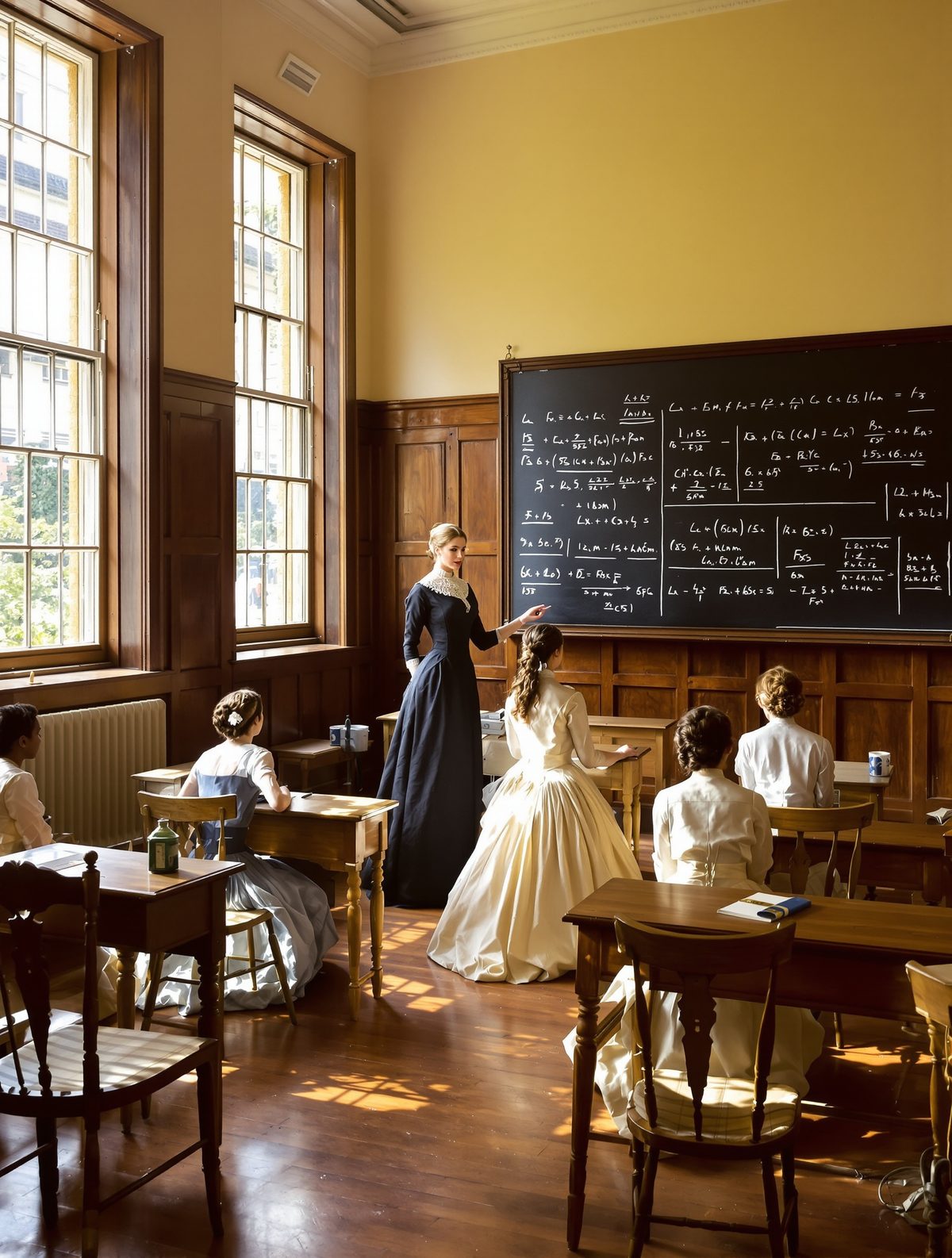
Picture this: It's a crisp October morning in 1858, and a young woman with steely determination in her eyes walks through the gates of Cheltenham Ladies' College. At just 27, Dorothea Beale is about to inherit an educational disaster. Parents are withdrawing their daughters in droves, the curriculum wouldn't challenge a child, and the very idea of seriously educating girls is considered somewhere between laughable and dangerous to their feminine virtue. What happened next would shatter Victorian assumptions about women's minds and change the course of British education forever.
A School on the Brink of Collapse
When Dorothea Beale stepped into her new role as principal, she discovered an institution that barely deserved the name "college." Founded just seven years earlier in 1853, Cheltenham Ladies' College was hemorrhaging students faster than a sinking ship. The numbers tell a stark story: enrollment had plummeted from 69 girls to a mere 42, with anxious mothers arriving weekly to collect their daughters.
What Beale found inside the elegant Regency buildings would have made any serious educator weep. Girls spent their mornings pressing flowers between sheets of paper, learning watercolor techniques that produced pretty but vapid paintings, and memorizing French poetry—not to understand literature or language, but because it sounded sophisticated at dinner parties. Mathematics was considered too taxing for delicate female minds, while Latin and Greek were deemed positively dangerous to a girl's marriage prospects.
The previous principal had resigned in frustration, teachers were demoralized, and the school's reputation in fashionable Cheltenham society was in tatters. One contemporary observer noted that the girls emerged "accomplished in nothing save the art of appearing accomplished"—a damning indictment of an education system that treated young women's minds like decorative ornaments rather than instruments of learning.
Read next: The Day a London Printer Stood Trial and Freed the Press
The Revolutionary in Respectable Clothing
Dorothea Beale looked every inch the proper Victorian lady: petite, modestly dressed, with her dark hair severely pulled back. But beneath that conventional exterior burned the mind of a revolutionary. Born in 1831 to a middle-class London family, she had experienced firsthand the intellectual starvation imposed on girls of her class. While her brothers went to university, she was expected to master nothing more challenging than needlework and drawing-room French.
But Beale had tasted something intoxicating: real education. She had attended Queen's College in London, one of the few institutions attempting to provide serious learning for women. There, she discovered that her mind could grapple with complex ideas, master difficult concepts, and—most shocking of all—compete intellectually with any man. The experience transformed her into what one contemporary called "a quiet fanatic for female education."
When the Cheltenham position was offered, Beale saw it as her chance to prove a radical proposition: that girls' minds were every bit as capable as boys', if only they were given the chance to flourish. She accepted the role knowing she was walking into what many considered a fool's errand. After all, why would respectable families pay good money to have their daughters educated like sons?
The Battle for Young Minds
Beale's transformation of Cheltenham began immediately, and it was nothing short of revolutionary. Out went the flower-pressing and vapid poetry recitation. In came rigorous mathematics, classical languages, and serious literature. She hired teachers based on their academic qualifications rather than their ability to charm parents at tea parties—a radical departure from standard practice.
The reaction was swift and fierce. Local society was scandalized when Beale introduced Latin classes. "Latin for girls?" spluttered one prominent father. "What next—Greek? Geometry? Will they be arguing politics at the breakfast table?" The answer, as it turned out, was yes to all of the above.
Parents worried that education would render their daughters unmarriageable. Victorian medical opinion held that intense study could damage women's reproductive systems—a belief so widespread that even educated families accepted it as scientific fact. One local doctor warned that girls studying algebra would develop "brain fever" and become unfit mothers.
Beale fought these prejudices with careful strategy. She invited skeptical parents to observe lessons, where they watched their daughters tackle complex problems with obvious delight. She produced evidence: examination results, university entrance successes, and testimonials from former pupils. Most powerfully, she let the girls themselves become her advocates, returning home bubbling with excitement about ideas and discoveries.
The Numbers Tell the Story
The transformation was remarkable by any measure. By 1863, just five years after Beale's arrival, enrollment had more than tripled to 130 girls. The school that had been on the brink of closure was turning away applicants. But numbers tell only part of the story—the real revolution was in what these young women were achieving.
Cheltenham girls were now studying mathematics to university level, mastering Latin and Greek, and engaging with scientific subjects that had been considered impossible for female minds. In 1865, when Cambridge University first opened its examinations to girls, Cheltenham students swept the top prizes. One 16-year-old, Amy Sharp, scored higher in mathematics than most male university students—a result that made headlines across Britain.
The school's success created what Beale herself called "a virtuous circle." As Cheltenham girls proved their intellectual abilities, more progressive families sought places for their daughters. This created demand for similar schools, and soon Beale was advising on the establishment of girls' schools across the country. St. Leonard's in Scotland, Wycombe Abbey, and Roedean all traced their educational philosophy back to the Cheltenham model.
Beyond the Classroom Walls
Beale understood that true educational revolution required more than curriculum changes—it demanded a complete reimagining of what young women could become. She encouraged her girls to think about careers beyond marriage, introducing them to female doctors, writers, and scientists. When Elizabeth Garrett Anderson became Britain's first qualified female physician in 1865, she visited Cheltenham to speak to the girls about medical careers.
The school became a launching pad for female achievement that would have been unimaginable just decades earlier. Cheltenham alumnae went on to found schools, write influential books, and become some of Britain's first female university graduates. When Oxford and Cambridge finally opened their doors to women in the 1870s and 1880s, Cheltenham girls were among the first to walk through them.
Perhaps most importantly, Beale proved that education enhanced rather than diminished young women's characters. Her pupils were confident, articulate, and intellectually curious—qualities that made them better wives, mothers, and citizens. The dire predictions about brain fever and damaged femininity proved utterly false.
A Legacy That Still Shapes Today
Dorothea Beale died in 1906, having devoted nearly half a century to championing girls' education. By then, the battle she had fought seemed almost quaint—of course girls deserved proper education. But her achievement was more profound than changing curriculum; she had fundamentally altered British society's conception of female potential.
Today, as we watch girls outperform boys at every level of education, it's worth remembering how recently this would have seemed impossible. In 1858, the idea that women might be intellectually equal to men was considered not just wrong but dangerous. Beale didn't just prove it was right—she demonstrated it was essential for a just and prosperous society.
Her story reminds us that progress often depends on individuals willing to challenge conventional wisdom, even when that challenge seems hopeless. In our own era of educational debates and gender discussions, Beale's quiet revolution offers a powerful lesson: given equal opportunities, human potential knows no boundaries of sex, class, or background. The real question isn't whether people can achieve great things—it's whether we're brave enough to let them try.