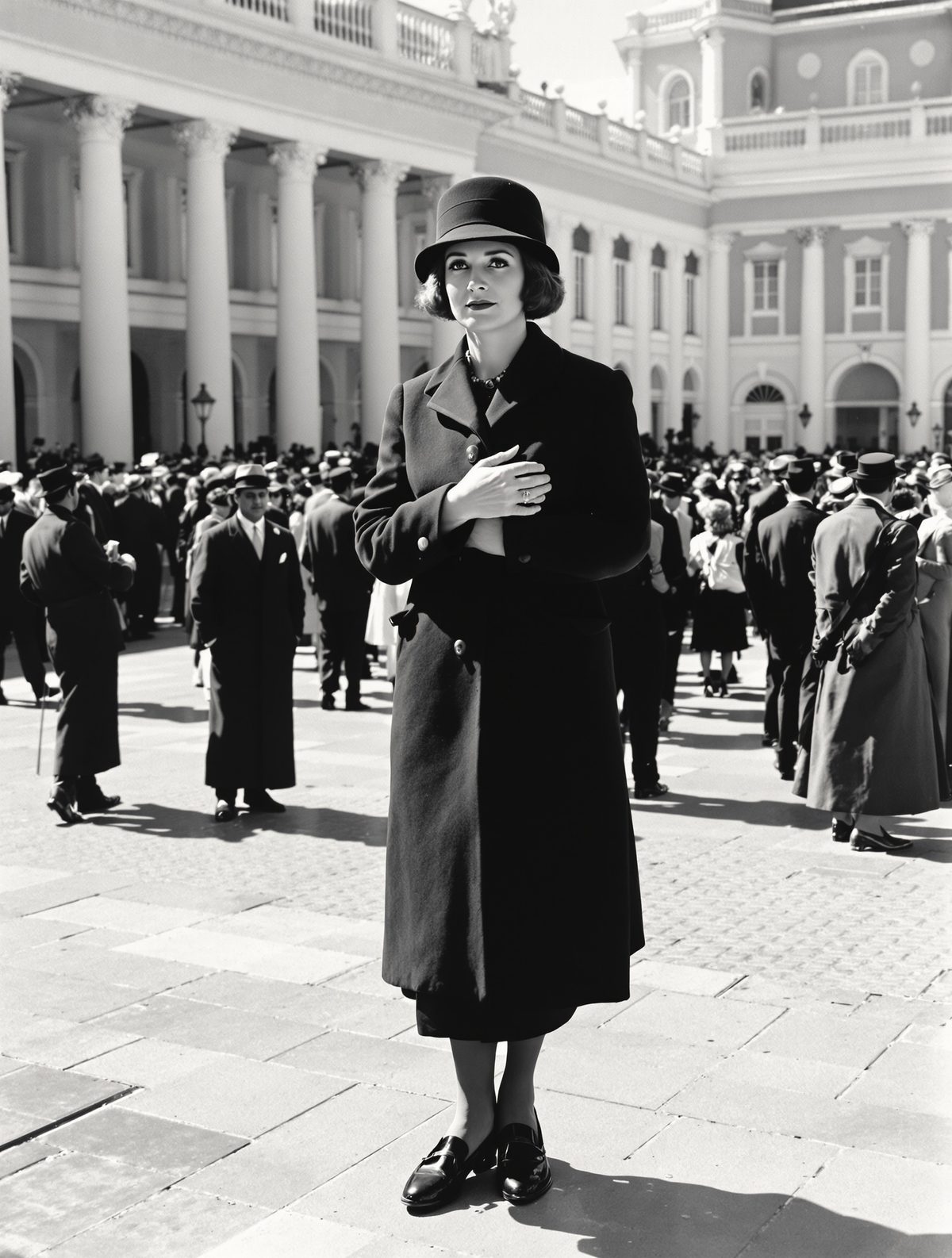
The crowd pressed closer as Benito Mussolini stepped onto the balcony overlooking Rome's Campidoglio square. It was April 7th, 1926, and Il Duce basked in the adoration of thousands who had gathered to hear him speak about fascist progress and Italian destiny. What none of them knew—including Mussolini himself—was that a 50-year-old Irish aristocrat stood among them, her hand wrapped around a small revolver hidden beneath her black coat.
Lady Violet Gibson had traveled from Dublin to Rome with one purpose: to kill the man she believed was leading Europe toward catastrophe. In just moments, this unlikely assassin would step forward, raise her weapon, and fire a shot that grazed the dictator's nose by mere millimeters—a shot that, had it found its mark, might have prevented the Second World War entirely.
The Aristocrat Who Became a Revolutionary
Violet Albina Gibson was born into privilege that most could only dream of. The daughter of Edward Gibson, 1st Baron Ashbourne and former Lord Chancellor of Ireland, she had grown up in the magnificent Ashbourne estate, surrounded by political power and social influence. Her father had been one of the architects of Irish land reform, a man who dined with prime ministers and shaped the destiny of nations.
But Violet was never content with the comfortable cage of aristocratic society. From her youth, she displayed an intensity that worried her family—a burning need to find meaning beyond garden parties and charitable committees. She converted to Catholicism, much to her Protestant family's dismay, and threw herself into religious devotion with the same fervor that would later drive her toward political violence.
Read next: The Night a Teenage Gunner Held the Bridge at Arnhem
By the 1920s, Violet had become increasingly disturbed by the rise of fascism across Europe. While many of her social class viewed Mussolini as a bulwark against communism, she saw him as something far more dangerous: a man whose charisma and ruthlessness could plunge the continent into war. Her family later described her as becoming "obsessed" with what she called "the Mussolini problem."
A City Under the Spell of Il Duce
Rome in 1926 was a city transforming itself. Mussolini had been in power for less than four years, but his mark was already everywhere. Blackshirt patrols marched through ancient streets, fascist slogans adorned buildings that had stood since Caesar's time, and the cult of personality surrounding Il Duce grew stronger by the day.
Violet had arrived in the Eternal City several weeks before her planned assassination, conducting what can only be described as surveillance. She attended fascist rallies, studied Mussolini's public schedule, and identified the moments when he would be most vulnerable. Her aristocratic bearing and advanced age made her invisible to the security apparatus—who would suspect a middle-aged Irish lady of harboring revolutionary intentions?
She purchased her weapon from a Roman gun dealer, telling him she needed protection while traveling. The seller later recalled that she seemed "nervous but determined," though he thought nothing of it at the time. Italy was still a country where many carried personal weapons, and foreign visitors often felt safer with protection.
Seven Minutes That Nearly Changed History
The morning of April 7th dawned bright and clear. Mussolini was scheduled to speak at the opening ceremony of the International Congress of Surgeons—an irony that wouldn't be lost on history, given what was about to unfold. Violet positioned herself strategically in the crowd, close enough to the podium to ensure she wouldn't miss, but far enough back to avoid immediate detection.
At exactly 2:40 PM, as Mussolini concluded his speech and began to leave the platform, Violet Gibson stepped forward. Witnesses later described the scene as surreal: this elegantly dressed woman suddenly producing a small revolver and raising it with both hands, her face a mask of grim determination.
"Abbasso il fascismo!" she reportedly shouted—"Down with fascism!"—as she pulled the trigger.
The bullet struck Mussolini's nose, creating a groove along the cartilage before exiting harmlessly. Had her aim been just one inch to the left, it would have entered his brain. Instead, Il Duce staggered backward, blood streaming down his face, while his bodyguards launched themselves toward Violet.
The crowd's adoration instantly transformed into murderous rage. Hands reached for Violet from every direction as voices screamed for her blood. Only the quick intervention of police officers saved her from being torn apart by the mob. Even then, she was beaten severely before being dragged to safety, her expensive coat torn and her face bloodied.
The Prisoner Who Bewildered Her Captors
In custody, Violet Gibson proved as enigmatic as her assassination attempt had been shocking. During interrogation, she remained calm and articulate, explaining her actions with the measured tones of someone discussing the weather. She told her captors that she had acted alone, driven by her conviction that Mussolini represented an existential threat to European civilization.
"I saw what he was becoming," she reportedly told investigators. "Someone had to stop him before it was too late."
What bewildered authorities most was her complete lack of political connections. This wasn't a communist plot or an anarchist conspiracy—this was a lone wolf assassination attempt by someone who, by all appearances, should have been sympathetic to fascist ideology. Her aristocratic background, her family's conservative politics, her advanced age—nothing about Violet Gibson fit the profile of a political assassin.
Meanwhile, Mussolini milked the incident for maximum propaganda value. He appeared in public the next day with a dramatic bandage across his nose, declaring that Providence had saved him to fulfill Italy's destiny. The assassination attempt only enhanced his image as a leader marked by fate for greatness.
The Cover-Up and the Forgotten Heroine
Here's where the story takes a turn that reveals the murky world of international diplomacy. The British government, anxious to avoid a diplomatic incident with Italy, quickly intervened. Rather than allowing Violet to face trial—where her motivations might receive public attention—they arranged for her to be declared mentally incompetent and quietly deported.
Lord Ashbourne used his political connections to have his daughter committed to a mental asylum back in England, where she would spend the remaining thirty years of her life. The official narrative became that she was simply a deranged woman whose actions meant nothing—a convenient fiction that both governments were happy to maintain.
But medical records from her confinement tell a different story. Asylum doctors noted that while Violet suffered from depression, she showed no signs of the delusional thinking that would characterize genuine mental illness. She remained articulate, rational, and unrepentant about her actions until her death in 1956—eleven years after Mussolini met his violent end at the hands of Italian partisans.
The Shot That Echo Through Time
In the grand sweep of history, we often wonder about the moments that could have changed everything. Violet Gibson's assassination attempt represents one of those critical junctures—a point where the trajectory of the twentieth century might have been altered by the precision of a single bullet.
Had she succeeded, would fascism have collapsed in Italy without its charismatic leader? Would Hitler have found the same success without Mussolini as his model and ally? Would fifty million people have died in a war that might never have begun?
Perhaps more importantly, Violet Gibson's story reminds us that history's most consequential moments often hinge on the actions of individuals we've forgotten. While we remember the dictators and generals, we overlook the ordinary people who saw evil rising and chose to act, regardless of the personal cost.
In our own age of political upheaval, when democracy faces new threats and authoritarianism wears fresh disguises, the courage of Lady Violet Gibson—the Irish aristocrat who risked everything to fire a shot for freedom—deserves to be remembered not as the delusion of a madwoman, but as the desperate gamble of someone who saw the future more clearly than anyone around her.