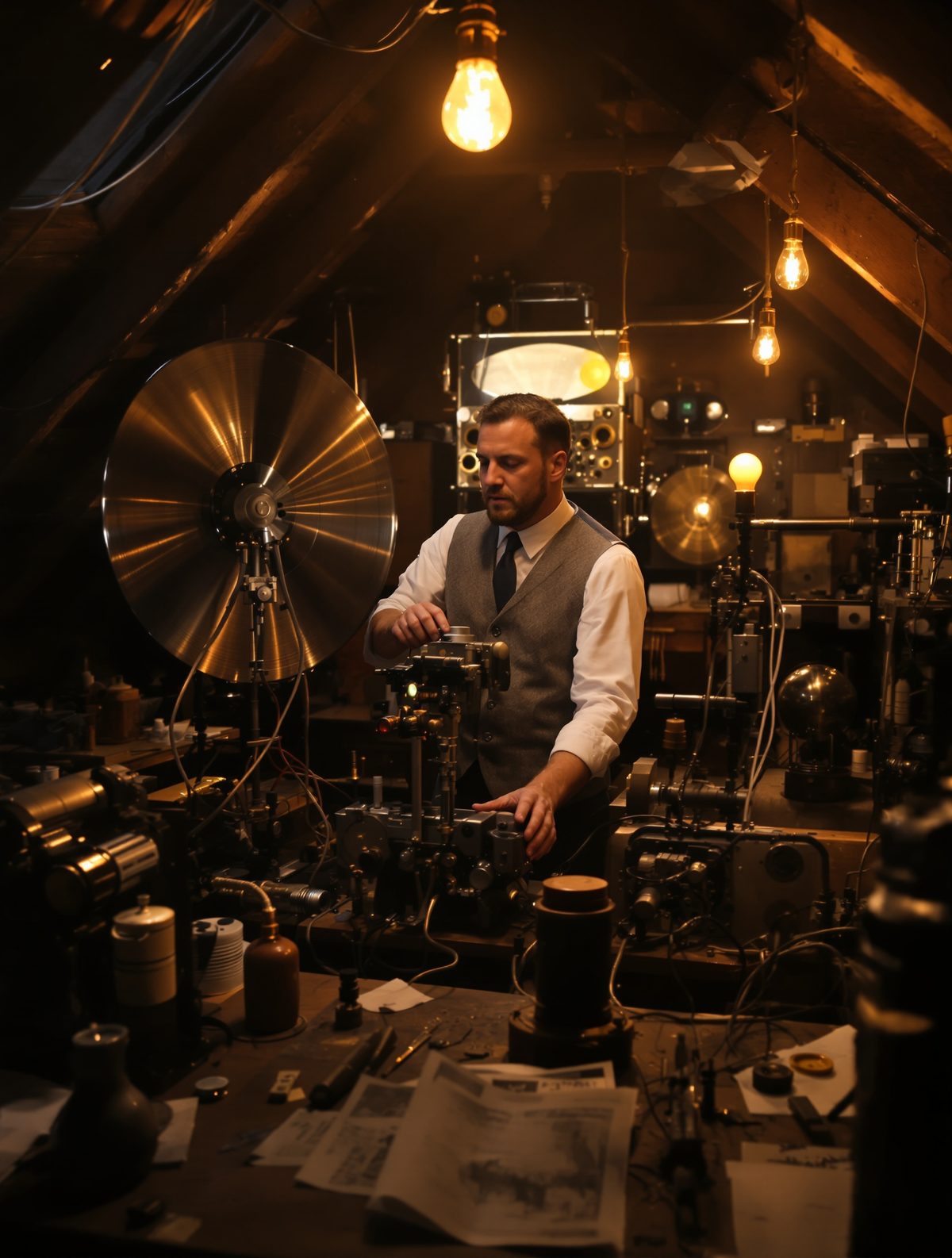
The attic at 22 Frith Street in London's Soho district reeked of solder and desperation. Flickering candles cast dancing shadows across a bizarre contraption of spinning discs, bicycle lamps, and cardboard boxes held together with string and sheer bloody-mindedness. It was October 2nd, 1925, and thirty-seven-year-old John Logie Baird was about to accidentally stumble into history.
The Scottish inventor had been tinkering with his mechanical monstrosity for months, transmitting crude silhouettes and shadows. But on this particular autumn afternoon, as London's fog pressed against the grimy windows, something extraordinary happened. The ventriloquist's dummy he'd been using as a test subject—a grotesque thing called "Stooky Bill"—suddenly appeared on his receiving screen with startling clarity. For the first time in human history, a recognizable television image had been transmitted and received.
Baird leaped up so violently he nearly knocked over his entire apparatus. Television, as we know it today, had just been born in a cramped London attic by a half-mad Scotsman who'd been written off as a crank by nearly everyone who knew him.
The Unlikely Pioneer from Helensburgh
John Logie Baird was hardly the sort of man you'd expect to revolutionize human communication. Born in 1888 in the genteel seaside town of Helensburgh, Scotland, he was a sickly child prone to mysterious ailments that would plague him throughout his life. His father was a Presbyterian minister, his mother the daughter of successful engineers—respectable middle-class stock with no hint of the maverick genius their son would become.
Read next: The Day a Scots Girl Thrust Her Arm Through a Door to Save a King
Young Baird showed early signs of his inventive obsession. At just twelve, he rigged up a telephone exchange connecting his bedroom to those of his friends across town, stringing copper wire along rooftops and telegraph poles. The local telephone company was not amused when they discovered this unauthorized network piggybacking on their infrastructure. It was the first of many run-ins Baird would have with established authority.
After a patchy education interrupted by ill health—he never completed his engineering degree at Glasgow University due to the outbreak of World War I—Baird embarked on a series of spectacularly unsuccessful business ventures. He tried his hand at manufacturing soap, selling socks, marketing pneumatic shoes, and even attempted to create artificial diamonds using an electric furnace that promptly short-circuited half of Glasgow.
Each failure pushed him closer to a nervous breakdown, but also closer to the obsession that would define his life: the possibility of transmitting moving images through the air, just as Marconi had done with radio waves.
The Madman's Laboratory
By 1924, Baird had washed up in London like so many ambitious Scots before him, renting a tiny attic workshop above an artificial flower shop in Frith Street. His landlord, suspicious of the strange noises and acrid smells emanating from upstairs, lived in constant fear that this eccentric tenant would burn down the building.
Baird's workshop looked like the lair of a demented inventor from a penny dreadful. His "televisor," as he called it, was constructed from the most unlikely materials: tea chests, biscuit tins, darning needles, bicycle lamps, and spinning discs cut from cardboard. The whole contraption was held together with sealing wax, string, and what Baird himself described as "more hope than engineering."
The principle behind his machine was elegantly simple, even if the execution was chaotic. A spinning disc perforated with holes scanned an image line by line, converting light into electrical signals that could be transmitted and then reconstituted into a flickering picture on a receiving screen. It was mechanical television—crude, noisy, and limited to tiny, grainy images—but it worked.
His test subject, "Stooky Bill," was a ventriloquist's dummy chosen for its stark contrasts and painted features. Unlike human faces, which were too subtle for his primitive system, the dummy's exaggerated expressions could survive the journey through Baird's mechanical maze of spinning wheels and photo-electric cells.
The Breakthrough Moment
October 2nd, 1925, started like any other day in Baird's chaotic laboratory. He'd been transmitting shadows and silhouettes for weeks, but the images were frustratingly indistinct—mere blobs of light and dark that required considerable imagination to interpret as recognizable objects.
That afternoon, as autumn light slanted through the grimy windows, Baird made a minor adjustment to his photo-electric cell—the device that converted light into electrical signals. It was a trivial tweak, the sort of thing he did dozens of times each day. But when he switched on his transmitter and looked at the receiving screen, he nearly fainted with shock.
There, flickering but unmistakable, was Stooky Bill's face. Not a shadow or silhouette, but an actual image with recognizable features, light and shade, depth and detail. The dummy's painted eyes seemed to stare back at Baird through the small screen, as if acknowledging the historic significance of the moment.
Trembling with excitement, Baird rushed downstairs to find a human test subject. He grabbed William Taynton, a 20-year-old office boy who worked in the shop below, offering him half a crown (a considerable sum for a young clerk) to sit in front of his strange machine. Taynton, initially terrified by the spinning discs and electrical sparks, became the first person in history to appear on television.
The World Refuses to Notice
You might expect that the invention of television would cause an immediate sensation, but the world greeted Baird's breakthrough with magnificent indifference. The scientific establishment dismissed him as a publicity-seeking amateur. The Times refused to cover his demonstrations. When he approached the Post Office (which controlled British telecommunications), they showed him the door with barely concealed contempt.
Part of the problem was Baird himself. With his gaunt frame, wild hair, and habit of wearing his overcoat indoors, he looked more like an impoverished artist than a serious inventor. His demonstrations often failed at crucial moments, his equipment held together with such improvised materials that respectable scientists couldn't take him seriously.
But Baird possessed the most important quality any pioneer can have: absolute, unshakeable belief in his vision. While others saw a flickering curiosity that might amuse the public for a few weeks, he envisioned a future where moving images could be transmitted across vast distances, bringing the world into people's homes.
He continued refining his system, achieving longer transmission distances and clearer images. On January 26, 1926, he gave his first public demonstration at the Royal Institution in London. The audience watched in stunned silence as human faces appeared on his small screen—grainy, flickering, but undeniably real. It was no longer possible to dismiss John Logie Baird as a harmless crank.
From Attic to Empire
Within two years of that breakthrough moment in his Frith Street attic, Baird had achieved what seemed impossible. In 1927, he transmitted television signals 438 miles from London to Glasgow—bringing his invention home to Scotland. In 1928, he accomplished the first transatlantic television transmission, sending images from London to New York. He even demonstrated the first television program broadcast by the BBC, though the corporation remained skeptical of this new medium.
Perhaps most remarkably for a man once dismissed as a failure, Baird demonstrated early color television in 1928 and primitive 3D television in 1930. His fertile mind seemed to leap decades ahead, envisioning applications that wouldn't become practical until long after his death in 1946.
The irony is that while Baird invented television, his mechanical system was ultimately superseded by electronic television developed by competitors like Philo Farnsworth and Vladimir Zworykin. By the time television became a mass medium after World War II, Baird's spinning discs had been replaced by electronic tubes and circuits. History remembers him as the father of television, but not as its ultimate architect.
The Revolution That Started with a Dummy
Today, as we live in a world where moving images flow endlessly through our phones, tablets, and screens, it's worth remembering that it all began with a desperate Scottish inventor and a ventriloquist's dummy in a cramped London attic. That flickering image of Stooky Bill on October 2nd, 1925, was the first pixel in a revolution that would transform human civilization.
Baird's breakthrough reminds us that world-changing innovations often come from the most unlikely sources—not from well-funded corporate laboratories or prestigious universities, but from obsessive individuals working with improvised equipment and unlimited determination. In our age of sophisticated technology and billion-dollar research budgets, perhaps we need more inventors willing to build the impossible from tea chests and bicycle lamps.
The next time you binge-watch a series or video-call a loved one on the other side of the world, spare a thought for the half-mad Scotsman who made it all possible. John Logie Baird never lived to see the full flowering of his invention, but every screen that flickers to life carries a trace of that miraculous October afternoon when television was born in a cluttered London attic, one spinning disc at a time.