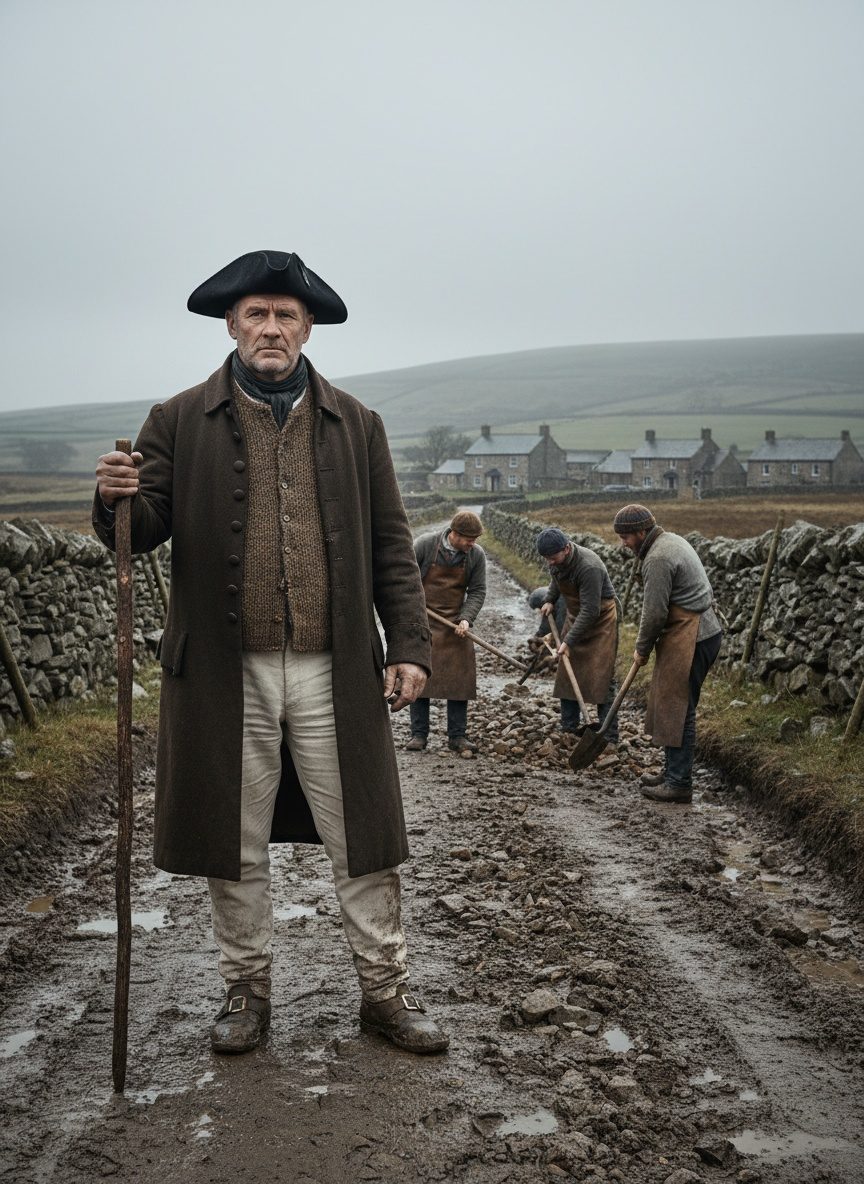
He could not see the stones he laid, yet he laid them perfectly. This was the remarkable reality of John Metcalf of Knaresborough, a pioneer road-builder in 18th-century Britain.
A Path Beyond Sight
The West Riding of Yorkshire, in the transformative era of the Industrial Revolution, was a land in need of connectivity. It was the mid-1760s, and the region was buzzing with the energy of innovation and enterprise. The stage was set for change, yet few could have predicted that the one to engineer it would be a man who had never seen the results of his labor. John Metcalf, more affectionately known as Blind Jack, had been blind since the age of six. Among the bustling towns and villages, where sight was an assumed necessity for work, Jack defied convention, driven by a remarkable spirit and acute sense of touch.
It might seem improbable that a man without sight could construct a road, let alone do so with an efficacy that matched or exceeded his seeing contemporaries. But Jack was no ordinary man. His blindness honed his other senses to acute levels. The earth spoke to him through his hands and feet, through the vibrations and textures via the staff he carried. Where others saw obstacles, Jack felt his way through them, his mind mapping the terrain through meticulous sensory detail.
The ambitious project began with Jack receiving contracts to build turnpike roads, crucial in facilitating the movement of goods spurred by industrial and mercantile expansion. Though met with skepticism by local officials and competitive engineers alike, Jack remained undeterred. He walked the length of proposed routes repeatedly, translating the rises and falls of the landscape into an internal blueprint long before the first stone was ever laid. He meticulously felt out the flattest, most stable ground, conceptualizing efficient routes by touch alone — a feat that resonated not just with curiosity, but with awe.
Read next: The Day a Mill Owner Kept Paying Wages He Could Not Afford
Crafting Connections
Blind Jack's ingenuity was especially evident when constructing complex parts of the road. One such marvel was where the roads twisted through the Yorkshire hillsides. How could someone unable to perceive the grandeur and complexities of the natural environment design something that respected yet reshaped it? Yet, he did.
His work was precise, his stones evenly laid, gradients expertly judged. He sensed drainage lines where water naturally wanted to go, intuiting that without proper management, roads could quickly turn to rivers under the heavy Yorkshire rains. John’s roads were well-drained and robust, capable of enduring the passage of time and traffic. These roads were not just practical pathways, but masterpieces of tactile engineering.
His approach to construction was methodical. Jack employed a team, leading them with calm certainty. Displays of kindness and respect were mixed with stern expectations. He instructed his men through detailed specifications whispered with confidence. As the road took shape under his guidance, skeptics became believers; his reputation grew, and his business thrived.
The construction of the turnpike was akin to opening superhighways of commerce at a time when horse-drawn carts reigned supreme. By providing direct routes between key towns and ports, Jack’s work transformed trade and communication, radically enhancing the movement that served as the lifeblood of progress.
Legacy in Stone
The sightless road-builder from Knaresborough left behind more than roads; he left legacies in stone and an audacious spirit that signified the relentless human drive to innovate and connect. Visitors to Yorkshire today may unknowingly tread the paths laid down by a man who, through resilience and extraordinary ability, beat all odds.
Blind Jack’s story resonates, not only as a curiosity but as an enduring narrative of the power of determination. In an age where ability was often judged physically, he epitomized how internal vision could surpass physical limitations. Through tactile intuition and unwavering spirit, John Metcalf visually interpreted a future many could not foresee, teaching us that intelligence and capability manifest in myriad forms.
In the stone veins he meticulously laid through the rugged heart of England, John Metcalf crafted more than roads. He built bridges across the chasms of disbelief and prejudice, affirming a truth that transcends centuries: that ability is not always seen; it is often felt. His roads, like his story, are silently steadfast, quietly enduring — a testament to all that is possible when one dares to navigate a path beyond sight.