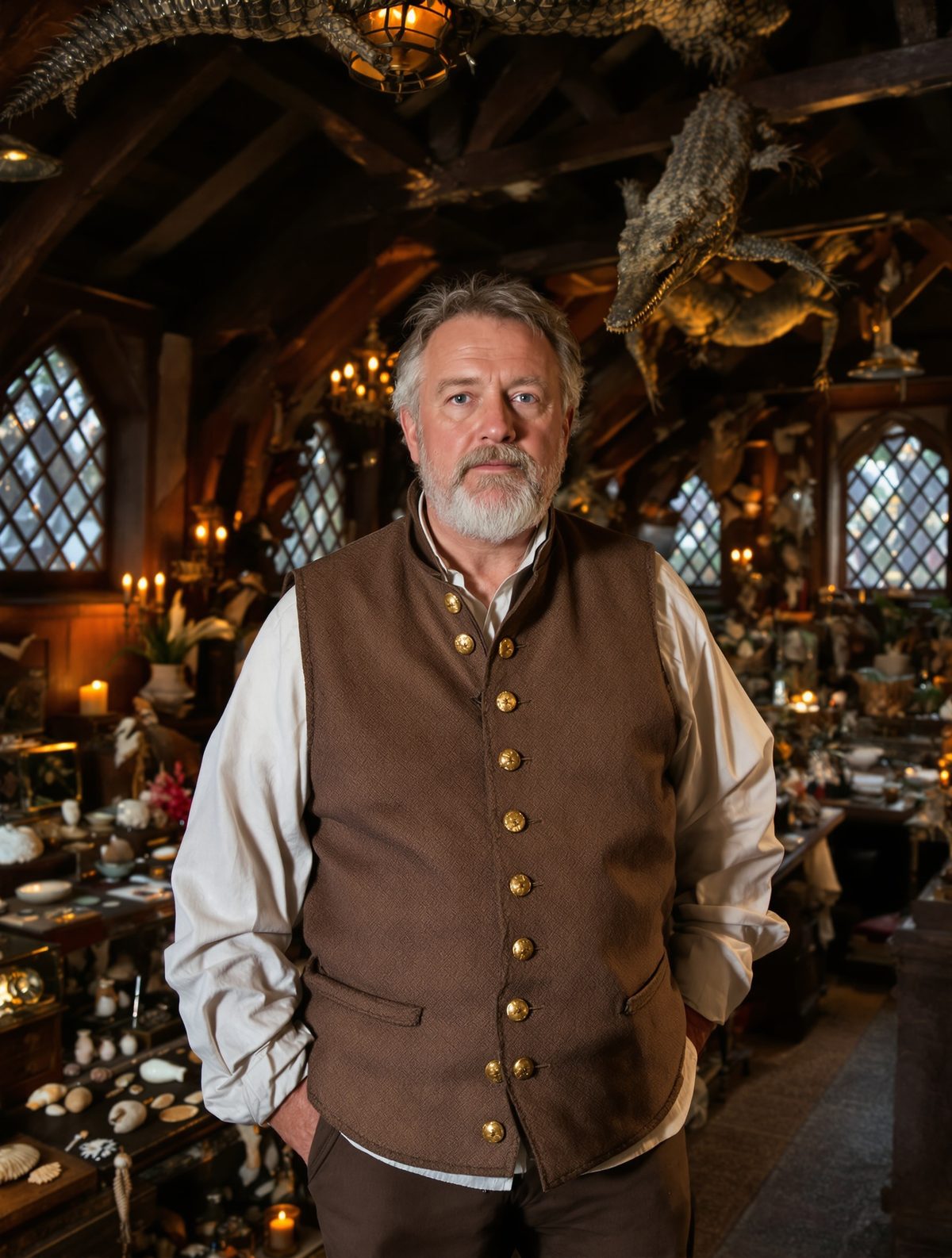
Picture this: a modest Tudor house in Lambeth, south London, where for sixpence—the price of a decent meal—you could step inside and find yourself face-to-face with a stuffed crocodile suspended from the ceiling, a dodo's skeletal remains, and the magnificent feathered cloak once worn by Pocahontas's father. Welcome to the world's most extraordinary front room, where in 1634, a royal gardener named John Tradescant turned his passion for collecting into Britain's first public museum.
While most of us struggle to display our holiday souvenirs tastefully, Tradescant had somehow crammed an entire world of wonders into his Lambeth home. Visitors didn't just come to gawk—they came to have their minds blown. This wasn't some dusty academic collection gathering cobwebs in a university hall. This was spectacle, education, and pure jaw-dropping amazement rolled into one unforgettable experience.
The Gardener Who Couldn't Stop Collecting
John Tradescant the Elder wasn't your average green-fingered enthusiast. As head gardener to King Charles I, he had connections that would make a modern museum curator weep with envy. But Tradescant's genius lay not just in his royal access—it was his insatiable curiosity about the natural world and everything in it.
Born around 1570, Tradescant had spent decades traveling across Europe and beyond, ostensibly hunting for exotic plants to grace royal gardens. But somewhere along the way, he'd developed what can only be described as a magnificent obsession. Every voyage, every expedition, every chance encounter became an opportunity to acquire something extraordinary. He collected shells from Mediterranean beaches, minerals from German mines, and artifacts from the expanding English colonies in America.
Read next: The Day a Tudor Chancellor Chose Death Over a Royal Lie
By the 1620s, his Lambeth house was bursting at the seams. Friends and fellow plant-hunters would arrive expecting to discuss the latest botanical discoveries, only to find themselves mesmerized by a cabinet containing everything from ancient Roman coins to what Tradescant claimed were "the hand of a mermaid" and "the claw of the bird Rock, who, as authors report, is able to truss an elephant."
The collection had taken on a life of its own, and Tradescant realized he was sitting on something unprecedented: a microcosm of the entire known world, assembled under one modest roof.
Opening the Ark to the World
The decision to open his doors to paying visitors in 1634 was revolutionary. This wasn't charity or scholarly access—this was commerce meets curiosity, and it worked brilliantly. Tradescant called his collection "The Ark," and the name couldn't have been more perfect. Like Noah's vessel, it seemed to contain specimens of everything under the sun.
For sixpence, visitors could spend hours wandering through rooms packed floor to ceiling with wonders. The crocodile hanging from the parlor ceiling was just the beginning. There were cases filled with exotic shells arranged in mesmerizing patterns, drawers packed with coins from ancient civilizations, and carefully preserved specimens of birds so exotic that many Londoners had never imagined such creatures could exist.
The American collection was particularly spectacular. Tradescant had cultivated relationships with Virginia Company officials and early colonists, who regularly sent back artifacts from the New World. The crown jewel was Chief Powhatan's ceremonial cloak—a magnificent deerskin garment decorated with shells that had once belonged to Pocahontas's powerful father. Imagine the conversations that piece sparked, arriving just years after the famous princess had charmed London society.
Word spread like wildfire through London's coffee houses and taverns. The Ark wasn't just attracting curious locals—foreign dignitaries, scholars from across Europe, and even members of the royal family made pilgrimages to this suburban house of wonders.
A Cabinet of Curiosities Like No Other
What made Tradescant's collection so extraordinary wasn't just its breadth—it was his eye for the genuinely remarkable. While other collectors might focus on one area, Tradescant seemed incapable of saying no to anything that sparked his imagination.
Visitors might find themselves examining a rhinoceros horn (a creature most had only heard described in fantastic tales), then moving on to inspect delicate butterfly specimens pinned with meticulous care. There were weapons from Africa, textiles from Asia, and an entire section devoted to what Tradescant called "artificial curiosities"—man-made objects so skillfully crafted they seemed almost magical.
One of the most talked-about specimens was a dodo—or rather, parts of one. The Tradescants possessed what they believed to be the head and foot of this strange flightless bird from Mauritius. Little did visitors know they were looking at remains of a creature that would be extinct within decades, making their glimpse a precious window into a vanishing world.
The collection also reflected the era's fascination with the mystical and unexplained. Alongside genuine natural specimens, visitors could marvel at supposed unicorn horns (likely narwhal tusks), dragons' eggs (probably ostrich eggs with embellished provenance), and other items that blurred the line between natural history and pure fantasy.
But perhaps most remarkably, Tradescant didn't just display his treasures—he documented them. In 1656, his son John Tradescant the Younger published "Musaeum Tradescantianum," the first printed museum catalog in England, listing over 750 items with careful descriptions that give us a window into this lost world of wonder.
The Business of Wonder
The Ark's success proved something profound: there was a genuine hunger among ordinary people for knowledge, beauty, and connection to the wider world. This wasn't just entertainment—it was education in its most engaging form.
The sixpence admission fee was carefully calculated. Expensive enough to keep the collection sustainable and attract serious visitors, but affordable enough that skilled craftsmen, prosperous merchants, and curious housewives could justify the expense. On busy days, the Tradescant house must have been packed with visitors from every level of society, all united in their amazement at the treasures before them.
The Tradescants also understood the importance of storytelling. Each object came with tales of its origin—some true, some embellished, all calculated to fire the imagination. That tomahawk wasn't just a weapon; it was a tangible connection to the mysterious American wilderness. Those exotic shells weren't merely pretty objects; they were evidence of God's infinite creativity in distant seas.
By the 1650s, "Tradescant's Ark" had become so famous that visiting it was considered an essential part of any educated person's London experience. Foreign visitors included it alongside Westminster Abbey and the Tower of London on their must-see lists.
Read next: The Day a Tudor Bishop Refused to Crown a Usurper
Legacy of the Lost Ark
When John Tradescant the Younger died in 1662, the collection's fate became the subject of one of the era's most fascinating legal battles. The ambitious antiquarian Elias Ashmole had befriended the aging Tradescant and somehow convinced him to bequeath the entire collection to him. Tradescant's widow fought the decision, but Ashmole prevailed.
In 1683, Ashmole donated the collection to Oxford University, where it became the foundation of the Ashmolean Museum—officially Britain's first public museum. Many of Tradescant's original specimens can still be seen there today, including that famous Powhatan cloak, still magnificent after nearly four centuries.
But something was lost in the transition from the intimate Lambeth house to the grand university halls. The Ark had succeeded because it felt personal, almost domestic. Visitors weren't just viewing artifacts—they were being welcomed into someone's passionate obsession made manifest.
The Wonder We've Lost—And Found Again
In our age of Google and instant access to information, it's worth pausing to consider what John Tradescant achieved in his Lambeth front room. He understood something profound about human nature: we crave connection to the mysterious, the distant, and the beautiful. We want to touch the untouchable and see the unseen.
The Ark succeeded because it offered something our digital age sometimes lacks—the irreplaceable thrill of standing before the genuine article. No illustration could capture the impact of seeing that crocodile suspended overhead, or holding the weight of that ancient coin in your palm.
Today, as museums struggle with funding and relevance, perhaps they could learn from Tradescant's example. He proved that wonder is a universal language, that curiosity transcends class boundaries, and that the most powerful education happens when we're too amazed to realize we're learning.
In that modest Lambeth house, a royal gardener created more than Britain's first public museum—he created a template for how knowledge, beauty, and sheer jaw-dropping amazement could transform an ordinary afternoon into an extraordinary journey around the world. For sixpence and an open mind, visitors could leave their everyday lives behind and return home with their horizons permanently expanded.
That, perhaps, is the most valuable curiosity of all.