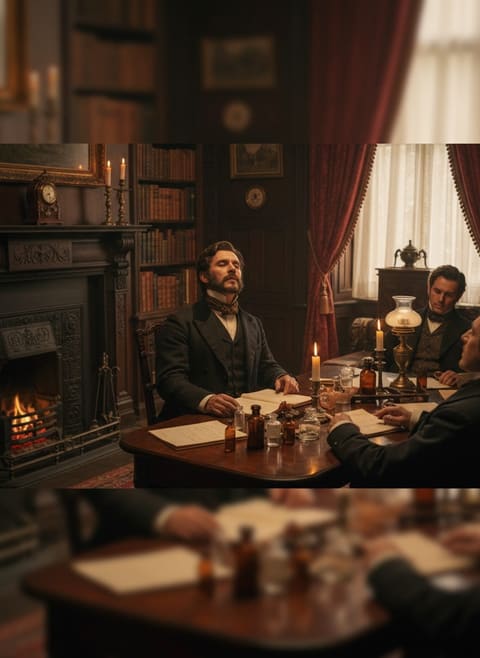
In 1886, a well-dressed gentleman knocked on a tenement door in London's East End. The woman who answered, clutching a malnourished child to her chest, had no idea she was about to become part of the most ambitious social experiment in British history. The man with the notebook was Charles Booth—shipping magnate, millionaire, and unlikely revolutionary—and he had come with an impossible mission: to map poverty across every single street in the world's largest city.
What Booth discovered would shatter Victorian Britain's comfortable assumptions about the poor and transform how governments think about social policy forever. But first, he had to walk through hell.
The Millionaire Who Doubted the Numbers
Charles Booth was not your typical social reformer. Born into wealth and privilege, he had built a fortune in the shipping trade with his Liverpool-based company. By the 1880s, he was worth millions—yet something gnawed at him about the condition of London's poor. When socialist agitators claimed that 25% of Londoners lived in abject poverty, Booth scoffed. Surely, he thought, these radicals were exaggerating.
There was only one way to find out: count them himself.
Read next: The Day a Surgeon's Son Chose Death Over Silence
In an age before government statistics or scientific polling, Booth's plan was audacious beyond belief. He would survey every household in London—all 4.5 million residents. He would walk every street, knock on every door, and classify every family according to their economic circumstances. No one had ever attempted anything remotely like it.
What began as a wealthy man's skeptical fact-checking mission would evolve into a 17-year odyssey that produced 17 volumes of data and changed the course of British social policy. Booth assembled a team of investigators, including his secretary Jesse Argyle and the brilliant social researcher Beatrice Potter (later Webb), and set out to create the first scientific poverty map in history.
Walking Through London's Hidden World
Booth's methodology was revolutionary. Rather than relying on government records or charitable reports, his team gathered intelligence from an unlikely source: school board visitors. These officials, who enforced attendance laws, visited working-class homes regularly and knew intimately which families were struggling. They became Booth's eyes and ears into London's hidden world of poverty.
But Booth didn't stop there. He walked the streets himself, often in disguise, staying in common lodging houses and eating in workingmen's cafes. He interviewed police constables on their beats, spoke with clergymen, and sat with dock workers as they waited for employment that might never come. In Whitechapel, he lodged with a family of seven crammed into a single room, witnessing firsthand how they survived on irregular wages of 15 shillings a week.
The team developed a color-coded classification system that would become legendary. Black marked the "lowest class"—criminals, prostitutes, and the utterly destitute. Dark blue represented the "very poor"—those earning less than 18 shillings weekly for a moderate family. Light blue indicated the "poor," while purple marked "mixed" neighborhoods. Pink showed the "fairly comfortable" working class, red the "middle class and well-to-do," and yellow the wealthy.
The Shocking Truth Revealed
When Booth published his first findings in 1889, Victorian society reeled. The socialists hadn't exaggerated—they had underestimated. A staggering 30.7% of Londoners lived below the poverty line. In the East End, the figure reached 35%. Nearly one in three of the world's wealthiest city's residents couldn't afford basic necessities.
The maps themselves became iconic—sheets of ordinary street plans transformed into vivid tapestries of inequality. Whole districts blazed in black and dark blue, marking areas where families crowded eight to a room, where children went barefoot year-round, and where a single day without work meant no food on the table.
Booth's investigators uncovered heartbreaking details that statistics alone couldn't convey. They found widows with six children surviving on parish relief of just four shillings a week. They documented families who had pawned everything they owned, keeping only the clothes on their backs. In Bethnal Green, they met a 12-year-old girl who worked 14-hour days making matchboxes, earning just two pence for every 144 boxes she completed.
But perhaps most shocking was the discovery that most of London's poor weren't the "undeserving" drunkards and criminals of popular imagination. They were working people—dockers, seamstresses, factory hands—whose wages simply couldn't keep pace with the cost of living in an increasingly expensive city.
The Color-Coded Revolution
Booth's poverty maps became the sensation of their age. Displayed in shop windows and reproduced in newspapers, they made visible what had long been hidden. The wealthy residents of Belgravia could see, literally mapped in color, the black streets of desperation just miles from their yellow squares of prosperity.
The visual impact was devastating. When Members of Parliament saw entire neighborhoods colored black and dark blue, the abstract concept of poverty became concrete reality. These weren't just statistics—these were streets you could visit, addresses you could find, neighbors whose suffering could no longer be ignored.
The maps revealed patterns that transformed understanding of urban poverty. It wasn't randomly distributed but concentrated in specific areas—the docks of East London, the casual labor districts south of the Thames, the overcrowded tenements of Whitechapel. Poverty, Booth demonstrated, was structural, not individual.
Read next: The Day a Chimney Sweep's Son Shamed a Whole Parliament
His work also exploded myths about the causes of destitution. While 55% of poverty resulted from irregular work and low wages, only 14% stemmed from drink or thriftlessness. The problem wasn't moral failing but economic insecurity in an industrial system that offered workers no safety net.
From Maps to Policy
Booth's revelations didn't just shock—they inspired action. His data became the foundation for the Liberal government's revolutionary social reforms of the early 1900s. When David Lloyd George introduced old-age pensions in 1908, he cited Booth's evidence of elderly poverty. The National Insurance Act of 1911 drew directly on Booth's documentation of how illness and unemployment devastated working families.
The methodology Booth pioneered—systematic data collection, scientific classification, visual representation—became the template for modern social research. Government departments began conducting their own surveys, charitable organizations adopted his techniques, and cities across Britain and beyond started mapping their own social conditions.
But perhaps most importantly, Booth had proven that poverty was measurable, mappable, and therefore solvable. By showing exactly where deprivation existed and what caused it, he made the case that targeted government intervention could make a real difference.
The Legacy of Walking Every Street
Today, as governments worldwide grapple with inequality and urban deprivation, Booth's work feels remarkably contemporary. His insights—that poverty clusters geographically, that it stems largely from structural economic factors rather than personal failings, and that effective policy requires detailed data—remain fundamental to modern social policy.
The man who set out to disprove socialist claims about London's poverty ended up documenting a crisis far worse than anyone had imagined. In doing so, he didn't just map the geography of want—he charted a course toward the welfare state that would define 20th-century Britain. Sometimes the most powerful act of skepticism is simply deciding to count, carefully and completely, what others prefer to leave uncounted.
Charles Booth's 17-year journey through London's streets proved that when you illuminate the hidden corners of society, you create the possibility of changing them. In our age of growing inequality, perhaps it's time to ask: who is walking our streets today, and what would they find?