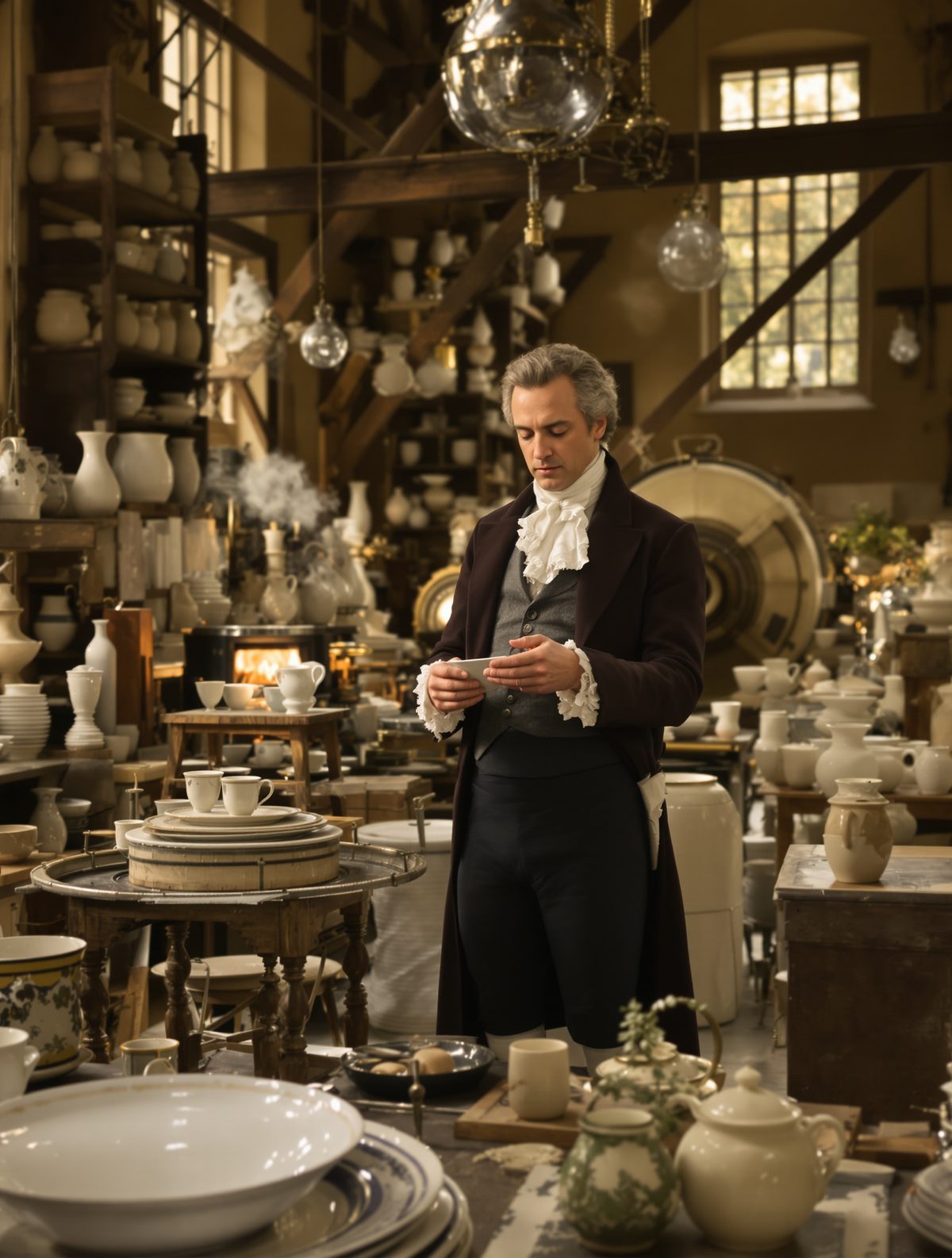
In the autumn of 1769, a well-dressed gentleman stepped into the porcelain workshops of Meissen, near Dresden. He spoke fluent German, carried himself with aristocratic bearing, and his purse jingled with the promise of substantial orders. The master craftsmen were delighted to show off their finest techniques to such a promising customer. They had no idea they were being systematically robbed.
The man was no wealthy collector. He was one of Josiah Wedgwood's secret agents, part of what would become Britain's first industrial spy network—a shadowy operation that helped secure the nation's dominance in the global pottery trade and established the blueprint for industrial espionage that continues to this day.
The Potter Who Changed Everything
Josiah Wedgwood wasn't supposed to revolutionise anything. Born in 1730 to a family of humble Staffordshire potters, a childhood bout of smallpox left him with a weakened leg that would plague him for life. But what his body lacked in strength, his mind made up for in brilliance. By the 1760s, Wedgwood had transformed pottery from a crude craft into an art form, creating pieces so exquisite that Queen Charlotte herself became a customer—earning him the coveted title "Potter to Her Majesty."
His secret weapon was obsessive experimentation. While other potters relied on tradition and guesswork, Wedgwood approached his craft like a scientist. He catalogued over 5,000 experiments, meticulously recording temperatures, clay compositions, and firing times. The result was jasperware—a stunning unglazed stoneware that could be tinted in delicate blues, greens, and lilacs, then decorated with intricate white reliefs that seemed to glow against the coloured background.
Read next: The Day a Weaver's Son Lit Britain's First Public Railway
But Wedgwood's masterpiece contained the seeds of his greatest crisis. By 1770, his pottery was the toast of European high society. Russian Empress Catherine the Great commissioned a 952-piece dinner service decorated with hand-painted English landscapes. The French aristocracy couldn't get enough of his neoclassical designs. Success, however, bred imitation—and imitation threatened everything Wedgwood had built.
When Flattery Became Theft
The first warning shot came from an unexpected source: his own customers. In 1771, a merchant returning from the Continent brought disturbing news. The royal porcelain factories of Europe—Sèvres in France, Meissen in Saxony, and the Imperial Porcelain Factory in St. Petersburg—were producing pieces that looked suspiciously like Wedgwood's designs. Not inspired by them, not influenced by them, but identical to them.
The implications were catastrophic. Wedgwood's entire business model depended on exclusivity and innovation. If European competitors could copy his techniques and undercut his prices with local production, his empire would crumble. Worse still, these weren't fly-by-night imitators—they were state-sponsored manufactories with royal patronage and unlimited budgets.
Traditional legal remedies were useless. There was no international copyright law, no patent protection that crossed borders. Besides, how could he prove theft when he didn't even know exactly what was being stolen or how? Wedgwood realised he needed intelligence—detailed, accurate information about what his competitors were doing, how they were doing it, and what they planned to do next.
His solution was as audacious as it was unprecedented: if knowledge was power, he would steal it.
The Birth of Industrial Espionage
In the winter of 1769, Wedgwood began recruiting his network. He couldn't use obvious spies—foreign pottery workers would be instantly suspect. Instead, he sought men who could blend seamlessly into European high society: educated gentlemen with linguistic skills, cultural knowledge, and the social graces to gain access to the most exclusive workshops.
His first and most successful agent remains known to history only as "Mr. H"—possibly John Howarth, a trusted business associate with connections across Europe. Wedgwood's instructions to his operatives were precise and comprehensive. They were to pose as wealthy collectors or merchants, express interest in commissioning large orders, and use these negotiations to gain access to workshops and manufacturing processes.
The intelligence they gathered was remarkably detailed. From the Sèvres factory outside Paris, agents reported back on clay compositions, firing temperatures, and the closely guarded secret of their translucent porcelain paste. From Meissen, they discovered new glazing techniques and colour formulations. Most importantly, they identified which Wedgwood designs were being copied and how closely the imitations matched the originals.
But Wedgwood's network didn't just gather defensive intelligence. His agents also engaged in what we would now recognise as industrial sabotage and talent acquisition. They approached skilled craftsmen with offers of employment in England, effectively brain-draining European workshops of their most valuable human resources.
Secrets, Lies, and Porcelain Spies
The methods employed by Wedgwood's agents would have impressed any modern intelligence service. They used code names and coded correspondence. They developed cover stories so detailed they could withstand scrutiny. One agent spent months establishing himself in Parisian society before ever approaching the Sèvres factory, creating an elaborate persona complete with forged letters of introduction from fictional English aristocrats.
Perhaps most ingeniously, they exploited the very exclusivity that made these workshops valuable. By presenting themselves as wealthy connoisseurs willing to pay premium prices, they triggered a competitive response among craftsmen eager to show off their skills. Master potters who jealously guarded their secrets from competitors gladly demonstrated techniques to "customers" who promised lucrative commissions.
The intelligence flowed back to Wedgwood through a network of seemingly innocent business correspondence. Letters discussing pottery orders contained coded references to manufacturing processes. Requests for specific colours or finishes were actually reports on competitor capabilities. Even the timing of correspondence carried meaning—urgent intelligence required immediate response, while routine updates could wait for the regular weekly reports.
By 1775, Wedgwood possessed what amounted to a comprehensive database of European pottery manufacturing. He knew which factories were experimenting with new techniques, which ones were struggling with quality control, and most importantly, which ones posed the greatest competitive threat to his business.
Read next: The Day a Mill Owner Walked Into Court and Freed His Rivals' Children
The Counter-Intelligence War
Wedgwood's success inevitably bred imitation of a different sort. European manufacturers began developing their own intelligence networks, sending agents to infiltrate British workshops and steal Wedgwood's secrets in return. What had begun as a one-sided information war quickly escalated into a complex game of spy versus spy.
The Staffordshire pottery region became a hotbed of industrial espionage. Foreign "visitors" with suspicious interest in manufacturing processes were common enough that local craftsmen developed their own counter-intelligence techniques. Wedgwood himself installed trusted supervisors to monitor his workshops and developed coded marking systems to track which employees had access to which sensitive information.
The most dramatic incident occurred in 1777, when Wedgwood's agents discovered that the French government was planning to establish a new porcelain factory specifically designed to compete with English pottery in international markets. The intelligence was so detailed—including architectural plans, equipment specifications, and recruitment lists—that it could only have come from someone with access to the highest levels of the French porcelain industry.
The Legacy of Clay and Espionage
Wedgwood's spy network operated successfully for over two decades, helping him maintain British dominance in the global pottery trade well into the 1790s. But its significance extends far beyond the world of ceramics. In creating the first systematic industrial espionage operation, Wedgwood established principles and methods that would be adopted by manufacturers across Britain and eventually around the world.
The network's success helped fund Wedgwood's later innovations, from his partnership with Matthew Boulton in developing new manufacturing techniques to his support for the Grand Trunk Canal that revolutionised British transportation. More importantly, it demonstrated that in an increasingly connected world, information was becoming as valuable as raw materials or skilled labour.
Today, as governments and corporations invest billions in protecting intellectual property while simultaneously attempting to acquire their competitors' secrets, Wedgwood's legacy is more relevant than ever. The potter who turned espionage into a business tool helped establish Britain as the world's first industrial superpower—not just through innovation, but through the systematic acquisition and protection of knowledge itself.
In our age of cyber-espionage and industrial hacking, Josiah Wedgwood's greatest creation may not have been his exquisite jasperware, but rather the understanding that in the modern economy, the most beautiful designs mean nothing without the intelligence to protect them.