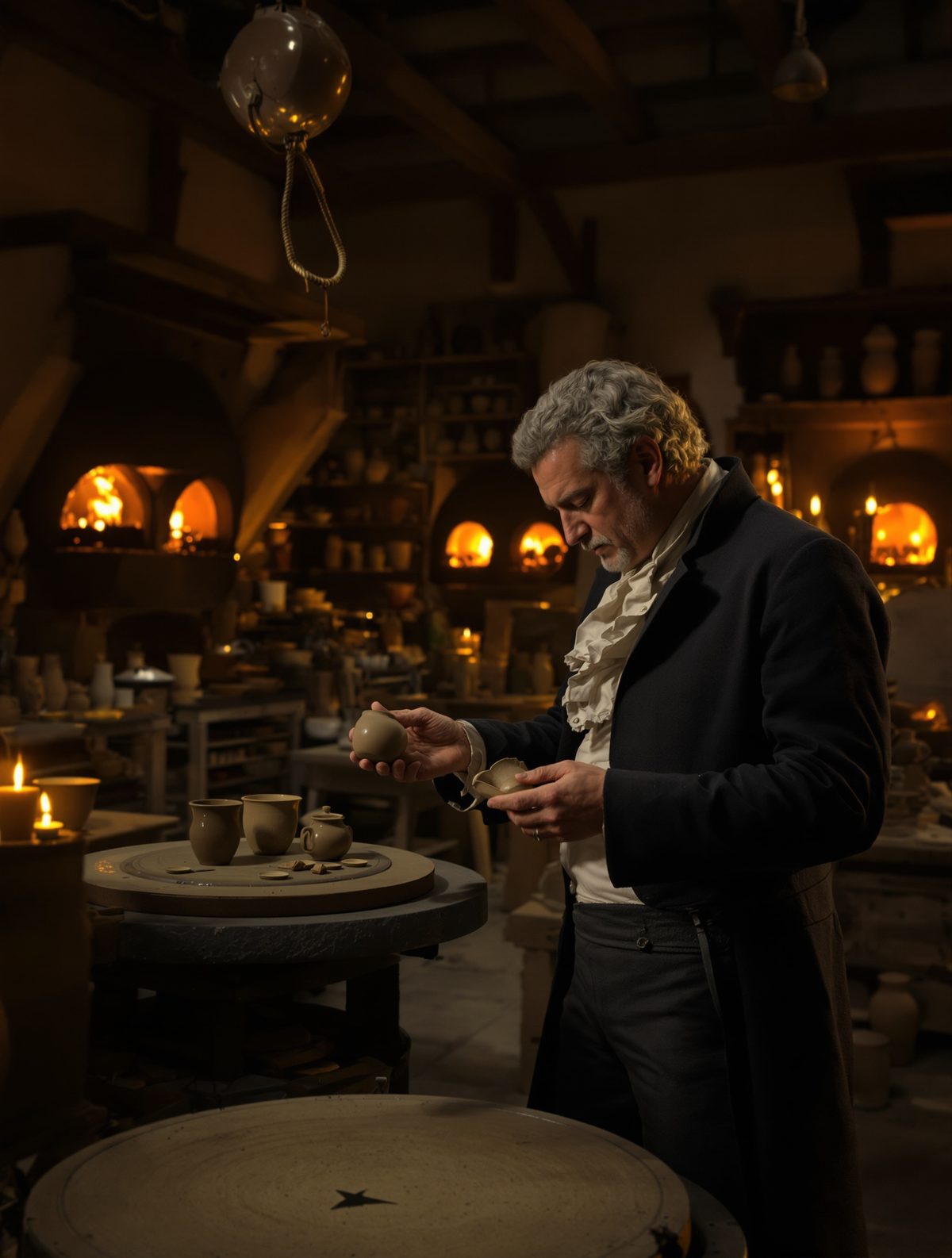
The acrid smell of smoke and shattered dreams filled the workshop as Josiah Wedgwood stared at the wreckage before him. It was a sweltering August morning in 1763, and the kiln doors had just been opened to reveal what should have been his masterpiece—an elegant dinner service destined for the table of a wealthy Staffordshire gentleman. Instead, a spider's web of cracks marred every piece, rendering months of painstaking work utterly worthless.
Any other potter would have swept the fragments into a barrel and chalked it up to experience. But Wedgwood wasn't any other potter. As he knelt among the broken ceramics, running his fingers along each hairline fracture, he was about to make the discovery that would transform him from a provincial craftsman into the father of modern pottery—and inadvertently help launch the Industrial Revolution itself.
The Perfectionist's Obsession
Josiah Wedgwood had always been different. Born in 1730 into a family of Staffordshire potters, he should have been content to follow the time-honored traditions passed down through generations. But where others saw "good enough," Wedgwood saw endless possibilities for improvement. A childhood bout of smallpox had left him with a weakened leg that would eventually require amputation, but it had also given him something perhaps more valuable—time to observe, think, and question everything about his craft.
By 1763, at just 33 years old, Wedgwood had already established himself as one of the region's most ambitious pottery manufacturers. His workshop in Burslem buzzed with activity as skilled craftsmen shaped clay on wheels that had remained essentially unchanged since Roman times. But Wedgwood's mind raced ahead of his hands, filled with visions of pottery so fine, so perfectly uniform, that it could grace the tables of royalty.
Read next: The Day a Weaver's Son Lit Britain's First Public Railway
The disaster that August morning involved what potters called a "best set"—their finest work, intended to showcase their skills to wealthy clients. Wedgwood had experimented with a new clay mixture, one he hoped would produce an almost translucent quality when fired. The pieces had emerged from their initial firing looking promising, but the second firing—the crucial stage that would set the glaze and determine the final quality—had gone catastrophically wrong.
The Science Hidden in Disaster
What happened next would have baffled Wedgwood's contemporaries. Instead of clearing away the ruined pottery, he began what can only be described as the 18th century's first systematic ceramic forensic investigation. He numbered each broken piece, sketched the crack patterns, and began correlating the damage with the position of each item in the kiln.
The revelation was startling. The pieces closest to the firebox showed tight, clean breaks—the result of thermal shock from excessive heat. Those in the middle displayed the fine crackling typical of cooling too quickly. But the pieces furthest from the heat source showed something else entirely: a different pattern of stress fractures that suggested they had never reached the proper temperature at all.
For the first time, Wedgwood realized that his kilns—like every pottery kiln in England—were essentially giant, inefficient ovens with massive temperature variations. Parts of his precious dinner service had been baked at nearly 2,000 degrees Fahrenheit while other sections barely reached 1,400 degrees. It was like trying to bake bread in an oven where one end was blazing hot and the other barely warm.
This insight led to a feverish period of experimentation. Wedgwood began developing what he called "pyrometric beads"—small clay cylinders that would bend at specific temperatures, giving him a precise reading of heat levels throughout his kilns. It was revolutionary technology disguised as simple pottery, and it gave Wedgwood something no potter had ever possessed: scientific control over the firing process.
The Birth of Industrial Precision
Armed with his temperature-measuring system, Wedgwood embarked on a campaign of kiln redesign that would make him the Henry Ford of ceramics. He repositioned fireboxes, redesigned chimney systems, and even developed new kiln furniture—the supports that held pottery during firing—to ensure more even heat distribution.
The results were nothing short of miraculous. By 1765, just two years after his disaster, Wedgwood was producing pottery of such consistent quality that he could guarantee uniformity across entire dinner services of 100 pieces or more. This reliability caught the attention of Queen Charlotte, who commissioned a tea service in 1765—leading to Wedgwood's appointment as "Potter to Her Majesty" and the birth of his famous "Queen's Ware."
But Wedgwood's innovations went far beyond royal recognition. His precise temperature control allowed him to perfect "jasperware"—the distinctive blue and white pottery with raised classical figures that remains synonymous with the Wedgwood name. Each piece required exactly 2,300 degrees Fahrenheit for precisely 17 hours, conditions impossible to achieve without his scientific approach to firing.
By 1769, Wedgwood had opened his purpose-built factory village of Etruria, complete with workers' housing, schools, and even a library. It was one of the world's first planned industrial communities, and it operated on principles of precision and quality control that wouldn't look out of place in a modern manufacturing plant.
The Unexpected Revolutionary
What makes Wedgwood's story particularly fascinating is how a man obsessed with making better dinner plates accidentally became one of the Industrial Revolution's most important innovators. His scientific approach to pottery influenced manufacturing across industries. His factory at Etruria became a pilgrimage site for industrialists from across Europe, eager to learn his methods of quality control and worker management.
Wedgwood's influence extended into unexpected realms. He was a founding member of the Lunar Society, a group of intellectuals that included Erasmus Darwin (Charles's grandfather), scientist Joseph Priestley, and industrialist Matthew Boulton. Together, they discussed everything from chemistry to philosophy, with Wedgwood's practical experiments in heat and materials providing crucial insights for their theoretical work.
Read next: The Day a Mill Owner Walked Into Court and Freed His Rivals' Children
His pottery innovations even played a role in the abolition movement. Wedgwood created thousands of medallions bearing the image of a kneeling enslaved person and the words "Am I Not a Man and a Brother?"—one of history's first examples of mass-produced political messaging, made possible by his precise manufacturing techniques.
Perhaps most remarkably, Wedgwood's temperature control methods helped solve one of the era's greatest industrial challenges: the production of reliable steam engine cylinders. His techniques for achieving consistent, high-temperature firing were adapted by ironworkers to create the precision-engineered components that made steam power practical.
The Legacy of Perfect Imperfection
By the time of Wedgwood's death in 1795, his company was producing over 100,000 pieces of pottery annually, each one meeting quality standards that would have been impossible just three decades earlier. His grandson would be Charles Darwin, and the scientific method that Wedgwood applied to pottery would echo in his grandson's revolutionary approach to biology.
The broken dinner service of 1763 had taught Wedgwood that perfection wasn't about avoiding failure—it was about understanding it so completely that it could be prevented in the future. This philosophy of learning from disaster, measuring everything, and refusing to accept "that's just how it's done" became the foundation of modern manufacturing.
Today, as we grapple with questions of quality, sustainability, and precision in everything from smartphone manufacturing to space exploration, Wedgwood's story offers a powerful reminder that breakthrough innovations often emerge not from success, but from the willingness to study our failures with scientific rigor. In our age of rapid technological change, perhaps the most important lesson from that smoky Staffordshire workshop is that disaster, properly examined, can become the foundation for perfection.
Every time we expect consistency in mass-produced goods—whether it's the uniform taste of our morning coffee or the precise engineering of our automobiles—we're benefiting from insights that began with a master potter kneeling among broken ceramics, determined to understand exactly what went wrong, and why.