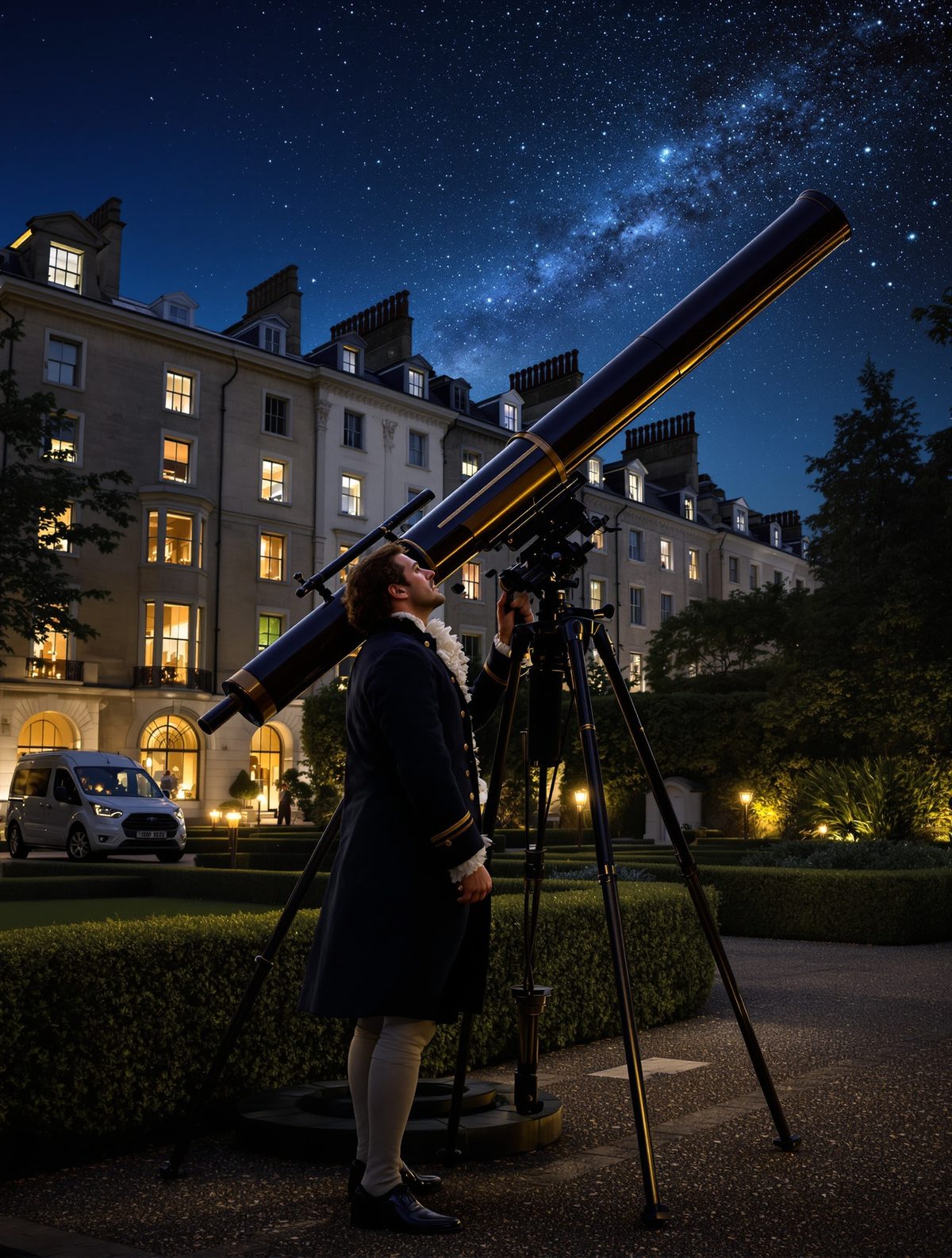
The candles flickered in the drawing rooms of fashionable Bath as the city's elite retired for the evening on March 13th, 1781. But in a modest house on New King Street, a German immigrant musician was just beginning his night's work. William Herschel climbed into his back garden, adjusted his peculiar homemade telescope, and prepared to scan the heavens—completely unaware that within hours, he would make a discovery that would rewrite every astronomy textbook in Europe and double humanity's understanding of our cosmic neighborhood.
The Unlikely Astronomer of Bath
William Herschel was perhaps the most improbable person to revolutionize astronomy. Born Friedrich Wilhelm Herschel in Hanover in 1738, he had arrived in Bath not to study the stars, but to escape them—specifically, the military service that would have dragged him into yet another European war. By day, he was the city's most sought-after music teacher, playing organ at the fashionable Octagon Chapel and conducting the Bath orchestra. His pupils included the daughters of wealthy merchants and minor nobility, all eager to master the harpsichord or learn the latest musical compositions.
But when darkness fell, Herschel transformed from respectable musician into obsessive stargazer. What started as casual curiosity had evolved into consuming passion. Unable to afford the expensive telescopes sold by London opticians—some costing more than a working man's annual wage—Herschel had taught himself to grind mirrors and craft his own instruments. His telescopes were marvels of amateur engineering, some standing nearly twenty feet tall in his garden, requiring elaborate pulley systems to operate.
His neighbors thought him eccentric at best, possibly mad at worst. Here was a man who would spend entire nights outdoors in the bitter cold, meticulously recording observations in a notebook while his sister Caroline called out star positions and brought him warm drinks. What they couldn't have imagined was that this peculiar routine was about to change the course of human knowledge.
Read next: The Day a Black Sailor Walked Into Court and Freed Himself
A Disc Among the Diamonds
On that fateful March evening, Herschel was engaged in what he called "star gauging"—systematically sweeping the sky to catalog every celestial object he could find. Using a telescope with a 6.2-inch mirror that he had painstakingly ground himself, he was examining stars in the constellation Gemini when something stopped him cold.
There, among the familiar points of starlight, hung something different. Unlike the sharp pinpricks of distant suns, this object appeared as a small, greenish disc. Even stranger, when he switched to higher magnification, it grew larger—something no star should do. His first thought was that he had discovered a comet, those mysterious visitors from the outer reaches of the solar system that occasionally graced the skies and made their discoverers famous.
Herschel immediately began tracking the object's movement against the background stars, a process that required night after night of careful observation. What he found puzzled him further. The object moved, yes, but far too slowly for a typical comet. And where was its tail? Comets approaching the sun should display the characteristic streaming tail of vaporized ice and dust. This object remained stubbornly disc-like, betraying nothing of comet behavior.
The Reluctant Revolutionary
Four nights later, Herschel made a decision that would catapult him from provincial music teacher to international celebrity. On March 17th, he penned a letter to the Royal Society in London, carefully describing his discovery of what he diplomatically termed "a curious either nebulous star or perhaps a comet." His cautious language betrayed both excitement and anxiety—he knew that bold claims required extraordinary evidence.
The Royal Society's response was swift and dramatic. Within weeks, astronomers across Europe were training their telescopes on Herschel's mysterious object. The French astronomer Pierre-Simon Laplace calculated its orbit with growing amazement. The object was traveling in an almost perfectly circular path around the sun—but at a distance nearly twice that of Saturn, the most distant planet known since ancient times.
The stunning conclusion was inescapable: Herschel had not found a comet. He had discovered an entirely new planet, the first addition to our solar system since humans began recording the wandering stars over 4,000 years ago. The implications were staggering. At a stroke, the known universe had doubled in size. The solar system, long thought to end at Saturn's orbit, suddenly extended far deeper into the cosmic dark.
Georgium Sidus: A Planet for a King
Ever the pragmatist, Herschel recognized opportunity when it knocked. He named his new world "Georgium Sidus"—George's Star—in honor of King George III. The flattery worked spectacularly. The king, delighted to have a celestial body bearing his name, appointed Herschel as the royal astronomer with an annual pension of £200—enough to abandon music teaching forever and devote himself entirely to astronomy.
The international astronomical community, however, proved less amenable to royal British nomenclature. German astronomer Johann Bode suggested "Uranus," after the Greek god of the heavens and father of Saturn, maintaining the mythological naming tradition. The name stuck, though it would take decades for British astronomers to grudgingly accept it. Some maps and textbooks continued listing "Georgium Sidus" well into the 19th century.
Read next: The Day a London Clerk Walked Into Court for a Dying Slave
The discovery transformed Herschel overnight from obscure provincial musician to the most famous astronomer in Europe. Scientific societies across the continent elected him to membership. Wealthy patrons funded increasingly ambitious telescopes—including a massive 40-foot instrument that became one of the wonders of the age. Caroline Herschel, his devoted sister and observing partner, became the first woman to discover a comet and receive payment for scientific work.
The Universe Expanded
But Uranus offered more than just fame and royal pensions. The planet itself proved deeply strange, even by the eccentric standards of our solar system. It rolls along its orbit like a ball rather than spinning like a top—its axis tilted a bizarre 98 degrees from vertical. Its day lasts about 17 hours, while its year spans 84 Earth years. The planet Herschel glimpsed as a tiny greenish disc is actually a giant ice world four times wider than Earth, shrouded in an atmosphere of hydrogen, helium, and methane.
Most remarkably, when the Voyager 2 spacecraft flew past Uranus in 1986—over two centuries after Herschel's discovery—it revealed a planet surrounded by faint rings and accompanied by dozens of moons. Herschel himself had discovered the two largest moons, Titania and Oberon, in 1787 using his improved telescopes. But the planet held secrets that would take space-age technology to unveil.
A Legacy Written in Light
Today, as we search for exoplanets around distant stars and plan missions to the outer solar system, William Herschel's achievement resonates with fresh significance. His discovery proved that our cosmic neighborhood held surprises, that careful observation could reveal wonders beyond ancient imagination. The shy musician who spent cold nights in a Bath garden had taught humanity its first modern lesson about the universe: we are smaller, and space is stranger, than we ever dared suppose.
Every time we marvel at images from the James Webb Space Telescope or celebrate the discovery of another Earth-like world orbiting a distant star, we follow in the footsteps of that March evening in 1781. One amateur astronomer with a homemade telescope and boundless curiosity had doubled the size of human knowledge in a single night—proving that the greatest discoveries often come not from grand institutions, but from individuals brave enough to look closely at what everyone else takes for granted.