The putrid stench of death hung heavy in the narrow streets of Norwich as another plague cart rumbled past the modest anchorage attached to St Julian's Church. Inside her tiny cell, a thirty-year-old woman lay dying, her body wracked with fever and her breathing shallow. The priest had already administered the last rites. Her family gathered around her bed, preparing for the inevitable. But what happened next would defy all medical explanation and create one of medieval England's most extraordinary literary legacies.
On May 8th, 1373, as death seemed to claim her, Julian of Norwich suddenly sat upright. Her eyes, moments before glazed with the approach of death, now blazed with an otherworldly intensity. For the next five hours, she would experience sixteen mystical visions of Christ that would not only save her life but inspire her to write the first book ever authored by a woman in the English language.
The Plague That Wouldn't Kill
Medieval Norwich was no stranger to death. As England's second-largest city with over 25,000 inhabitants, it had endured wave after wave of the Black Death since 1348. The plague of 1373 was particularly vicious, cutting down entire families within days. Medical knowledge was primitive—physicians still believed illness was caused by "bad air" and treated patients with leeches, prayers, and herb poultices that did more harm than good.
Julian—whose real name remains unknown to us, as she took her name from the church where she lived—had specifically prayed for three gifts from God: to experience Christ's passion as if she had been present at the crucifixion, to suffer a near-fatal illness at age thirty, and to receive three spiritual wounds. The medieval mind saw suffering as a pathway to divine understanding, and Julian's prayers were about to be answered in the most dramatic way possible.
Read next: The Day a Queen Walked Into a Rebel Camp Alone
As her illness reached its crisis point, something remarkable occurred. Witnesses later described how the crucifix held above her bed seemed to come alive, blood appearing to flow from Christ's wounds. Julian herself reported seeing the crown of thorns dripping with fresh blood, and suddenly, impossibly, her fever broke. Within hours, the woman who had been moments from death was sitting up, fully conscious, and frantically trying to record the extraordinary visions flooding her mind.
Visions in a Dying City
What Julian experienced during those five pivotal hours on May 8th, 1373, defied the religious orthodoxy of her time. While the medieval Church preached a God of wrath and judgment—a deity who demanded suffering and penance—Julian's visions revealed something startlingly different. She saw Christ not as a stern judge but as a loving mother figure, speaking of divine love that was unconditional and all-encompassing.
Perhaps most shocking of all, Julian claimed to have received direct answers to theology's most troubling questions. When she asked about sin and damnation—core tenets of medieval Christianity—Christ reportedly told her: "All shall be well, and all shall be well, and all manner of thing shall be well." These words would become among the most famous in English mystical literature, but in 1373, they bordered on heretical.
Julian's visions included remarkable details that she would spend decades trying to understand. She saw the entire universe as something no bigger than a hazelnut in God's palm. She witnessed the Trinity not as three separate persons but as a divine family where Christ took on maternal qualities. Most controversially, she received what she called "showings" that suggested universal salvation—the idea that all souls, regardless of their earthly sins, would ultimately be saved.
In an age when women were forbidden from preaching or interpreting scripture, Julian was experiencing direct revelation from the divine. And she wasn't content to keep it to herself.
The Recluse Who Became a Revolutionary
After her miraculous recovery, Julian made a decision that would define the rest of her life. She became an anchoress—a type of female hermit who was literally walled into a cell attached to a church, with only a small window for receiving food and speaking with visitors. The ceremony of enclosure was essentially a funeral; anchoresses were considered dead to the world.
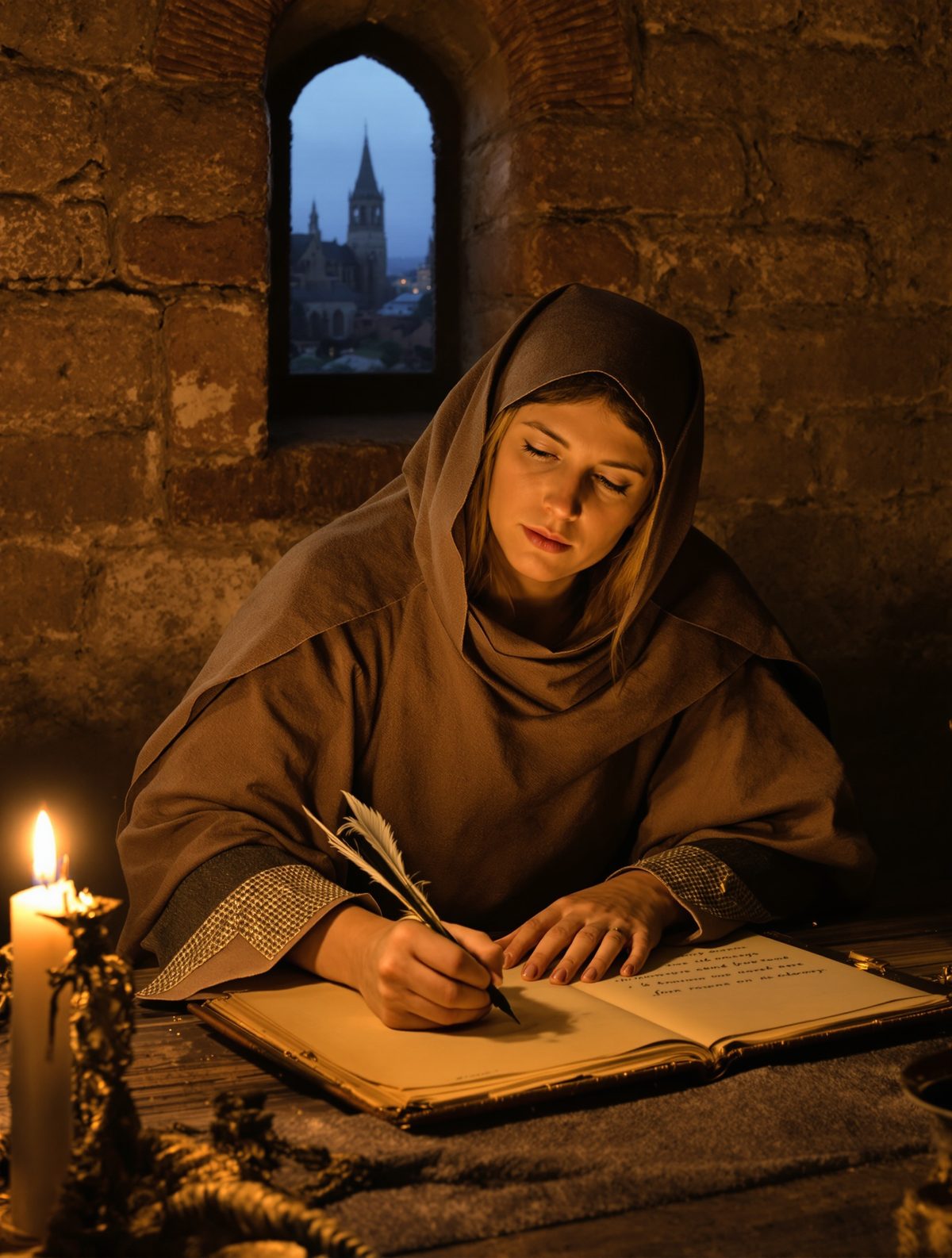
Julian's anchorage at St Julian's Church measured roughly twelve feet by eight feet, with three windows: one looking into the church for worship, one facing outward for conversation with visitors seeking spiritual guidance, and one through which her servant could provide food and necessities. From this tiny space, she would spend the next forty-odd years of her life contemplating her visions and slowly, painstakingly, crafting them into written form.
The physical act of writing was itself extraordinary. In the 14th century, literacy rates hovered around 5% for men and were virtually nonexistent for women. Julian was likely self-taught, learning to read Latin from religious texts and developing her skills in written English—a language that was still considered inferior to Latin and French for serious theological work. She wrote on expensive parchment with quill pens she probably made herself, mixing her own ink from oak gall, iron, and water.
What makes Julian's achievement even more remarkable is that she produced not one but two versions of her work. The first, completed shortly after her visions, was a relatively brief account. But over the following thirty years, she expanded and refined her experiences into the longer Revelations of Divine Love—a sophisticated theological work that demonstrated her deep understanding of scripture, philosophy, and mystical tradition.
A Literary Revolution in a Cell
Julian's Revelations of Divine Love shattered multiple barriers simultaneously. Not only was it the first book written by a woman in English, but it was also one of the first works of theology written in the vernacular rather than Latin. This was literary revolution disguised as religious devotion.
The book's structure reveals Julian's sophisticated understanding of both theology and narrative technique. She doesn't simply recount her visions chronologically but weaves them together thematically, creating a complex meditation on the nature of divine love, human suffering, and ultimate salvation. Her prose style—rhythmic, repetitive, and intensely personal—was unlike anything that had come before in English literature.
Julian's theological innovations were equally groundbreaking. She was the first Christian writer to extensively explore the maternal aspects of Christ, writing: "Jesus Christ, who doeth good against evil, is our very Mother. We have our being of him, where the ground of motherhood beginneth." This feminine imagery of the divine was not entirely unprecedented, but Julian developed it more fully than any previous theologian.
Her approach to the problem of evil was similarly innovative. Rather than accepting the Church's teaching that suffering was punishment for sin, Julian proposed that pain was educational—a way for souls to grow in understanding and compassion. She even suggested that sin itself might serve a divine purpose, famously writing that sin was "behovely" (necessary or fitting) because it leads to greater self-knowledge and humility.
The Dangerous Truths
What Julian was writing could have gotten her burned at the stake. In 1373, the Church was beginning its crackdown on mystical movements, particularly those led by women. The Inquisition was active across Europe, and England would soon see its own religious persecution under laws against heresy.
Julian navigated these dangerous waters with remarkable skill. Throughout her writings, she consistently deferred to Church authority, stating that if anything she had experienced contradicted official doctrine, she submitted to the Church's judgment. This wasn't mere diplomatic cover—Julian genuinely saw herself as a faithful Catholic. But it also protected her from charges of heresy.
She was equally careful about claiming authority as a woman. While she insisted that her visions were genuine divine revelations, she presented herself as a humble "unlettered creature" who was simply passing along what she had received. This self-deprecation was both genuine humility and shrewd survival strategy in a world where women who claimed religious authority often faced brutal consequences.
Despite these precautions, Julian's ideas remained radical. Her suggestion of universal salvation contradicted core Church teachings about hell and damnation. Her maternal imagery of Christ challenged traditional masculine conceptions of the divine. Her insistence that sin might serve a positive purpose undermined the Church's emphasis on guilt and penance. She was, in effect, proposing an entirely different version of Christianity—one based on unconditional love rather than conditional salvation.
Legacy of a Hidden Revolutionary
Julian lived until at least 1416, possibly longer, continuing to receive visitors seeking spiritual counsel throughout her decades of enclosure. Her book, however, nearly disappeared entirely. Only a handful of manuscripts survived the medieval period, and Revelations of Divine Love remained largely unknown until the 20th century brought renewed interest in women's religious experiences.
Today, Julian of Norwich is recognized not only as a pioneering author but as one of the most profound theologians of the medieval period. Her famous assurance that "all shall be well" has comforted countless readers across the centuries. T.S. Eliot quoted her in his Four Quartets, and her cell in Norwich has become a pilgrimage site for visitors from around the world.
But perhaps Julian's most enduring legacy lies in what she represents: the power of individuals to challenge established authority through the simple act of writing down their truth. In an age when women were silenced, she found her voice. In a time when English was considered unsuitable for serious theological work, she proved its capabilities. In a society that saw suffering as divine punishment, she proposed it might be divine education.
From her tiny cell in plague-ravaged Norwich, a dying woman who should have been forgotten by history instead became its first English female author. Her survival of the plague was miraculous, but her transformation of that experience into enduring literature was perhaps the greater miracle—one that continues to inspire writers, theologians, and seekers more than six centuries later.