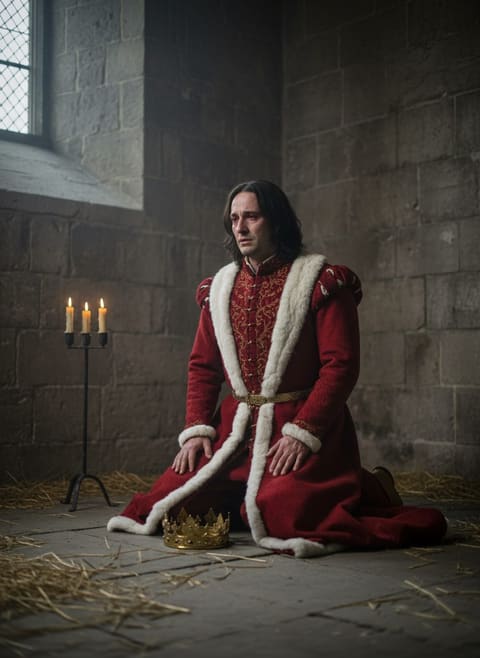
The king's hands trembled as he reached for the second shirt. Not from fear—Charles Stuart would never admit to that—but from the bitter January cold that had settled into his bones during weeks of imprisonment. Outside the windows of St. James's Palace, London shivered under a blanket of frost, and soon thousands would gather to watch their anointed sovereign die. But if Charles I was determined about anything on this, the last morning of his life, it was that his subjects would not mistake the winter chill for cowardice.
"If I shake from the cold," he told his attendants with characteristic royal precision, "they will think I am afraid to die." And so, with the same meticulous attention he had once given to matters of state, the doomed king dressed himself in two linen shirts, ensuring that whatever happened on the scaffold, his final performance would be flawless.
The King Who Would Not Bend
By January 30th, 1649, Charles I had already defied every expectation of how a defeated monarch should behave. For three years, he had been Parliament's prisoner, yet he carried himself as if he still commanded divine authority. During his trial, he had refused to recognize the court's legitimacy, declaring that no earthly power could judge a king appointed by God himself. When asked to enter a plea, Charles remained silent, his chin raised in aristocratic disdain.
This was not mere stubbornness—it was political theater of the highest order. Charles understood that his execution would be watched across Europe, where other monarchs nervously wondered if revolution might be contagious. Every gesture, every word, every visible reaction would be dissected for signs of weakness or strength. The king who had lost his kingdom was determined not to lose his dignity.
Read next: The Day a King Wept and Gave His Crown to His People
The night before his execution, Charles had slept peacefully—a detail that astonished his guards. He rose at his usual hour, asked for his favorite spaniel to keep him company, and requested that his hair be trimmed shorter than usual. The reasoning was practical and chilling: he wanted nothing that might interfere with the executioner's axe.
A Wardrobe for Eternity
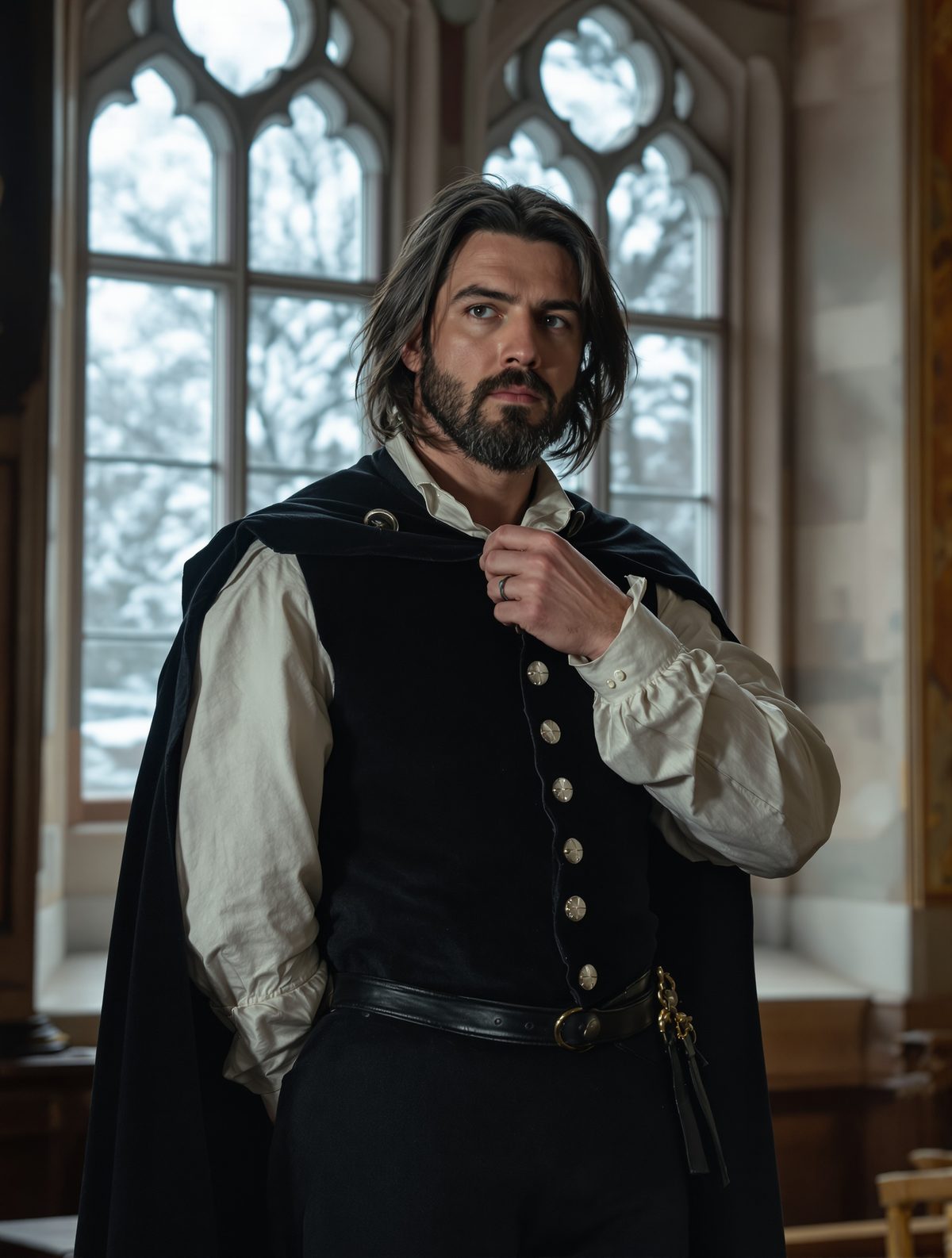
Charles's choice of clothing for his final day revealed a mind still thinking like a king. Beneath his second shirt, he wore warm silk stockings and his finest undergarments. Over the shirts, he donned a white satin waistcoat, chosen for its symbolic purity, and a black cloak—the color of mourning that would soon engulf his supporters across England.
But it was a simple silver pendant that provided the most poignant touch: the medallion of St. George that he had worn since childhood. Even facing death, Charles clung to the symbols of the divine kingship he believed Parliament could never truly destroy. Around his neck, he also wore the blue ribbon of the Order of the Garter, England's most prestigious honor, which no earthly tribunal could strip from him.
The king's valet, Thomas Herbert, later recalled the eerie calm with which Charles prepared himself that morning. There was no frantic praying, no desperate appeals for mercy. Instead, Charles moved through his morning routine with the same methodical precision he had applied to court ceremonies for over two decades. He was, Herbert observed, more concerned with the proper arrangement of his cloak than with the prayers offered for his soul.
The Walk to Whitehall
At ten o'clock, Charles began his final journey. From St. James's Palace, he walked through the frost-covered park toward Whitehall, flanked by soldiers but moving with the measured pace of a monarch processing to his coronation rather than his execution. Witnesses noted that despite the bitter cold, he appeared perfectly composed, his extra shirt successfully concealing any tremor that might betray his mortal fears.
The route took him past Whitehall Palace, where he had once held court in magnificent splendor. Now, workers were putting finishing touches on the scaffold that had been erected outside the Banqueting House—a building Charles himself had commissioned, decorated with ceiling paintings that celebrated the divine right of kings. The irony was not lost on observers: the monarch who had surrounded himself with artistic tributes to royal power would die in their shadow.
As Charles walked, crowds gathered despite the authorities' attempts to limit the spectacle. Many wept openly—not all of England had embraced Parliament's radical experiment. Others watched in stunned silence, struggling to comprehend that they were witnessing the impossible: the judicial murder of God's anointed representative on earth.
The Final Performance
On the scaffold, Charles's careful preparation paid dividends. Before a crowd estimated at thousands, he delivered a final speech with the confidence of a man addressing his court rather than his executioners. His voice carried clearly in the cold air as he maintained his innocence and forgave his enemies, though he pointedly refused to admit that Parliament had any right to judge him.
The two shirts proved their worth as Charles knelt at the execution block without any visible trembling. Witnesses later testified that his hands remained steady as he arranged his hair and adjusted his position. Even the executioner, hidden behind a mask, reportedly trembled more than his royal victim.
When Charles placed his neck on the block and stretched out his hands as the agreed signal, the axe fell cleanly. A groan rose from the crowd—whether from horror, relief, or grief, none could say. But Charles Stuart had achieved his final goal: he had died like a king, with no sign of fear visible to those who watched.
Read next: The Scots Girl Who Became Britain's Most Loved Queen
The Legend Lives On
In the immediate aftermath of his execution, something remarkable happened. The crowd surged forward, not to celebrate, but to dip handkerchiefs and scarves in the royal blood. Within hours, stories spread of miraculous healings attributed to these grisly relics. Charles the king had died, but Charles the martyr was being born.
The detail of the two shirts became part of the legend almost immediately. Royalist pamphlets seized upon it as proof of Charles's courage and dignity in his final moments. Here was a king so concerned with his subjects' perception that he endured extra discomfort to avoid any appearance of weakness. The story spread across Europe, where other monarchs took note: even in defeat, Charles had managed to transform his execution into a testament to royal majesty.
But perhaps the most telling detail emerged years later. When Charles's son reclaimed the throne as Charles II in 1660, one of his first acts was to commission a detailed investigation into his father's final hours. The testimony of Thomas Herbert and other witnesses was carefully recorded, ensuring that history would remember not just that Charles I died, but how he died—with the calculated dignity of a man who understood that his final performance would outlive his body.
A King's Last Victory
Today, the image of Charles I donning two shirts on a bitter January morning resonates far beyond the dusty corridors of royal history. In an age of social media and constant public scrutiny, there's something both admirable and unsettling about a man so concerned with public perception that he would suffer extra discomfort to maintain his image, even facing death.
Charles's obsession with appearances ultimately contributed to his downfall—his unwillingness to compromise or show vulnerability alienated potential allies and hardened his enemies' resolve. Yet in his final moments, that same stubborn pride transformed potential humiliation into something approaching triumph. The king who had failed to read the political winds of his time proved masterful at stage-managing his own demise.
Perhaps that's why the story of the two shirts endures. It captures something essentially human about the need to control our narrative, to ensure that others see us as we wish to be seen rather than as we fear we might appear. Charles I lost his kingdom, his freedom, and ultimately his life. But on a frozen morning in 1649, he ensured that history would remember him not as a defeated tyrant trembling on the scaffold, but as a king who faced eternity on his own terms—warm, dignified, and utterly unrepentant.