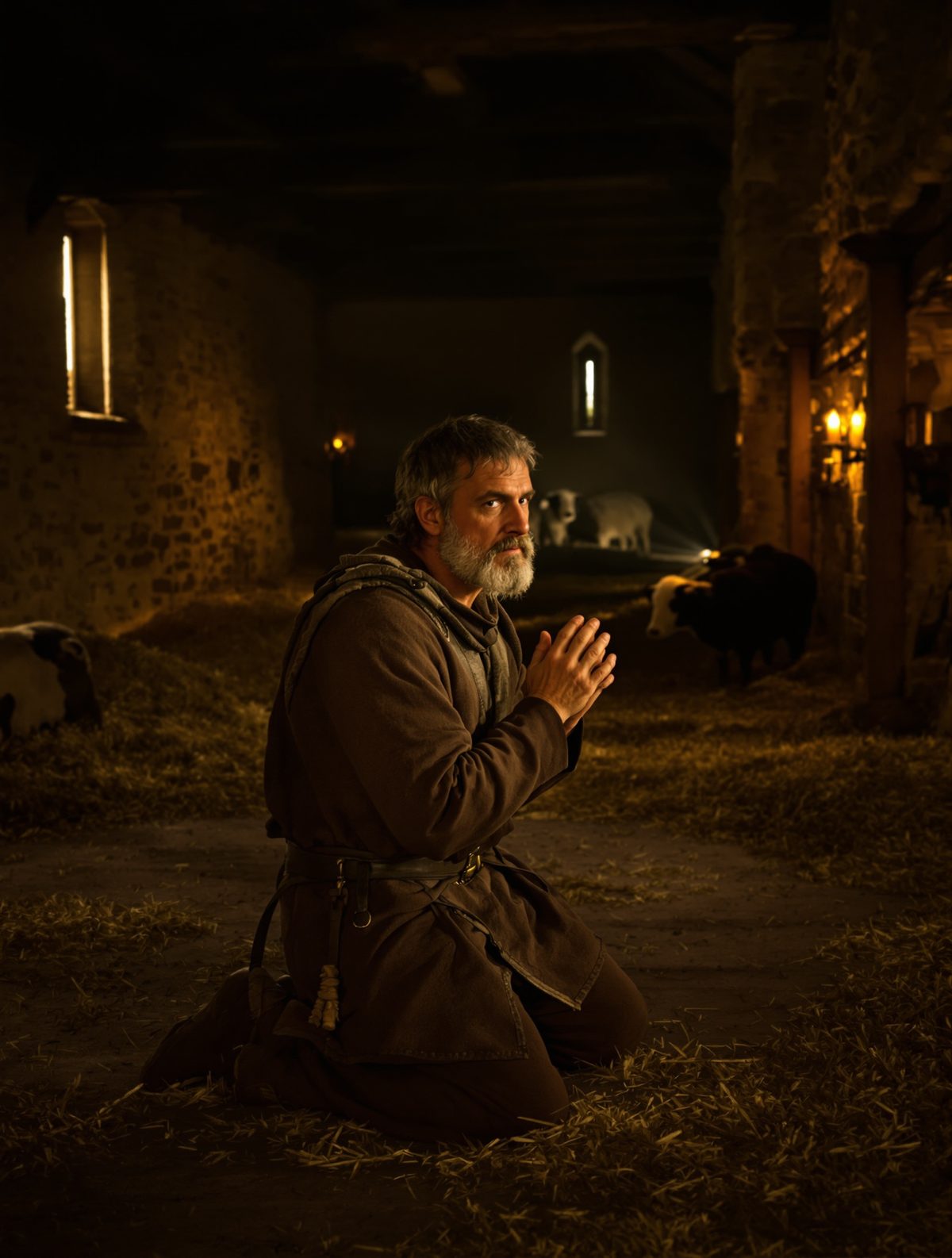
Picture this: A grown man slipping away from the feast hall as laughter echoes behind him, his face burning with shame. The harp is making its rounds again, and when it reaches his place at the table, he knows he'll have nothing to offer but stammered excuses and awkward silence. So Caedmon does what he always does—he flees to the stables where only the cattle can witness his humiliation.
It's 680 AD at Whitby Abbey in Northumbria, and this illiterate cowherd has just experienced the most mortifying moment of his week. Again. But tonight will be different. Tonight, as Caedmon settles into the straw beside his beloved animals, he has no idea he's about to receive a gift that will echo through English literature for over a thousand years.
The Harp of Shame
Anglo-Saxon England was a world where music mattered more than we might imagine. In the smoky halls of monasteries and royal courts alike, the evening feast wasn't complete without the ritual passing of the harp. Each person was expected to contribute—a song, a poem, a tale of heroic deeds or spiritual devotion. It was entertainment, yes, but also something deeper: a way of binding the community together through shared stories and melodies.
For most people, this was a moment to shine. Even the humblest servant could earn respect with a well-sung verse or a cleverly crafted riddle. But for Caedmon, it was torture. Week after week, month after month, year after year, he watched that harp approach his place at the table with growing dread. When his turn came, he would mumble some excuse about needing to tend the animals and slip away into the night.
Read next: The Viking Women Who Ruled Britain's Northern Shores
The other monastery workers probably whispered about him. Here was a man well into middle age—unusual for the time when life expectancy hovered around forty—who couldn't manage even the simplest tune. In a culture that valued oral tradition above almost everything else, Caedmon was essentially mute when it counted most.
But there's something beautiful about how he spent those exile moments. Rather than sulking in some corner, he sought comfort among the cattle he tended. These animals knew nothing of his musical failings. To them, he was simply Caedmon—gentle, reliable, caring. Perhaps it was this humility, this genuine love for God's creatures, that marked him as worthy of what was about to happen.
The Voice in the Darkness
On this particular night in 680 AD, as Caedmon settled into his usual spot in the stables, exhaustion overtook his embarrassment. The warmth of the animals, the soft rustling of straw, the familiar smell of hay—all of it lulled him toward sleep. But just as consciousness began to fade, something extraordinary happened.
A figure appeared before him. The historical accounts, preserved by the Venerable Bede just decades later, describe this as an angel, though Caedmon himself might have simply seen a man of unusual radiance. The being spoke with authority that brooked no argument: "Caedmon, sing me something."
Imagine the irony. Here was the very request that had driven him from the feast hall, now echoing in his place of refuge. Caedmon's response was probably automatic by this point: "I don't know how to sing. That's why I left the feast and came here."
But the figure persisted, and there's something profound about what happened next. The angel didn't ask for a drinking song or a tale of warriors. Instead, he made a request that spoke directly to Caedmon's heart: "Sing about the beginning of created things."
What happened next was nothing short of miraculous. Words began to flow from Caedmon's lips—not just any words, but verses in perfect Anglo-Saxon alliterative meter. He sang of creation, of God's glory, of the formation of the world. The poem poured out of him as if he'd been composing it his entire life, yet he knew with absolute certainty that these words were not his own.
Nine Lines That Changed Everything
When Caedmon awoke the next morning, he might have dismissed the entire experience as a vivid dream—except for one remarkable thing. He could remember every single word. More than that, he found he could compose new verses in the same style, as if some divine switch had been flipped in his mind.
The poem he received that night was just nine lines long, but they represent something monumentally significant: the first Christian poem composed in English. Here are those lines, translated from the original Anglo-Saxon:
"Now we must praise the Guardian of the heavenly kingdom,
the Creator's might and his mind's thought,
the glorious Father's work, as he of every wonder,
eternal Lord, established the beginning.
He first shaped for the children of earth
heaven as a roof, the holy Creator;
then middle-earth the Guardian of mankind,
eternal Lord, afterwards adorned,
the earth for men, the almighty Ruler."
What's remarkable isn't just the beauty of the verse, but its technical sophistication. Anglo-Saxon poetry followed strict rules of alliteration and stress, requiring years of training to master. Yet Caedmon, who had never successfully strung together even a simple tune, was now composing with the skill of a master.
The Abbess Who Changed History
When word of Caedmon's transformation reached Abbess Hild, she could have dismissed it as mere gossip or delusion. Instead, this remarkable woman—one of the most powerful religious figures in 7th-century England—decided to investigate personally.
Hild was no ordinary abbess. She had been baptized by Paulinus himself, one of the missionaries sent directly from Rome. She ruled over a double monastery housing both monks and nuns, and her influence extended far beyond Whitby's walls. Five future bishops trained under her guidance, and even kings sought her counsel.
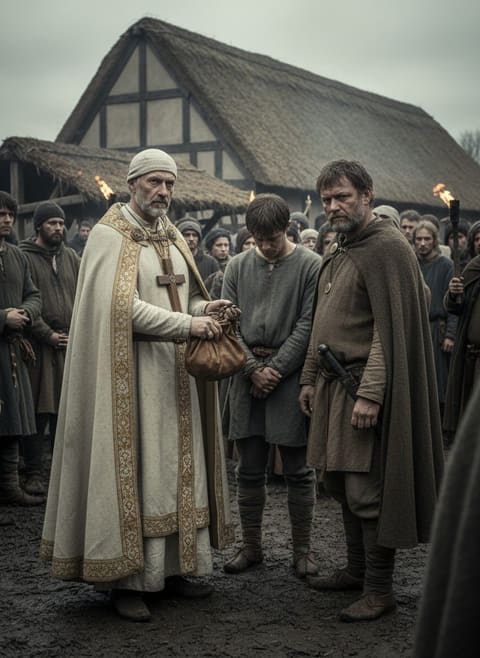
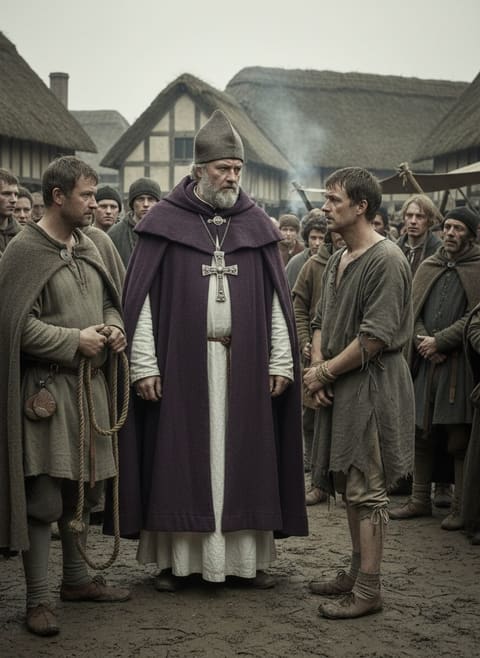
When the trembling cowherd was brought before her, Hild could have been forgiven for skepticism. But something in Caedmon's manner, or perhaps in the verses he recited, convinced her she was witnessing something divine. She ordered her most learned scholars to test him.
The test was ingenious: they read Caedmon passages from Scripture and asked him to turn them into verse. Remember, this was a man who couldn't read or write. He had to absorb complex theological concepts through hearing alone, then transform them into sophisticated poetry. Yet time after time, he succeeded brilliantly.
Recognizing the magnitude of this gift, Hild made a decision that would preserve Caedmon's legacy for posterity: she invited him to take monastic vows and join the community officially. For the rest of his life, he would be fed and housed by the abbey in exchange for continuing to compose religious poetry.
Read next: The Day a Saxon Bishop Stood Alone and Freed a Market Full of Slaves
The Poet Who Couldn't Write
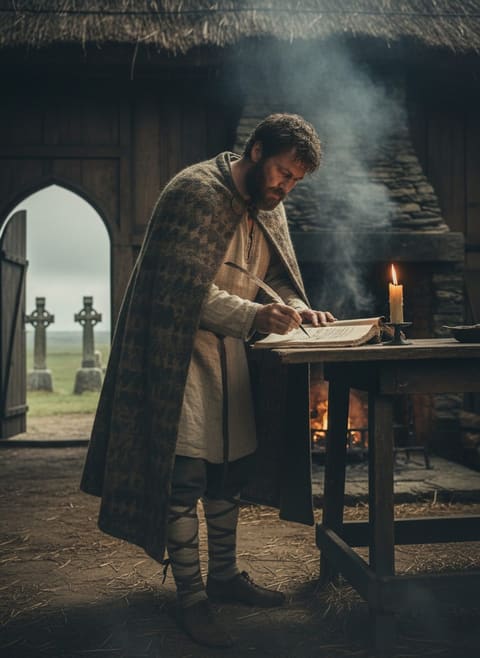
Here's one of the most fascinating aspects of Caedmon's story: he never learned to read or write. Every single poem he composed was created orally and then transcribed by literate monks. In our age of keyboards and word processors, it's almost impossible to imagine creating complex literary works entirely in one's head.
Yet this limitation might have been part of his genius. Anglo-Saxon poetry was fundamentally an oral art form, designed to be heard rather than read. The alliterative patterns, the rhythmic stress, the vivid imagery—all of these elements worked together to create verses that lingered in the memory long after the performance ended.
Caedmon spent the remaining years of his life at Whitby, transforming biblical stories into English verse. He composed poems about the creation of the world, the exodus from Egypt, Christ's incarnation and passion, and the terrors of the Last Judgment. Sadly, only that original nine-line hymn survives today—the rest were lost when Viking raiders destroyed much of Northumbria's literary heritage in the following centuries.
But even this single surviving work had an enormous impact. It was copied into manuscripts across England and the continent, inspiring countless other poets to write Christian verse in their native languages rather than Latin.
The Legacy of the Singing Cowherd
Why does Caedmon matter today? His story offers something our modern world desperately needs to hear: that extraordinary gifts can emerge from the most unlikely places, often when we least expect them.
In our age of social media performances and instant expertise, there's something deeply moving about a man who spent decades believing he had nothing worthwhile to contribute. Caedmon's transformation reminds us that creativity isn't always about training or talent in the conventional sense—sometimes it's about being open to inspiration when it finally arrives.
More broadly, Caedmon represents a pivotal moment in English literature. Before him, serious religious poetry was written in Latin, accessible only to educated elites. After him, the floodgates opened for vernacular religious verse. He proved that profound spiritual truths could be expressed just as powerfully in the everyday language of ordinary people.
Perhaps most importantly, his story challenges our assumptions about ability and worth. The next time you encounter someone who seems to have nothing to offer—the quiet colleague, the struggling student, the person who always fades into the background—remember Caedmon. Sometimes the most beautiful songs come from those who thought they could never sing at all.