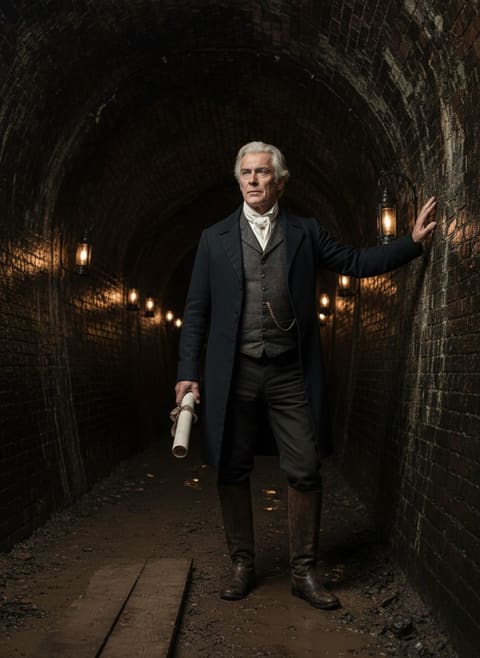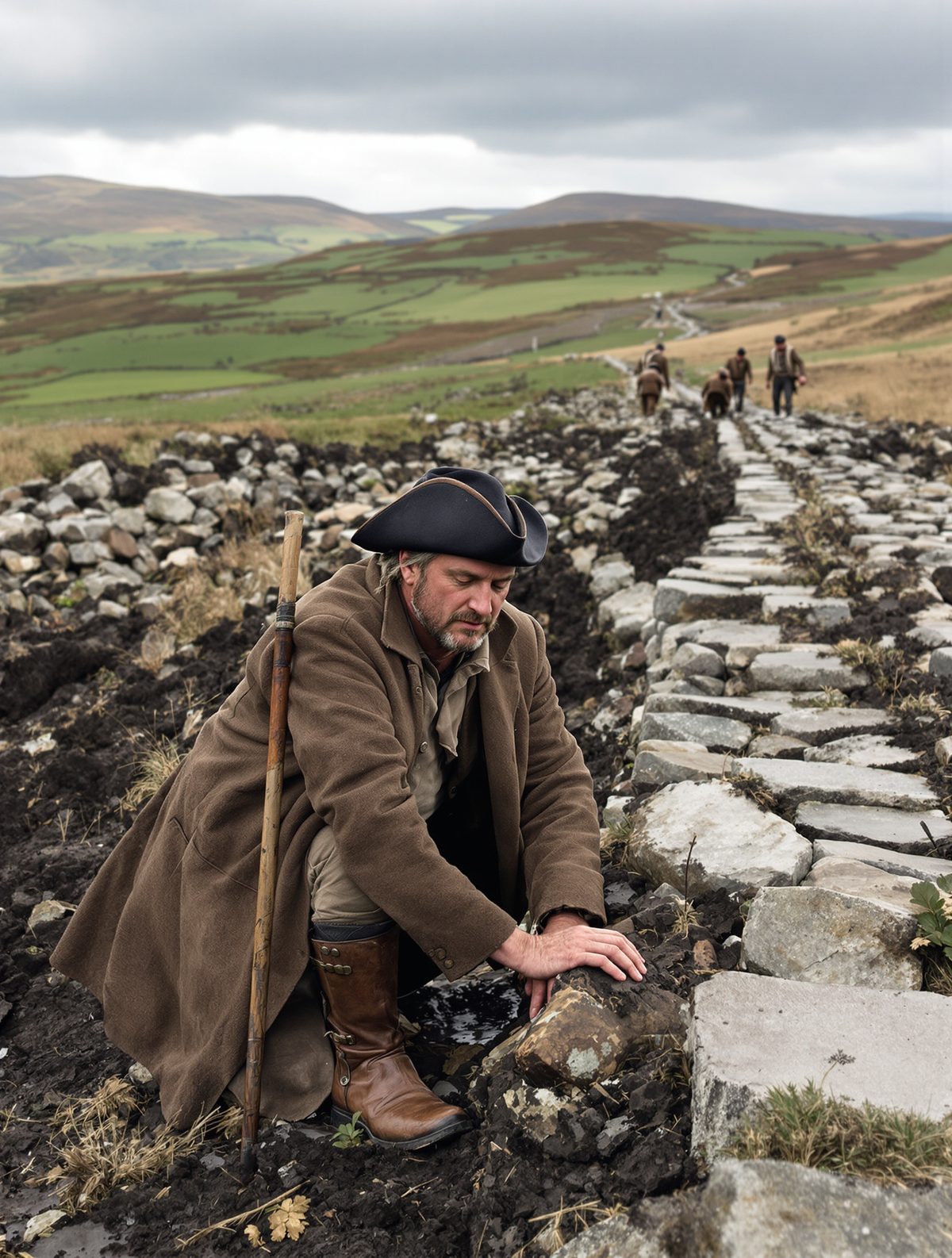
Picture this: a man crawling on his hands and knees across the treacherous Yorkshire moors, feeling every stone, every patch of bog, every rise and fall of the land beneath his fingers. The year is 1765, and John Metcalf is surveying what will become one of the most challenging road construction projects in Georgian England. The catch? He's been completely blind since the age of six.
While his rivals squint through surveying instruments and pore over maps by candlelight, Metcalf works in permanent darkness, yet sees the landscape more clearly than any of them. By the time he hung up his surveying stick, this extraordinary man had built 180 miles of turnpike roads across some of Britain's most impossible terrain—roads so well-constructed that many survive to this day.
This is the story of Blind Jack of Knaresborough, the man who revolutionized road-building in the age of industry, one handful of earth at a time.
The Making of a Legend
John Metcalf was born in Knaresborough in 1717 into a world that had little patience for disability. When smallpox robbed him of his sight at age six, conventional wisdom suggested he'd become a burden on his family—perhaps learning to weave baskets or beg for alms. Instead, young Jack had other plans.
Read next: The Day a Weaver's Son Lit Britain's First Public Railway
By his teens, he was already defying expectations with an almost supernatural ability to navigate the world around him. Local stories tell of him swimming across the River Nidd in flood, hunting with friends using a gun (his companions would aim it while he pulled the trigger), and even becoming the area's most sought-after fiddle player. But perhaps most remarkably, he developed an intimate relationship with the Yorkshire landscape that would later make him legendary.
Metcalf would spend hours walking the moors and dales, building a mental map of extraordinary detail. He could identify different types of soil by touch, predict where water would collect after rain, and sense the subtle gradients that would either make or break a road. What seemed like aimless wandering was actually the education of a future engineering genius.
After brief careers as a soldier (yes, he fought in the Jacobite uprising of 1745), horse dealer, and publican, Metcalf found his true calling when Yorkshire's expanding economy desperately needed better roads to connect its growing industrial towns.
Roads to Nowhere: The Georgian Transport Crisis
To understand Metcalf's achievement, you need to picture Georgian Yorkshire's transport nightmare. The ancient packhorse routes that crisscrossed the moors were utterly inadequate for the coal wagons, wool shipments, and passenger coaches that industrialization demanded. Existing roads turned to quagmires in winter and were barely passable in summer.
Parliament's solution was turnpike trusts—local authorities empowered to build and maintain roads, then charge tolls to recover costs. The problem? Most turnpike trusts were run by gentlemen farmers and local worthies who knew plenty about sheep but nothing about engineering. Their early attempts at road-building across Yorkshire's challenging terrain were often catastrophic failures.
Enter the most unlikely road contractor in British history. In 1765, the 48-year-old Metcalf approached the turnpike trust responsible for building a road between Harrogate and Boroughbridge. When he announced his intention to bid for the contract, the trustees initially thought it was an elaborate joke. A blind man proposing to survey and construct roads across difficult terrain?
But Metcalf had done his homework. He'd already walked every mile of the proposed route multiple times, identifying the best gradients, the most stable ground, and the drainage solutions that would be needed. His detailed knowledge of the terrain—acquired entirely through touch, hearing, and an almost mystical understanding of landscape—convinced the skeptical trustees to give him a chance.
The Revolutionary Methods of a Blind Engineer
Metcalf's surveying technique would have looked bizarre to any professionally trained engineer. Armed with nothing but his walking stick and an uncanny ability to read the land through his other senses, he would crawl across proposed routes on hands and knees, feeling the lie of the land with his bare hands.
Where conventional surveyors relied on instruments, Metcalf used his body as a measuring tool. He could judge gradients by the feel of the slope against his legs, assess soil drainage by its texture and smell, and identify the firmest routes across boggy ground by the sound his stick made when striking different surfaces.
But Metcalf's true genius lay in his construction methods, particularly his revolutionary approach to building roads across marshland. While other engineers either avoided bogs entirely or attempted to drain them (usually unsuccessfully), Metcalf pioneered the technique of "floating" roads across unstable ground.
His method was ingenious in its simplicity. First, he would bundle heather and ling into tight faggots, then lay these in carefully calculated patterns across the bog. On top of this foundation, he'd place layers of gravel and stone, creating a flexible roadway that could move with the marsh without breaking up. These "floating causeways" distributed the weight of traffic across the unstable ground, preventing the road from sinking into the bog.
The technique worked so well that several of Metcalf's roads across marshland remained in use well into the twentieth century—some sections are still visible today, 250 years after construction.
Building an Empire, One Mile at a Time
Word of the blind road-builder's success spread quickly across Yorkshire. Between 1765 and 1792, Metcalf secured contracts for increasingly ambitious projects, often underbidding established contractors who couldn't match his intimate knowledge of local terrain or his innovative construction methods.
His most famous achievement was the road from Huddersfield to Manchester, a route that required crossing some of the most challenging terrain in the Pennines. The section across Standedge—still notorious today as one of England's most exposed moorland crossings—was considered impossible by conventional engineers. Metcalf not only built a road across it but constructed it so well that it remained the primary route between Lancashire and Yorkshire for decades.
The numbers tell the story: 180 miles of turnpike roads built across Yorkshire, Lancashire, and Derbyshire. Roads that connected Halifax to Austerlands, Wakefield to Dewsbury, Leeds to Selby. Each mile represented a triumph of ingenuity over seemingly impossible odds.
Metcalf didn't just build roads—he created economic arteries that pumped life into the Industrial Revolution. His routes carried Yorkshire wool to Lancashire mills, transported coal from Yorkshire pits to growing towns, and enabled the passenger traffic that knitted northern England into a single economic unit.
What made his achievement even more remarkable was that he managed his own workforce of up to 400 men, negotiated contracts with hard-headed turnpike trustees, and maintained quality control across multiple simultaneous projects—all while unable to see a single element of the work in progress.
Read next: The Day a Mill Owner Walked Into Court and Freed His Rivals' Children
The Science of Seeing Without Sight
How did Metcalf achieve what seems impossible? Modern neuroscience offers clues about his extraordinary abilities. When the brain loses input from one sense, it often compensates by heightening others and developing new neural pathways.
Metcalf's heightened sense of touch allowed him to read subtle variations in soil composition, moisture content, and stability that sighted engineers might miss. His acute hearing helped him interpret the sounds of different terrain—the hollow thud of unstable ground, the solid rap of firm earth, the subtle squelch that warned of hidden water.
But perhaps most importantly, his blindness forced him to develop what we might call "landscape literacy"—an ability to construct detailed mental maps based on sensory information that others ignored. While his competitors relied on visual surveys that might miss crucial underground conditions, Metcalf's hands-on approach gave him superior understanding of the actual engineering challenges.
His success also depended on remarkable organizational skills. Unable to supervise work visually, he developed systems for quality control based on touch, sound, and the reports of trusted foremen. He could walk along a completed road section and immediately identify problems—loose stones, inadequate drainage, poor foundation work—that might escape visual inspection.
Legacy of the Impossible
John Metcalf died in 1810 at the age of 93, having lived to see his roads carry the mail coaches and freight wagons that bound industrial Britain together. But his legacy extends far beyond the miles of turnpike he constructed.
Metcalf proved that disability need not mean inability—and he did so in an age when such ideas were radical. His techniques for building roads across difficult terrain influenced engineering practice well into the railway age. Some of his innovations, particularly his methods for constructing stable foundations on unstable ground, anticipate modern geotechnical engineering principles.
Today, as we grapple with questions about accessibility, inclusion, and the untapped potential of marginalized communities, Blind Jack's story carries special resonance. He succeeded not despite his blindness, but in many ways because of it. His different way of seeing the world allowed him to solve problems that had defeated conventional approaches.
Perhaps most importantly, Metcalf's story reminds us that innovation often comes from unexpected quarters—from those willing to crawl across the moors with their bare hands while others peer through instruments, from those who trust their own experience over conventional wisdom, from those who see possibilities where others see only obstacles.
The next time you drive across Yorkshire's moors on roads that seem to find the only possible route across impossible terrain, remember Blind Jack of Knaresborough—crawling through the heather in 1765, building the future one handful of earth at a time.