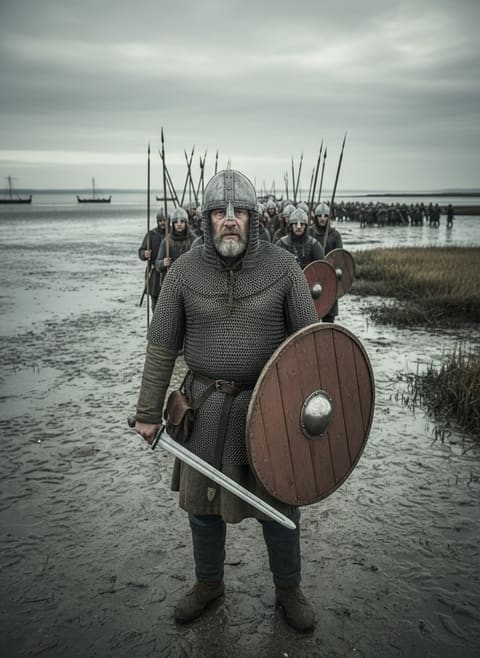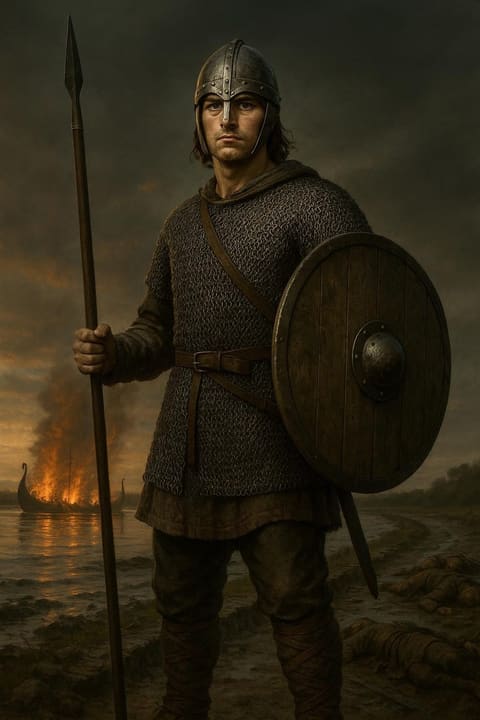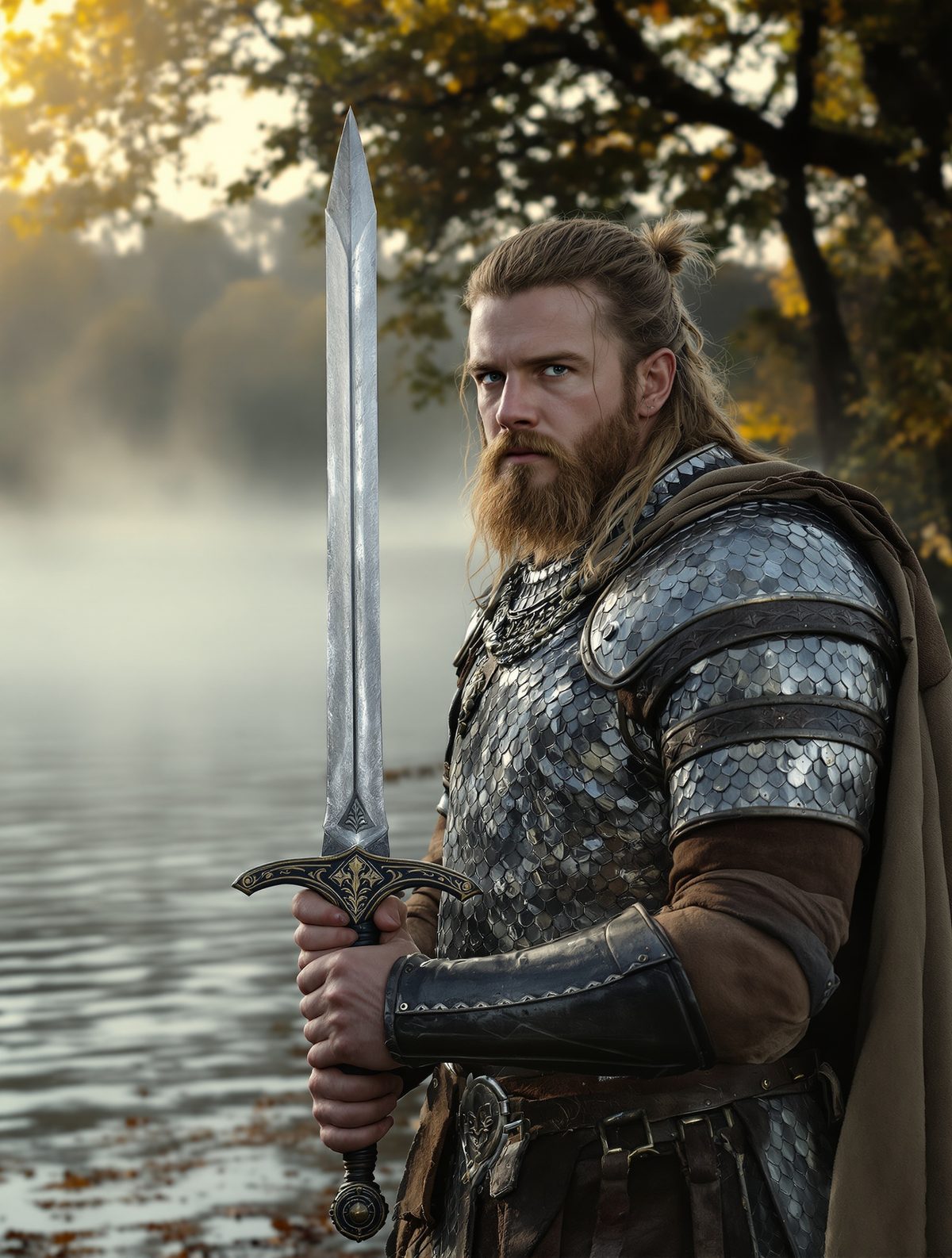
Picture this: two exhausted kings standing knee-deep in the muddy waters of the River Severn, their swords glinting in the autumn sun of 1016. Around them, the carnage of a summer's worth of battles has left England bleeding. Neither Edmund Ironside nor Cnut the Great can claim victory after five brutal encounters that have torn the kingdom apart. So they do something extraordinary—something that sounds more like legend than history. They draw their blades and literally carve up England between them, using their sword points to sketch boundaries in the riverbank mud that will reshape a nation.
This isn't the stuff of fantasy novels. This actually happened. And it might be the most audacious peace treaty in British history.
The Summer of Steel and Blood
The year 1016 had been a nightmare for England. When Æthelred the Unready died in April, leaving his son Edmund to inherit a kingdom under siege, few could have predicted the epic confrontation that would follow. Edmund wasn't just any prince—he was a warrior who'd earned the nickname "Ironside" through sheer bloody-minded courage. At barely twenty-two, he'd already proven himself in battle against the Vikings, showing the kind of fierce determination his father had conspicuously lacked.
But his opponent was equally formidable. Cnut—or Canute as he's sometimes known—was the son of Sweyn Forkbeard, the Viking king who had briefly conquered England before his sudden death in 1014. At just twenty years old, Cnut commanded a professional army of seasoned Danish warriors who had been ravaging English shores for over a decade. These weren't just raiders anymore; they were conquerors with their eyes fixed firmly on the English throne.
Read next: The Day a Saxon Abbess Stood Between a King and His Rage
The summer campaign that followed reads like something from the Iliad. Edmund and Cnut clashed at Penselwood in Somerset, where Edmund's Anglo-Saxon forces managed to hold their ground against the Viking onslaught. They met again at Sherston in Wiltshire, where the battle was so fierce that both sides claimed victory. Each encounter left hundreds dead but no clear winner.
What made this conflict so extraordinary was that both kings led from the front. This wasn't medieval warfare where nobles directed battles from hilltops—Edmund and Cnut were in the thick of it, swinging swords and inspiring their men through personal example. Contemporary chronicles describe Edmund as fighting "like a wild boar," while Cnut was praised for his cool tactical brilliance under pressure.
The Siege That Changed Everything
By October, the decisive moment seemed to have arrived. Cnut had managed to capture London—the prize both men desperately needed. But Edmund wasn't finished. In a move that surprised everyone, including his own advisers, he launched a daring assault to retake the city.
The siege of London in October 1016 was unlike anything the city had experienced. Edmund's forces managed to break through the Viking defenses and reclaim the capital, but at enormous cost. The Anglo-Saxon Chronicle records that "there was great slaughter on both sides." More tellingly, both armies were now utterly exhausted.
Here's a detail that rarely makes it into the textbooks: by this point, both kings were struggling to keep their armies together. Edmund's English forces had been fighting almost continuously for months, losing men not just to battle but to desertion as soldiers drifted away to tend their farms before winter. Cnut's Vikings, meanwhile, were growing restless. They'd come for quick plunder, not a prolonged campaign that was eating into their profits.
The final battle came at Assandun (probably modern-day Ashingdon in Essex) on October 18, 1016. It should have been decisive—and in a way, it was. Cnut achieved a tactical victory, but at such cost that he couldn't press his advantage. Edmund retreated with enough of his army intact to continue the fight, but he too lacked the strength for another major engagement.
The Meeting of Kings
What happened next is so remarkable that some historians have questioned whether it actually occurred. But multiple sources, including the Anglo-Saxon Chronicle and later Scandinavian sagas, confirm the basic facts: Edmund Ironside and Cnut the Great arranged to meet face-to-face on Alney Island in the River Severn, near Deerhurst in Gloucestershire.
Think about how extraordinary this was. Two men who had spent months trying to kill each other agreed to meet alone on a small island, with nothing but their personal honor as guarantee of safe conduct. In an age when treachery was commonplace and royal assassinations routine, this meeting represented an almost unbelievable act of mutual respect.
The island they chose was tiny—barely large enough for a serious conversation. Contemporary accounts suggest it was deliberately selected because it could accommodate only the two kings and a handful of witnesses from each side. No armies, no overwhelming advantage for either party—just two exhausted warriors trying to find a way out of a war that was destroying the very kingdom they both wanted to rule.
What makes this meeting even more fascinating is what it reveals about both men's characters. Edmund could have chosen to fight to the death, rallying his people for a final, glorious last stand. Cnut could have pressed his slight military advantage and risked everything on one more battle. Instead, both chose pragmatism over pride—a decision that probably saved thousands of lives.
Dividing a Kingdom with Steel
The treaty they hammered out on Alney Island was breathtakingly simple and utterly unprecedented. Using their swords as crude drawing instruments, Edmund and Cnut literally carved up England between them. Edmund would keep Wessex—the ancient heartland of Anglo-Saxon power, including London. Cnut would take everything north of the Thames—Mercia, East Anglia, and Northumbria.
But here's the clever bit that most people miss: they didn't just divide territory. They created a succession plan. Whichever king died first, the other would inherit the whole kingdom. It was a winner-takes-all arrangement with a built-in delay mechanism.
The treaty also included practical arrangements that show just how thoroughly these two had thought things through. They agreed on tribute payments, the treatment of each other's supporters, and even trade arrangements between their respective territories. This wasn't a hasty compromise—it was a sophisticated political settlement between two rulers who had developed grudging respect for each other's abilities.
Contemporary sources suggest that both armies received the news with a mixture of relief and bewilderment. Soldiers who had been killing each other weeks earlier were now expected to coexist peacefully. Remarkably, it worked. There are no records of significant violence between the two halves of the kingdom during the brief period when the treaty was in effect.
Read next: The Day a Small Island's Language Conquered the World
The Crown Prince Who Ruled for Weeks
The Treaty of Alney might have created one of history's most intriguing political experiments—a divided England ruled by two warrior-kings who had fought each other to a standstill. We'll never know how it would have worked long-term, because Edmund Ironside died on November 30, 1016, barely six weeks after the treaty was signed.
His death remains one of history's great mysteries. The official cause was given as "natural illness," but rumors immediately began circulating about poison or assassination. Some later chronicles tell lurid tales of Edmund being stabbed while using a primitive toilet, but these stories emerged decades later and are almost certainly fictional. The truth is probably more prosaic: Edmund was likely suffering from wounds sustained during months of brutal campaigning, and his young body simply gave out.
What's remarkable is Cnut's reaction. He could have simply seized Wessex by force—after all, Edmund's death left no clear successor strong enough to resist. Instead, Cnut honored the spirit of their agreement, paying compensation to Edmund's supporters and integrating Anglo-Saxon nobles into his administration. It was a masterclass in political reconciliation that would define his twenty-year reign as one of medieval England's most successful.
Cnut also made sure Edmund received a royal funeral worthy of his courage, burying him alongside previous kings at Glastonbury Abbey. For a Viking conqueror, this showed remarkable respect for his fallen rival—and smart politics. By honoring Edmund, Cnut sent a clear message that he intended to be a king of all England, not just the Danish parts.
The Legacy of Two Swords
The meeting on Alney Island lasted perhaps a few hours, but its implications shaped English history for generations. Cnut's willingness to negotiate rather than simply conquer helped establish him as one of England's most effective medieval rulers. His reign brought two decades of peace and prosperity, trade connections across the North Sea, and a level of political stability that England hadn't enjoyed for years.
But perhaps more importantly, the Treaty of Alney represents something timeless about leadership and conflict resolution. Here were two young men—barely out of their teens—who chose pragmatism over pride, negotiation over destruction. In an age when political disputes were typically settled by wholesale slaughter, they found a third way.
Their example resonates today in a world still plagued by seemingly intractable conflicts. The image of Edmund Ironside and Cnut the Great, standing knee-deep in the Severn with their swords drawn not in anger but as tools of diplomacy, reminds us that even the fiercest enemies can find common ground when the stakes are high enough and the leadership is brave enough to take risks for peace.
Sometimes the most powerful thing two warriors can do with their swords isn't to fight each other, but to use them together to carve out a better future.