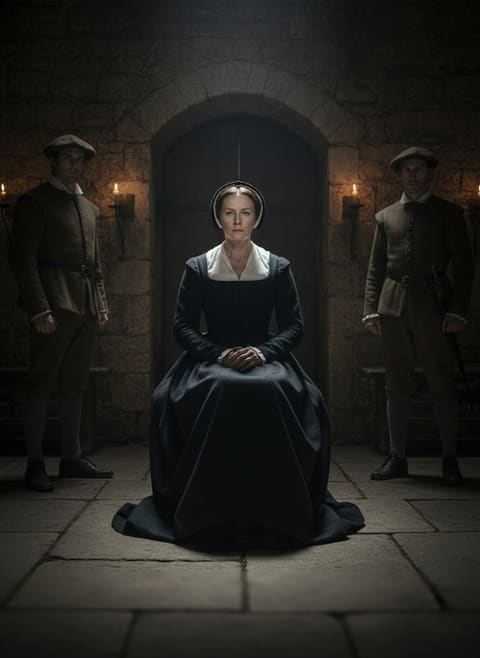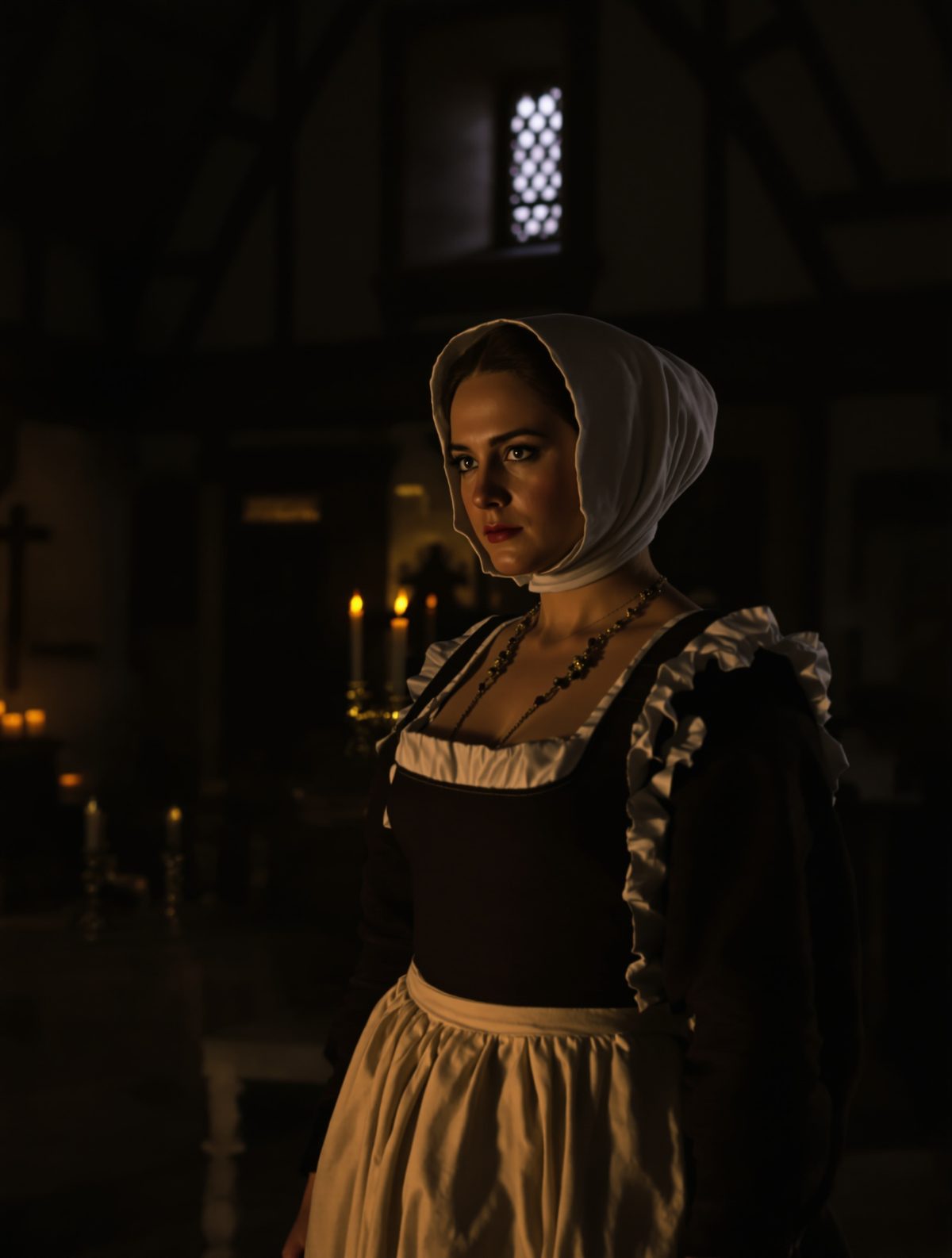
The wooden door was thick enough to muffle screams, but not thick enough to hide the sound of snapping ribs. On March 25th, 1586, in the shadow of York Castle, Margaret Clitherow lay beneath a seven-hundredweight of stones, her body slowly being crushed into the muddy ground. She had been given a simple choice: plead guilty or innocent to the charge of harboring Catholic priests, and face a trial that might spare her life. Instead, this butcher's wife chose silence—and in doing so, chose one of the most excruciating deaths imaginable. What drove a mother of three to such an unthinkable end?
The Pearl of York's Hidden Life
Margaret Middleton had seemed destined for an unremarkable life when she married John Clitherow, a successful butcher in York's Shambles district, around 1571. At eighteen, she was a Protestant bride entering a respectable Protestant household in a city that had largely embraced the religious reforms of the Tudor monarchy. The narrow, overhanging buildings of the Shambles—where butchers' shops lined the medieval street so closely that neighbors could shake hands from their upper windows—provided the perfect cover for what would become one of England's most dangerous households.
But Margaret harbored a secret that would have horrified her Protestant neighbors. Sometime around 1574, she converted to Catholicism—a decision that transformed her from a respectable merchant's wife into what the Tudor state considered a dangerous traitor. In Elizabeth I's England, Catholic priests faced execution simply for being ordained abroad and returning to English soil. Anyone who harbored them committed high treason, punishable by death.
Margaret didn't just convert; she turned her home into a sophisticated safe house. Behind false walls and beneath floorboards, she created a network of hiding places so ingenious that priest hunters could search the building without finding their quarry. The Clitherow house became known among England's underground Catholic network as one of the most reliable sanctuaries in the North—a reputation that would ultimately seal Margaret's fate.
Read next: The Day a Tudor Chancellor Chose Death Over a Royal Lie
The Art of Concealment
What made Margaret's operation so successful was its sheer audacity. While government agents scoured the countryside for Catholic priests, she was hiding them in plain sight in one of York's busiest commercial districts. The Shambles teemed with customers, apprentices, and traders, providing perfect camouflage for the comings and goings of disguised clergymen.
Margaret worked with skilled craftsmen to create priest holes—secret compartments built into the very fabric of Tudor houses. These weren't simple hiding spots behind bookcases; they were architectural marvels of concealment. Some were accessed through rotating hearth backs, others through panels that appeared to be solid walls. The most sophisticated had their own ventilation systems and were soundproofed to prevent discovery during raids.
But Margaret's network extended far beyond hiding places. She arranged for the smuggling of Catholic books and religious artifacts, coordinated secret masses, and helped organize the education of Catholic children—including sending her own son abroad to be educated in the Catholic faith. By the 1580s, she was effectively running a Catholic resistance cell from her butcher's shop, under the nose of Protestant authorities who grew increasingly frustrated by York's persistent Catholic underground.
The Trap Springs Shut
Margaret's downfall began with the testimony of a child. In March 1586, government agents arrested a young boy who had been living in the Clitherow household. Under interrogation—and possibly torture—the eleven-year-old broke down and revealed the locations of the priest holes and described the Catholic activities he had witnessed.
On March 10th, 1586, pursuivants—the Tudor equivalent of religious police—surrounded the Clitherow house. They knew exactly where to look. Within hours, they had discovered the hiding places, along with Catholic vestments, books, and other evidence of "treasonous" religious activity. Though no priests were found during this particular raid, the evidence was overwhelming.
Margaret was arrested and taken to York Castle to await trial. Under Tudor law, she faced charges of harboring Catholic priests and maintaining a household for "superstitious and popish practices." The penalty for such crimes was death, but she might have hoped for mercy—Elizabeth's government sometimes commuted death sentences for women, particularly those with young children.
However, when Margaret appeared before Judge Clinch at York Assizes on March 14th, she made a decision that stunned the court. When asked how she pleaded to the charges, she remained absolutely silent.
The Choice of Martyrs
Margaret's silence wasn't defiance or confusion—it was a calculated decision based on a terrifying understanding of Tudor law. If she pleaded guilty, she would certainly be executed. If she pleaded innocent and stood trial, the prosecution would call witnesses—including her own children and servants—who would be forced to testify against her under oath. This would damn their souls (in Catholic theology) and potentially implicate them in her crimes.
But there was a third option, one so horrific that few chose it: peine forte et dure—pressing to death. Under ancient English law, defendants who refused to plead could not be tried. Instead, they would be subjected to this special form of execution, designed to be so terrible that it would force them to enter a plea and face trial.
The process was deliberately torturous. The condemned would be stripped and laid on their back on the ground. A sharp stone would be placed under their spine, and a wooden door laid over their body. Then weights—usually heavy stones—would be gradually added until the pressure crushed them to death. The process could take hours or even days, depending on how much weight was applied.
Margaret understood all of this when she chose silence. She was trading a possibly quick death by hanging for certain death by crushing—but she was also ensuring that her family and servants would not be forced to perjure themselves or face prosecution as accomplices.
Fifteen Minutes to Eternity
On March 25th, 1586—the Feast of the Annunciation in the Catholic calendar—Margaret was taken to a toll booth on Ouse Bridge for her execution. The location was deliberately public; the Tudor state wanted her death to serve as a warning to other Catholics.
Read next: The Day a Tudor Bishop Refused to Crown a Usurper
The surviving accounts of her pressing are both detailed and harrowing. She was laid upon the ground with the sharp stone beneath her back, her arms stretched out in the shape of a cross and bound to posts. The door was placed over her, and the crushing began.
Witnesses reported that Margaret prayed throughout the ordeal, calling out "Jesu, Jesu, Jesu, have mercy upon me!" The weight was applied gradually—contemporary accounts suggest it took about fifteen minutes for her to die, though it must have felt like an eternity. One witness later wrote that they could hear her bones breaking, but that she continued to pray until the very end.
The executioners used approximately seven hundredweight—roughly 800 pounds—of stones to crush her. She was thirty-three years old, the same age tradition assigns to Christ at his crucifixion—a parallel that Catholics of the time would not have missed.
The Saint of the Shambles
Margaret Clitherow's death created a scandal that reverberated far beyond York. Even some Protestant observers were horrified by the brutality of her execution, particularly given that she left behind young children, including a baby. Her story spread throughout Catholic Europe, where she was immediately regarded as a martyr.
But perhaps most remarkably, her death achieved exactly what she had hoped. Because she never stood trial, her family and household were largely spared persecution. Her husband John, though questioned, was never prosecuted and continued to run his butcher's business. Her children survived and thrived—her daughter Anne even followed her mother's path, becoming a Catholic and eventually a nun in France.
In 1970, Margaret Clitherow was canonized by Pope Paul VI as one of the Forty Martyrs of England and Wales. She became known as "the Pearl of York," and today a small shrine marks the spot where her house once stood in the Shambles. Visitors can still walk the narrow medieval street where she lived her double life, hiding priests and defying an empire.
Margaret's story illuminates a side of Tudor England often overlooked in histories focused on Henry VIII's marriages or Elizabeth's naval victories. For ordinary people caught between competing religious loyalties, the stakes were literally life and death. Her choice—to endure unimaginable suffering rather than compromise her principles or endanger her loved ones—speaks to a kind of moral courage that transcends religious boundaries. In an age when we debate the limits of conscience and the price of conviction, the butcher's wife who chose crushing stones over compromise offers a stark reminder that some people really will die for what they believe in.