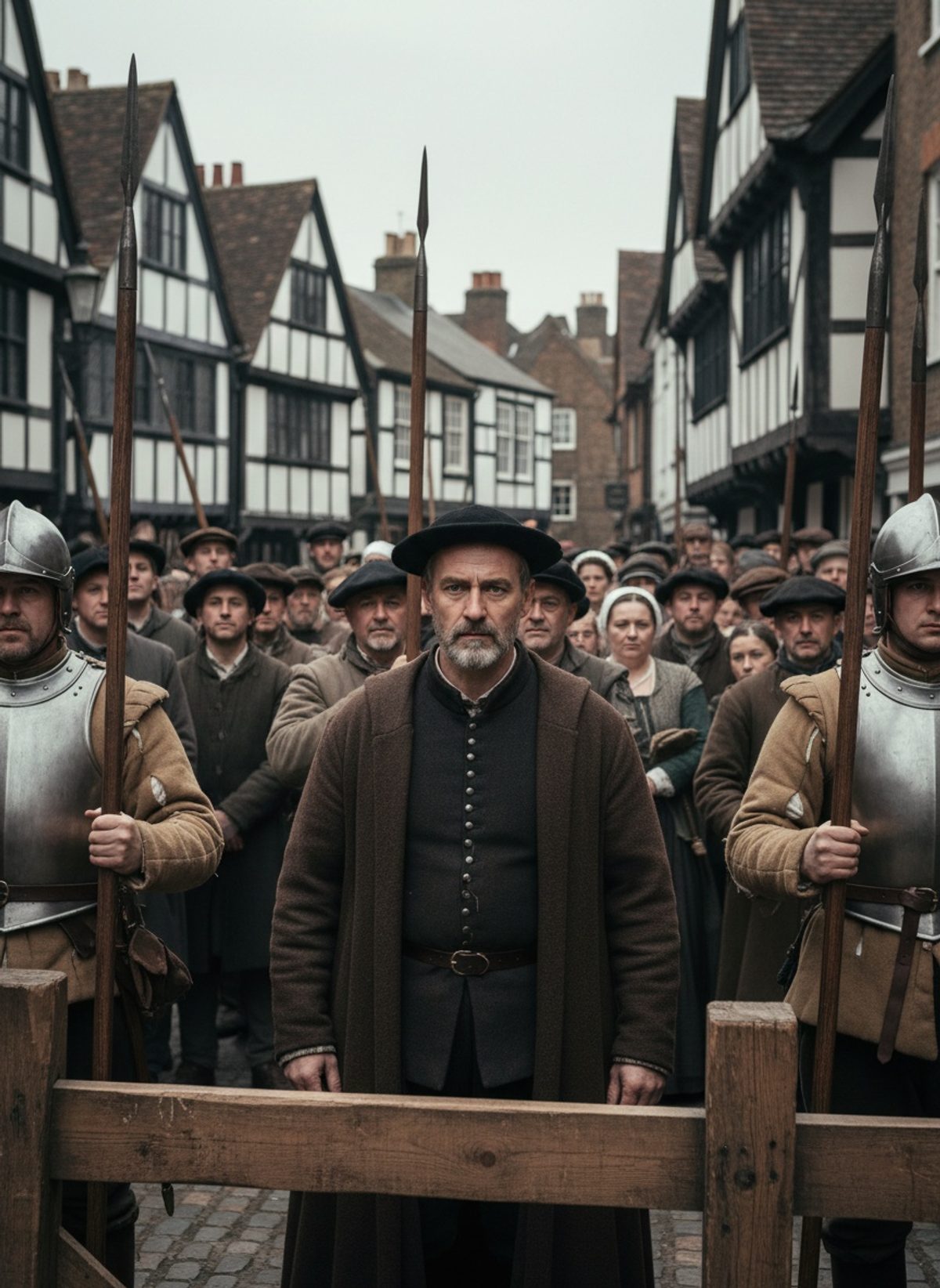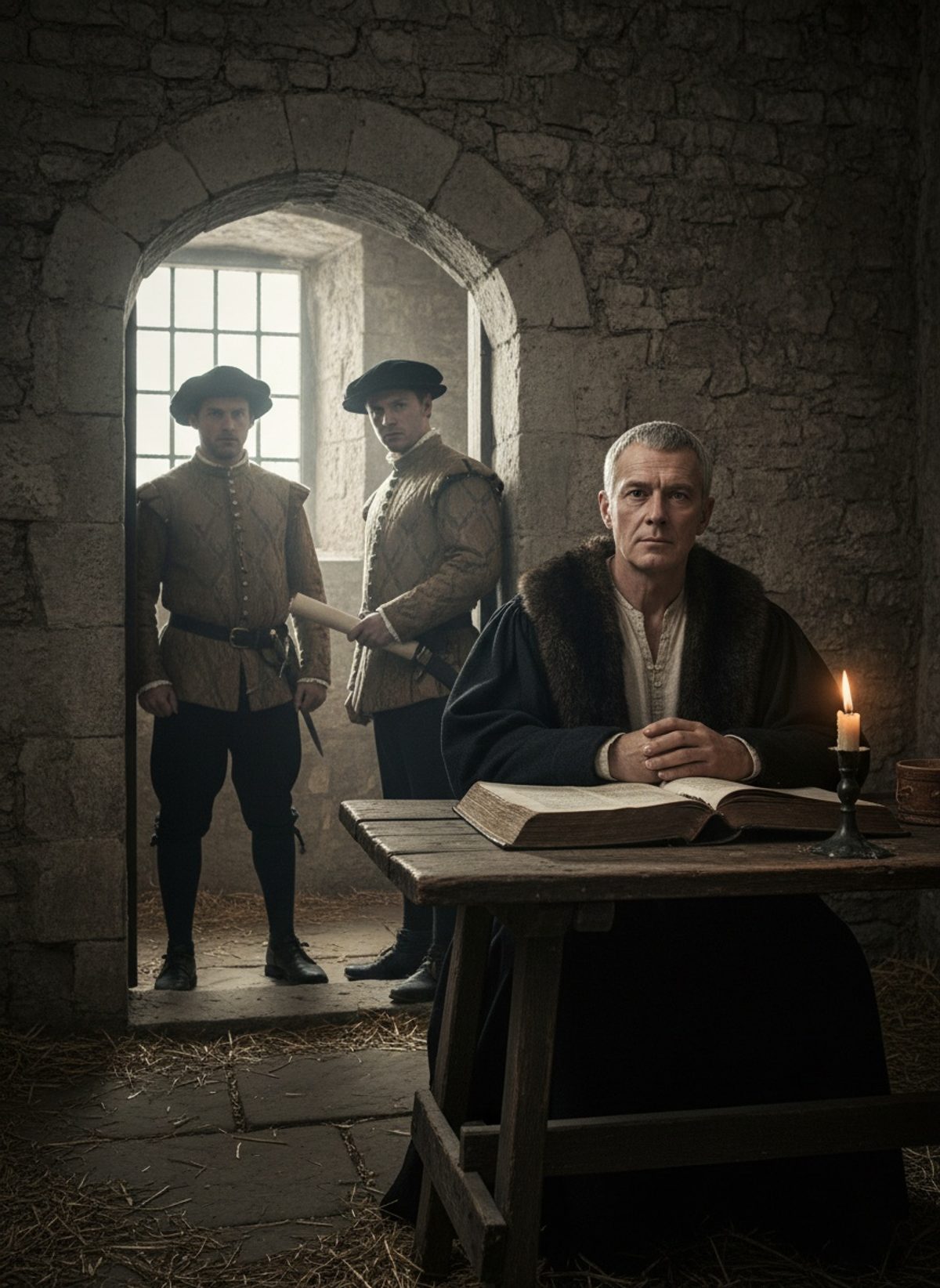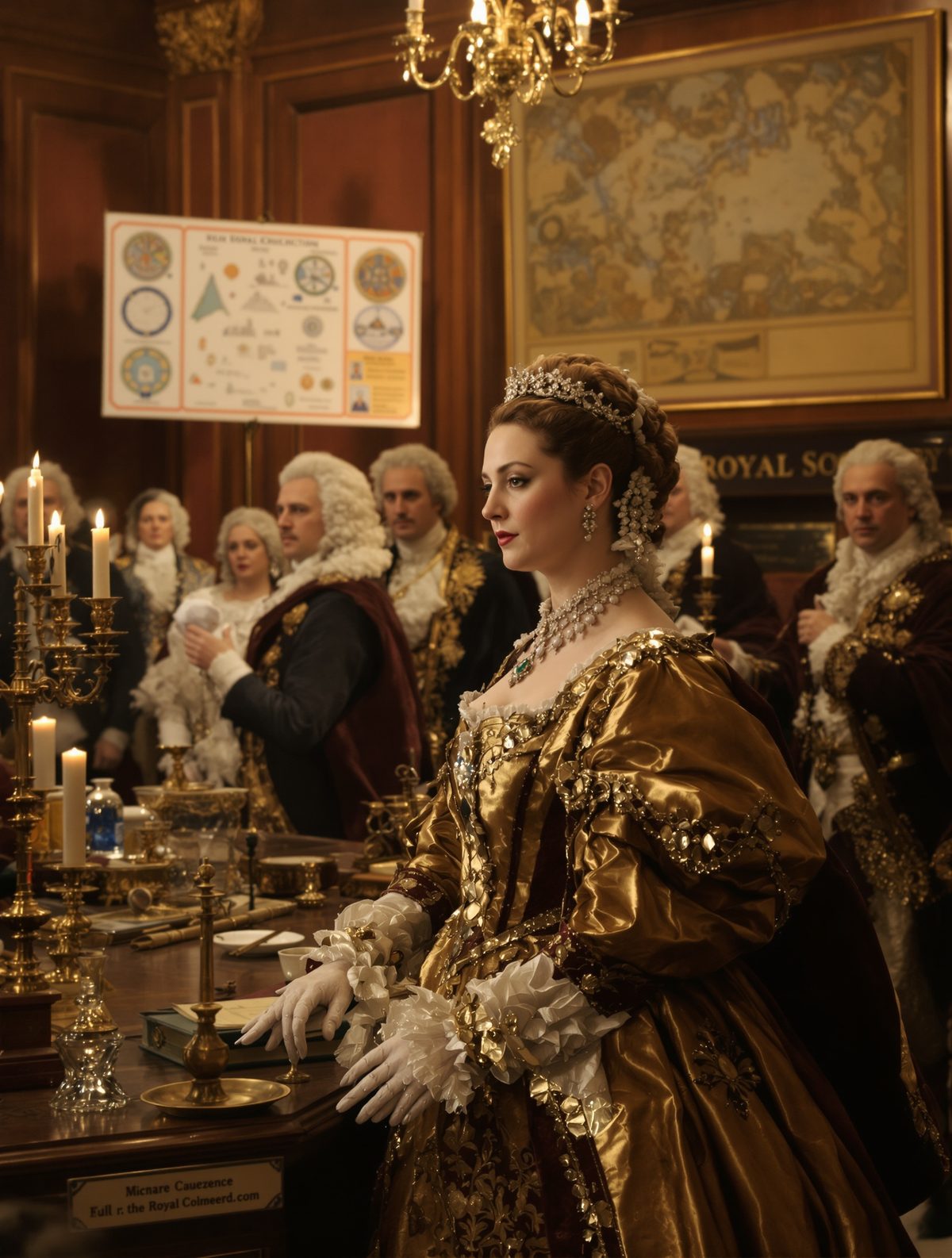
The gentlemen of the Royal Society had seen many extraordinary things in their hallowed meeting rooms at Gresham College. They had watched Robert Hooke peer through microscopes at the hidden world of fleas and cork cells. They had witnessed Christopher Wren's architectural genius unfold in mathematical precision. They had debated Newton's theories and marveled at Boyle's experiments with air pumps. But on May 30th, 1667, they witnessed something that had never happened in the five-year history of their institution—or indeed, in the entire history of English scientific academia.
A woman walked through their doors.
Not just any woman, but Margaret Cavendish, Duchess of Newcastle—a controversial figure who dared to write about natural philosophy when ladies were expected to embroider and arrange flowers. As she stepped into that testosterone-filled sanctum of learning, accompanied by a retinue that included her devoted husband, she didn't just break protocol. She shattered it into a thousand pieces.
The Eccentric Duchess Who Dared to Think
Margaret Cavendish was already the most talked-about woman in Restoration England, and not always for flattering reasons. Born Margaret Lucas in 1623, she had spent her formative years in exile in Paris during the English Civil War, where she served as a maid of honor to Queen Henrietta Maria. It was there she met William Cavendish, the Duke of Newcastle—a man thirty years her senior who would become not just her husband, but her intellectual champion.
Read next: The Day a Stuart King Walked Calmly to His Own Execution
By 1667, the Duchess had already published works that made London's literary circles buzz with a mixture of admiration and horror. Her Philosophical and Physical Opinions, published in 1655, boldly tackled questions about the nature of matter and motion. Her The Description of a New World, Called the Blazing World—one of the earliest works of science fiction—imagined a utopian society where a woman ruled through scientific knowledge. Samuel Pepys, the famous diarist, called her "a mad, conceited, ridiculous woman," yet he couldn't resist reading her work.
The Royal Society knew exactly who was requesting admission to their meeting. This wasn't some curious aristocrat seeking entertainment—this was a woman who had written extensively about atomic theory, challenged Descartes and Hobbes, and had the audacity to call herself a natural philosopher. The very idea should have been preposterous. Women weren't even allowed to attend universities, let alone participate in serious scientific discourse.
Breaking Down the Boys' Club
The Royal Society, founded in 1660 and granted its royal charter by Charles II two years later, represented the pinnacle of England's scientific establishment. Its motto, "Nullius in verba" (take nobody's word for it), championed empirical evidence over ancient authority. Yet when it came to gender, they seemed perfectly content to take everyone's word that women were intellectually inferior.
The Society's meetings were sacred rituals of masculine learning. Fellows would gather around polished wooden tables in rooms lined with curiosities—exotic shells, preserved specimens, and gleaming brass instruments. They would debate, argue, and demonstrate with the passion of men who believed they were unlocking the secrets of creation itself. The very air seemed thick with intellectual testosterone and pipe smoke.
But Margaret Cavendish had powerful allies. Her husband, the Duke of Newcastle, was a respected figure despite his Royalist past. More crucially, she had caught the attention of some forward-thinking members of the Society who were genuinely curious about her ideas. When the formal request came for her to attend a special meeting, the fellows faced an unprecedented dilemma.
After considerable debate—imagine the furious whispering and concerned letters!—they agreed to make an exception. Just this once. For one meeting only. She could observe, but not participate in discussions. It was grudging permission wrapped in so many conditions it barely qualified as welcome, but it was enough.
The Day That Changed Everything
On that spring morning in 1667, Margaret Cavendish arrived at Gresham College dressed, according to contemporary accounts, in her typically flamboyant style. She favored elaborate gowns with unconventional touches—perhaps a masculine-inspired jacket or unusual accessories that proclaimed her rejection of conventional feminine dress codes. Her appearance was as carefully calculated as any scientific experiment: she would be memorable, unmistakable, undeniably present.
The Society had prepared a special program for their unusual guest. Robert Hooke, the brilliant curator of experiments whose Micrographia had revolutionized how people saw the natural world, had prepared several demonstrations. Through his powerful microscopes, the Duchess observed the intricate structure of various specimens—perhaps the compound eyes of flies magnified hundreds of times, or the detailed architecture of plant cells that looked like tiny rooms.
She watched Boyle's air pump experiments, where small animals were placed under glass domes to demonstrate the properties of vacuum. She observed the mixing of chemicals that produced colorful reactions and witnessed the behavior of magnets and iron filings. For several hours, she stood in that room absorbing cutting-edge science, asking questions that, according to surviving accounts, were both intelligent and challenging.
What made the day even more remarkable was her behavior. Contemporary accounts suggest she didn't play the role of the grateful, humble woman receiving male wisdom. She engaged. She questioned. She offered her own observations. The very thing the fellows had feared—a woman treating their sacred space as if she belonged there—was exactly what happened.
The Ripple Effects of Revolution
The immediate aftermath of Cavendish's visit reveals just how extraordinary the event was. Samuel Pepys, who wasn't even present, devoted significant space in his diary to discussing it. He noted the mixed reactions—some fellows were impressed by her intelligence, others scandalized by her boldness. The visit became the talk of London's intellectual circles for months.
But perhaps most tellingly, the Royal Society quickly moved to ensure it wouldn't happen again. They tightened their admission policies and made it clear that Cavendish's visit was a singular exception, not a precedent. The speed with which they closed ranks reveals just how threatening they found the idea of women in their midst.
Cavendish herself seemed to understand the historical significance of her brief invasion. In later writings, she reflected on the experience with characteristic directness, noting both the courtesy she received and the underlying resistance to her presence. She had proven that a woman could engage with the highest levels of scientific discourse without causing the apocalypse, but she also understood that one successful visit wouldn't transform centuries of exclusion overnight.
The scientific community's reaction across Europe was equally revealing. Some praised the English for their progressive attitude, while others used the incident as evidence of dangerous English radicalism. The very fact that continental intellectuals were discussing the event shows how unprecedented it truly was.
Legacy of a Single Day
Margaret Cavendish never attended another Royal Society meeting. She died in 1673, just six years after her historic visit, at the relatively young age of fifty. For the next 278 years, no woman would be elected as a fellow of the Royal Society. When Crystallographer Kathleen Lonsdale and biochemist Marjory Stephenson finally broke that barrier in 1945, World War II had already ended. It's a sobering reminder of how slowly institutional change can move, even after barriers are proven to be artificial.
Yet Cavendish's single day at Gresham College reverberates through history with surprising power. She proved that women could engage with natural philosophy at the highest level. She demonstrated that scientific discourse didn't require a Y chromosome. Most importantly, she showed that progress sometimes requires someone willing to walk through doors that "shouldn't" be open to them.
Today, as we grapple with ongoing questions about diversity in STEM fields, Margaret Cavendish's bold walk into the Royal Society feels remarkably contemporary. She reminds us that every barrier broken, every assumption challenged, every door opened creates possibilities for those who follow. Sometimes the most important scientific experiment isn't conducted in a laboratory—it's conducted by simply showing up where you're not supposed to be, and proving you belong there after all.
In our age of increasing scientific complexity, when we need every brilliant mind working on humanity's greatest challenges, the Duchess of Newcastle's legacy poses a simple but profound question: How much human potential have we wasted by deciding who gets to participate in the great conversation of discovery? Her answer, delivered with characteristic boldness on that spring day in 1667, was clear: waste no more.