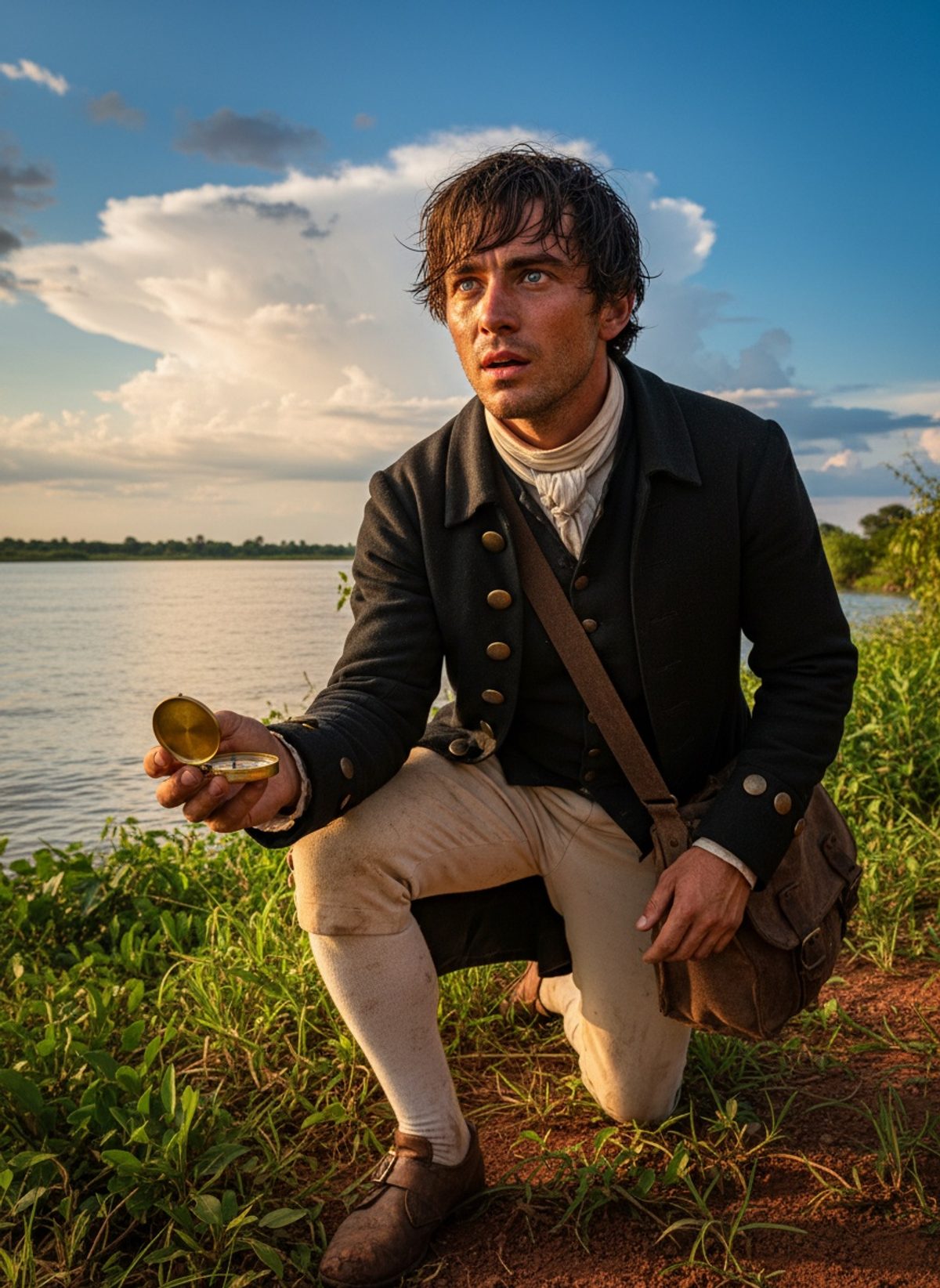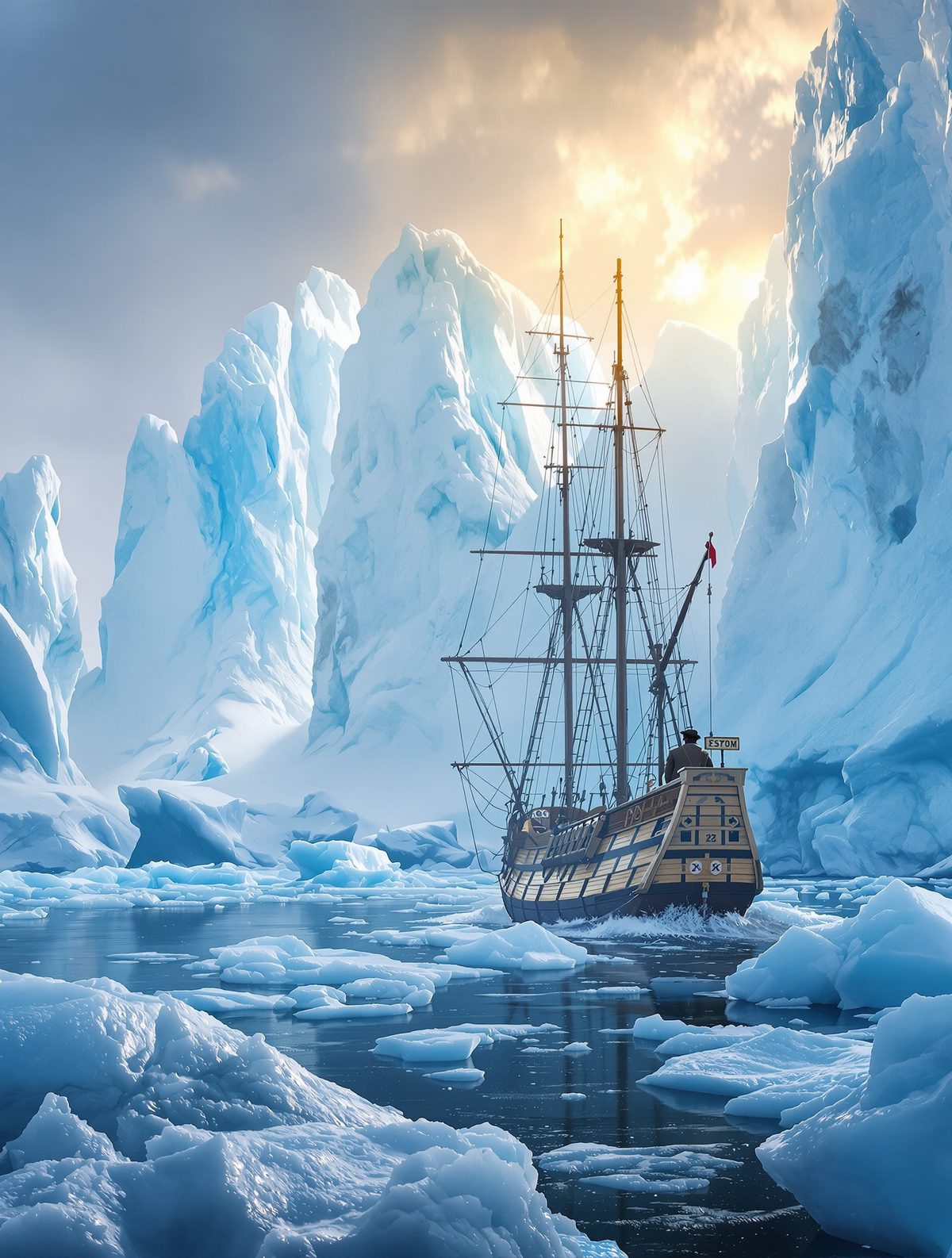
On July 5th, 1616, as dawn broke over the Arctic Ocean, navigator William Baffin stood on the deck of the Discovery and gazed upon a sight no European had ever witnessed. Towering icebergs drifted like floating cathedrals through waters so far north they defied every map of the known world. The compass needle swung wildly, pointing toward a magnetic pole somewhere beyond the frozen horizon. Lesser men would have turned back weeks ago—but Baffin was about to accomplish something extraordinary that would echo through centuries of Arctic exploration.
While his contemporaries were getting trapped in ice for years at a time, this unassuming pilot from London was methodically charting 300 miles of unmappable coastline with such breathtaking accuracy that his work would guide explorers well into the 19th century. What he discovered that summer would reshape our understanding of the Arctic—and yet his name remains curiously absent from most history books.
Into the Realm of Perpetual Ice
The year 1616 found England gripped by Arctic fever. The Northwest Passage—that legendary sea route to the riches of the Orient—had become the Holy Grail of Tudor and Stuart exploration. Sir Martin Frobisher had tried and failed. Henry Hudson had vanished without a trace after his crew mutinied and cast him adrift in the icy waters that now bear his name. The Arctic Ocean had swallowed fortunes and lives with equal appetite.
Enter William Baffin, a man whose background was as mysterious as the waters he would conquer. Unlike the gentleman adventurers who typically commanded such expeditions, Baffin was a working navigator—a mathematical wizard who had taught himself astronomy and could calculate longitude with uncanny precision. When the Muscovy Company chose him to pilot their latest Arctic venture, they were betting on brains over breeding.
Read next: The Day a Scots Surgeon Walked Into Timbuktu Alone
The Discovery, a weathered 55-ton vessel that had already survived Hudson's final voyage, set sail from Gravesend on March 26, 1616. Commanded by Robert Bylot, a survivor of Hudson's expedition, the ship carried seventeen souls into waters where the very concept of seasons seemed to break down. Their mission was simple in theory, terrifying in practice: find a passage through the ice-choked channels west of Greenland, or prove once and for all that none existed.
The Compass Points to Nowhere
By early July, Baffin and his crew had sailed farther north than any expedition in recorded history. They crossed the 77th parallel—a feat that wouldn't be matched for another 200 years. But the real magic wasn't in how far they traveled; it was in how Baffin mapped every mile of their impossible journey.
Working with instruments that seem primitive by modern standards—a backstafff, a compass that spun like a dervish so close to the magnetic pole, and his own mathematical genius—Baffin began charting coastlines that existed beyond the edge of European imagination. He identified and named geographical features that still bear those names today: Smith Sound, Jones Sound, and Lancaster Sound, honoring the expedition's financial backers with a permanence they could never have imagined.
What makes Baffin's achievement truly staggering is the accuracy of his work. When Sir Edward Parry finally reached these same waters in 1818—over two centuries later—he found that Baffin's charts were accurate to within mere miles. In an age when most maps were educated guesses decorated with sea monsters, Baffin was producing navigation aids with the precision of modern satellite surveys.
Dancing with Death in the Devil's Ballroom
The Arctic in 1616 was not merely cold—it was actively hostile. Ice floes the size of villages drifted with crushing force, capable of splintering a wooden ship like kindling. The sun hung at impossible angles, making navigation by traditional methods nearly useless. Men went snow-blind staring at the endless white landscape, and frostbite claimed fingers and toes with ruthless efficiency.
Yet Baffin thrived in these conditions. While other expeditions became trapped for months or years, he used the ice itself as an ally. He understood the rhythms of Arctic weather, reading the signs that told him when channels would open and when they would snap shut. His logs reveal a man who approached the hostile environment like a chess master, thinking several moves ahead of the ice itself.
On July 12, 1616, the expedition reached what Baffin calculated to be 77°45' North latitude—deep within what is now known as Baffin Bay. Here, surrounded by towering ice cliffs and beneath a sun that never set, he made careful observations that would define Arctic geography for generations. He noted the behavior of whales, the patterns of wind and current, the subtle variations in ice formation that marked different seasons and depths.
The Merchant Adventurers' Bitter Disappointment
When the Discovery returned to London in September 1616, Baffin carried news that his sponsors decidedly did not want to hear. There was no Northwest Passage, at least not in the waters he had explored. The channels he had discovered—Smith Sound, Jones Sound, Lancaster Sound—all ended in walls of impenetrable ice or solid land.
For the Muscovy Company's investors, this was financial catastrophe. They had funded the expedition hoping for a sea route to Chinese silk and Indian spices. Instead, they received detailed charts of frozen wasteland that seemed to offer no commercial value whatsoever. The irony, lost on those disappointed merchants, was that Baffin had actually discovered the true route to the Pacific—Lancaster Sound does indeed lead to the Northwest Passage, but it would take another 334 years and the icebreaker St. Roch to successfully navigate it.
The commercial failure of Baffin's voyage led to a peculiar historical amnesia. His detailed charts were filed away and forgotten. Geographic societies dismissed his latitude readings as impossible exaggerations. For nearly two centuries, the waters he had mapped with such precision were marked on official charts as nonexistent or inaccessible.
When Memory Became Legend
It wasn't until 1818, when Captain John Ross sailed HMS Isabella into the same waters, that the full magnitude of Baffin's achievement became clear. Ross found himself navigating by charts that were over 200 years old, marveling at their accuracy. Every cape, every inlet, every dangerous ice formation was exactly where Baffin had plotted it. The man who had been dismissed as a fantasist was posthumously recognized as one of history's greatest navigators.
But perhaps the most remarkable aspect of Baffin's legacy isn't found in the geography that bears his name. It's in the method he pioneered—the patient, scientific approach to exploration that valued accuracy over glory, knowledge over gold. While his contemporaries chased legends and fairy tales, Baffin was quietly creating the foundation of modern polar exploration.
His logs reveal a man who understood that the Arctic's greatest secrets wouldn't be unlocked by heroic gestures or desperate gambles, but by careful observation and mathematical precision. He recorded water temperatures, ice thickness, wildlife behavior, and magnetic variations with the methodical dedication of a true scientist. In doing so, he created not just maps, but a template for how humans could survive and work in Earth's most unforgiving environment.
The Navigator's Eternal Legacy
Today, as climate change transforms the Arctic Ocean and new shipping routes emerge from melting ice, William Baffin's 1616 voyage feels remarkably prescient. The Northwest Passage that eluded him—and that remained theoretical for centuries after his death—is now opening during summer months. Ships carrying cargo between Europe and Asia increasingly follow routes that pass through waters he first charted with his backstafff and mathematical genius.
Yet Baffin's true legacy transcends geography. In an age when exploration was often synonymous with exploitation, he demonstrated that the greatest discoveries come from understanding rather than conquering. His charts lasted for centuries not because he claimed territory for England, but because he respected the environment enough to map it accurately. In our current era of climate crisis and environmental degradation, perhaps that's the lesson we need most: that true exploration means learning to read the world's subtle languages rather than shouting our own intentions over them.
The next time you see satellite images of Arctic ice flows or read about polar research stations, remember the man who stood on a wooden deck in 1616, surrounded by ice that could have crushed his ship in an instant, patiently taking measurements that would guide human understanding for centuries to come. William Baffin mapped the unmappable not through courage alone, but through the revolutionary idea that precision and patience could triumph where brute force had failed.