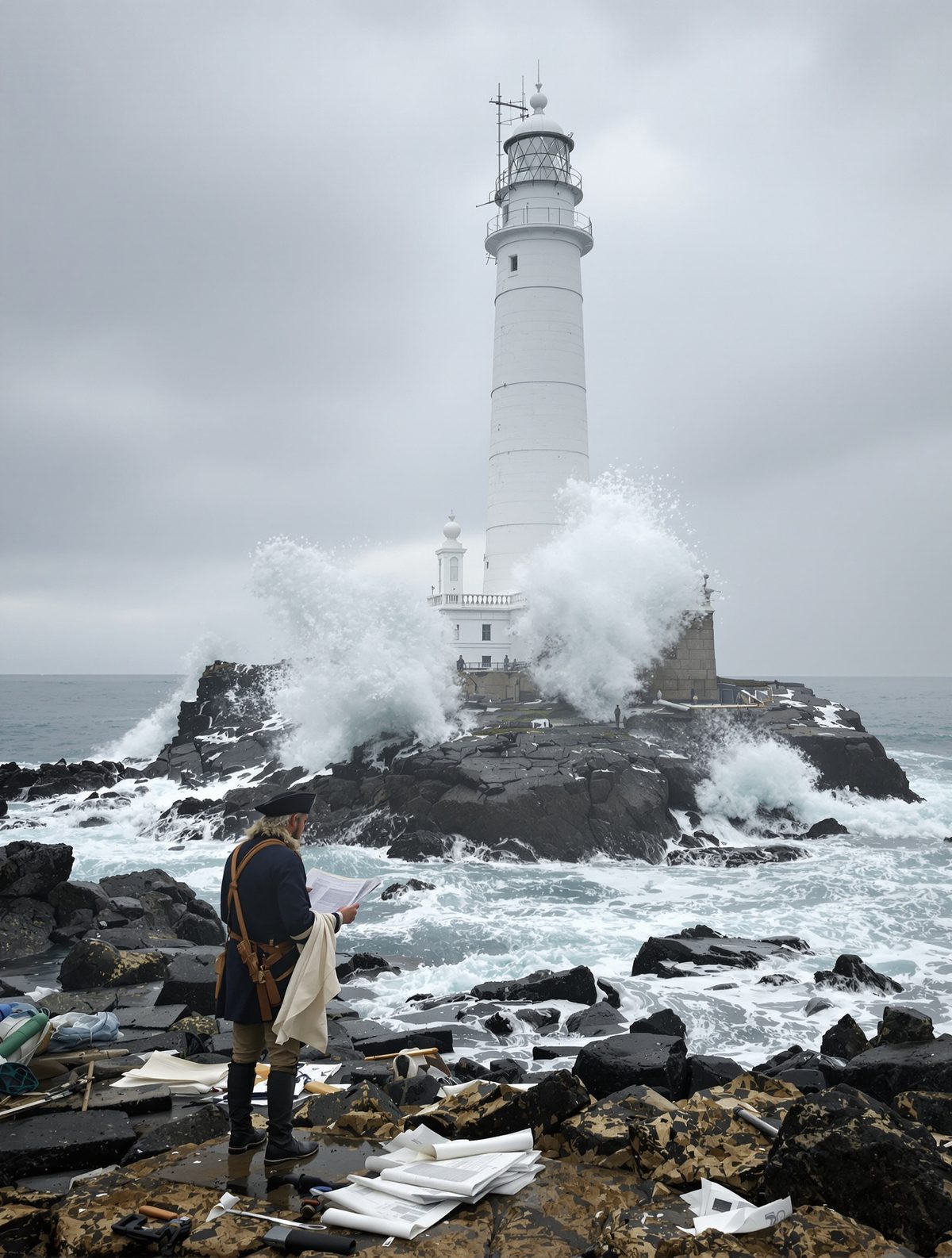
The morning of November 27th, 1703, brought with it the kind of storm that sailors whisper about in taverns—the sort that turns the English Channel into a cauldron of liquid fury. As dawn broke over Plymouth Sound, horrified onlookers could see nothing where Henry Winstanley's lighthouse had stood just hours before. The Eddystone Rock, that murderous finger of granite jutting from the waves fourteen miles offshore, had claimed not only the lighthouse but its creator too. Winstanley, who had boasted that he wished to be in his lighthouse during "the greatest storm that ever was," got his wish. Neither he nor his revolutionary structure would ever be seen again.
But this wasn't just another maritime tragedy. The disappearance of Winstanley's lighthouse marked the beginning of one of the most extraordinary engineering challenges of the 18th century—a challenge that would ultimately forge the reputation of a young millwright named John Smeaton and revolutionize lighthouse construction forever.
The Graveyard of Ships
To understand the magnitude of what Smeaton would accomplish, you need to grasp the sheer horror of the Eddystone Rock. Rising barely four feet above high tide, this serrated mass of granite sat directly in the path of every vessel entering or leaving Plymouth—England's most vital naval port. Ships' captains called it "the wolf rock," and with good reason. In fog or storm, it was virtually invisible until the moment your vessel's hull was being torn apart by its razor-sharp edges.
The statistics were staggering. Maritime records from the early 1700s show that the waters around Eddystone claimed an average of fifty ships every winter. That's more than one vessel per week, along with hundreds of lives and cargo worth millions in today's currency. The Royal Navy alone lost warships worth £2 million—roughly £300 million in modern terms—to this single rock between 1690 and 1756.
Read next: The Day a Mill Owner Kept Paying Wages He Could Not Afford
Winstanley's first lighthouse, completed in 1698, had been a marvel of ambition if not engineering wisdom. Standing 80 feet tall and festooned with ornate galleries, weather vanes, and even a bedroom for the keeper, it looked more like a gothic mansion than a maritime beacon. When the great storm of 1703 obliterated it, the Admiralty commissioned a replacement from John Rudyard, a London silk mercer with no engineering experience whatsoever.
Rudyard's lighthouse lasted longer—46 years—but met an equally dramatic end. On December 2nd, 1755, the 94-year-old keeper Henry Hall noticed sparks falling from the lantern room onto the wooden structure below. Within hours, the entire lighthouse was a towering inferno visible from the Devon coast. Hall, in a desperate attempt to fight the flames, looked up at the burning lantern just as molten lead from the roof poured into his mouth. He died twelve days later, and doctors found a lump of lead weighing seven ounces in his stomach—a grisly testament to his heroic final act.
Enter the Revolutionary
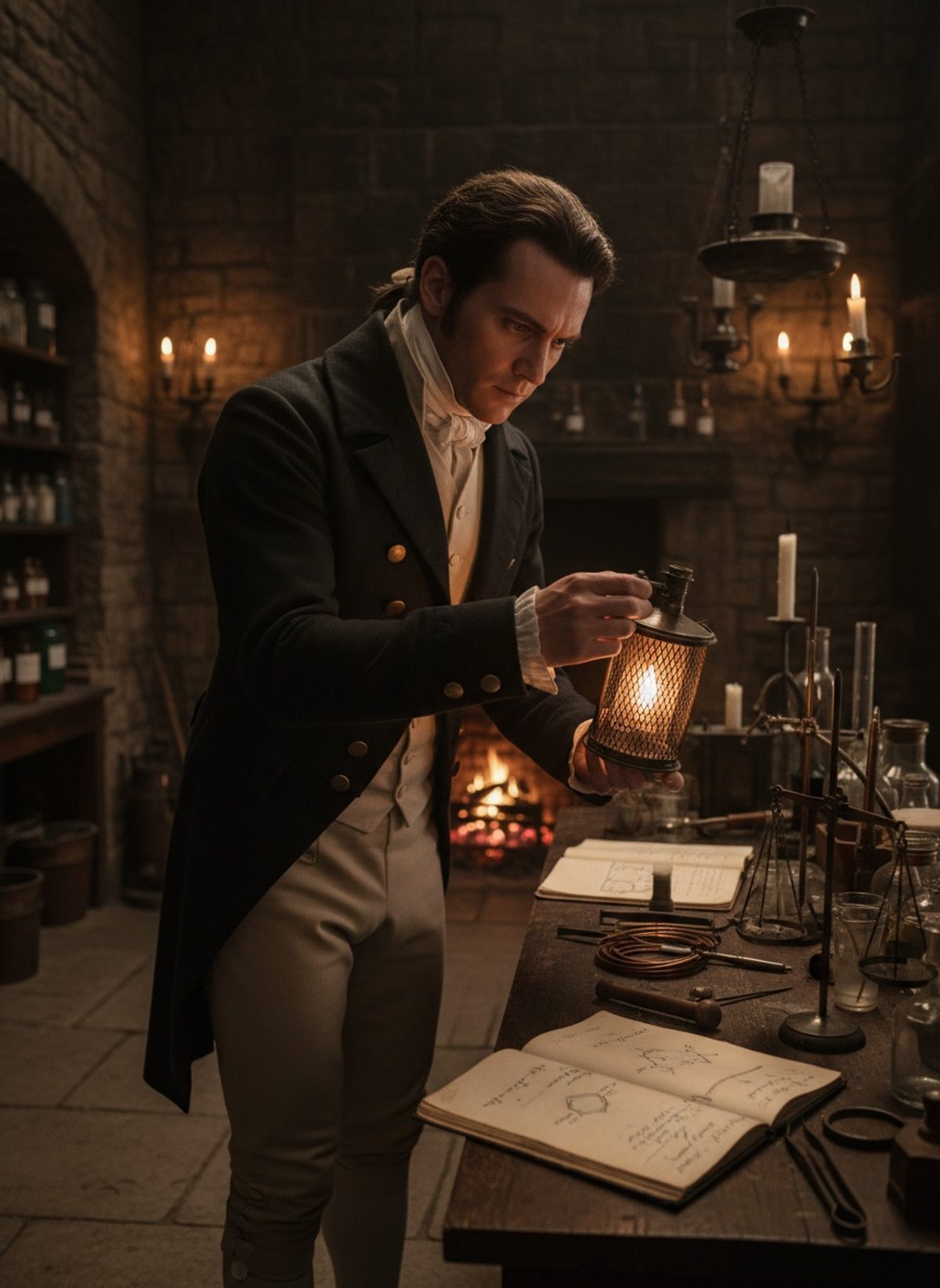
When the call went out for a third lighthouse, it reached John Smeaton in his workshop in Leeds. At 32, Smeaton was already gaining a reputation as a brilliant mechanical engineer, the man who had improved everything from windmills to water pumps. But this commission was different. This wasn't about tweaking existing technology—this was about reimagining lighthouse construction from the ground up.
Smeaton's genius lay not in his tools, but in his powers of observation. While other engineers looked at previous lighthouse failures and thought about stronger materials or better foundations, Smeaton walked through the English countryside and studied oak trees. Here were structures that had weathered centuries of storms, anchored by roots that gripped the earth with impossible tenacity, their trunks tapering upward to bend rather than break in the wind.
What if, Smeaton wondered, a lighthouse could be built like a tree?
His revolutionary design abandoned the cylindrical towers of his predecessors in favor of something entirely new: a graceful curve that was widest at the base and tapered smoothly upward. But the real innovation lay in how it would be built. Instead of wood or rubble held together with mortar, Smeaton proposed to construct his lighthouse from interlocking blocks of stone, each one cut with such precision that they would form a single, monolithic structure.
The Impossible Construction
On August 3rd, 1756, Smeaton set foot on the Eddystone Rock for the first time. What he found would have discouraged a lesser man. The working area measured just 30 feet in diameter, and it disappeared entirely under water at high tide. Worse still, the rock was accessible for construction work only during the brief periods of calm weather between spring tides—perhaps four hours at a time, and only if the weather cooperated.
Smeaton's solution was as ingenious as his design. He established a base camp on the mainland where skilled stonemasons could work year-round, cutting blocks of granite and Portland stone to tolerances measured in fractions of an inch. Each block was numbered and test-fitted before being loaded onto specially designed barges that could land on the rock during the brief windows of opportunity.
The work was backbreakingly difficult and often dangerous. Workers had to be ferried out before dawn to maximize their time on the rock, hauling tools, stone, and materials up a treacherous landing stage that was slick with seaweed and constantly washed by waves. On more than one occasion, men were stranded on the rock when sudden storms made evacuation impossible, forced to cling to the partially built structure as waves crashed over them.
But Smeaton's methodical approach paid dividends. Each stone was cut with dovetail joints that locked it to its neighbors. The foundation courses were actually carved into the living rock, creating an anchor that would hold the structure against the most violent storms. Most remarkably, Smeaton developed a new type of mortar—hydraulic lime cement that would set underwater and actually grow stronger when exposed to seawater.
A Beacon Rises from the Waves
The lighthouse that emerged from these Herculean efforts was unlike anything previously built. Standing 59 feet tall, it rose from the rock in a perfect curve, its diameter shrinking from 26 feet at the base to just 17 feet at the top. The entire structure contained 1,493 individual blocks of stone, each one fitting so perfectly that the completed lighthouse appeared to be carved from a single piece of granite.
On October 9th, 1759, after more than three years of construction, Smeaton's lighthouse was officially lit for the first time. The beacon—powered by a revolutionary system of silvered reflectors behind oil-burning wicks—could be seen from 23 miles away on a clear night. Ships' captains reported that the light was not only brighter than its predecessors but also produced a distinctive pattern that made the Eddystone Rock unmistakable even in crowded shipping lanes.
The true test came during the winter storms of 1759-60. As mountainous waves crashed against the lighthouse, observers on shore watched in amazement as the structure barely trembled. The curved profile that Smeaton had borrowed from oak trees allowed the waves to flow smoothly up and over the lighthouse rather than striking it with their full force. Contemporary accounts describe waves breaking over the lantern room 70 feet above sea level, yet the lighthouse stood firm.
The Engineering Marvel That Redefined an Industry
What Smeaton achieved at Eddystone went far beyond solving a local navigation problem. His lighthouse became the template for coastal engineering projects around the world. The dovetail stone construction technique was copied for lighthouses from Scotland to Australia. His hydraulic cement became the foundation for modern concrete. Even the curved profile—now known as the "Smeaton curve"—became the standard design for lighthouse construction that persists to this day.
The numbers tell the story of his success. In the 50 years before Smeaton's lighthouse, an average of 50 ships per year were wrecked on or near the Eddystone Rock. In the 50 years after its completion, that number dropped to fewer than two per year—a 96% reduction in maritime casualties. Lloyd's of London, the famous insurance market, immediately reduced premiums for ships passing the Eddystone Rock, recognizing that Smeaton had effectively eliminated one of the most dangerous navigation hazards in British waters.
But perhaps the most remarkable testament to Smeaton's genius was the lighthouse's longevity. It weathered every storm the Atlantic could throw at it for 123 years, only being replaced in 1882—not because it was failing, but because the rock beneath it was being eroded by the constant pounding of the waves. When dismantled, Smeaton's lighthouse was so perfectly preserved that it was reconstructed stone by stone on Plymouth Hoe, where it stands today as a monument to 18th-century engineering brilliance.
The Legacy of Looking Closely
Standing today on Plymouth Hoe, looking out toward the modern Eddystone Light that marks those treacherous waters, it's worth reflecting on what John Smeaton's achievement really represents. In an age when engineering was still more art than science, when trial and error claimed lives and fortunes with depressing regularity, Smeaton succeeded by doing something remarkably simple: he paid attention to nature.
His lighthouse saved thousands of lives and millions of pounds in shipping, but its deeper legacy lies in the approach it represented. Smeaton didn't just build a better lighthouse—he fundamentally changed how engineers thought about construction in hostile environments. By studying how natural forms had evolved to survive extreme conditions, he pioneered what we now call biomimetic engineering, centuries before the term was coined.
In our modern age of climate change and rising seas, as engineers grapple with building structures that can withstand increasingly violent storms, Smeaton's lesson remains as relevant as ever. Sometimes the most revolutionary solution isn't found in the latest technology, but in taking the time to observe how nature has already solved the problem. The day John Smeaton built his lighthouse like a tree trunk, he didn't just save ships from a deadly rock—he showed us that the best engineering often begins with simply learning to see.