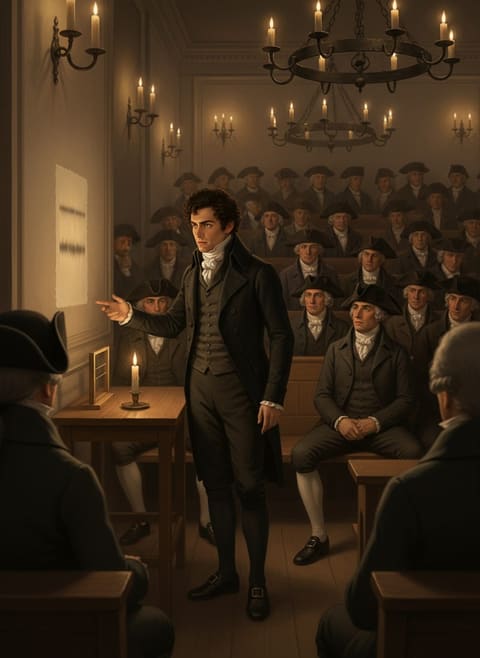
On a fog-shrouded morning in January 1767, Nevil Maskelyne climbed the winding stairs of the Royal Observatory at Greenwich, carrying the weight of an impossible dream. Through the frost-etched windows, he could see the Thames below, crowded with merchant ships preparing for voyages to distant lands. Many would never return — not from storms or pirates, but from something far more insidious: they simply wouldn't know where they were.
The fifth Astronomer Royal was about to embark on a twenty-year crusade that would transform every ship into a time machine, every star into a signpost, and every sailor into a navigator capable of finding home from anywhere on the planet. His weapon? Nothing more than meticulous observation, mathematical precision, and an unshakeable belief that the heavens held the key to earthly salvation.
The Navigation Nightmare That Killed Thousands
Picture this: you're a captain in 1767, three weeks out from Portsmouth, somewhere in the vast Atlantic. You know roughly how far north or south you are — latitude is easy enough to calculate using the sun or North Star. But your longitude? Your east-west position? You might as well be guessing. Ships routinely missed their destinations by hundreds of miles, running aground on hidden reefs or sailing aimlessly until their supplies ran out.
The scale of this maritime catastrophe was staggering. In 1707, Admiral Sir Cloudesley Shovell's fleet, returning from Gibraltar, became lost in thick fog. Believing they were safely west of France, they were actually approaching the Scilly Isles. Four warships smashed into the rocks, killing nearly 2,000 men including Shovell himself. It was just one disaster among hundreds.
Read next: The Day a Weaver's Son Mapped the Invisible World
The British government was so desperate for a solution they offered £20,000 — roughly £3 million today — for any method that could determine longitude at sea within 30 nautical miles. While clockmaker John Harrison pursued his revolutionary marine chronometer, Maskelyne championed a different approach entirely: turning every sailor into an astronomer.
The Man Who Dared to Map the Unmappable
Nevil Maskelyne was an unlikely revolutionary. Born in 1732 to a well-to-do London attorney, he seemed destined for the law until Cambridge University awakened his passion for mathematics and astronomy. Tall and angular, with penetrating eyes that seemed to pierce through problems as easily as they did the night sky, Maskelyne possessed that rare combination of theoretical brilliance and practical determination.
His appointment as Astronomer Royal in 1765 came with a royal mandate: make Greenwich Observatory useful to the nation's mariners. Previous astronomers had focused on grand theories and cosmic mysteries. Maskelyne would focus on something far more immediate — keeping British sailors alive.
The concept behind his solution was elegant in its simplicity. If you could predict exactly where the moon would be relative to the stars at any given time, a sailor could observe the moon's position, consult a table of predictions, and calculate both the time at Greenwich and his longitude. The moon would become a giant celestial clock, visible to anyone with a clear sky.
There was just one problem: no one had ever created star charts accurate enough to make this work.
Twenty Years of Watching the Sky
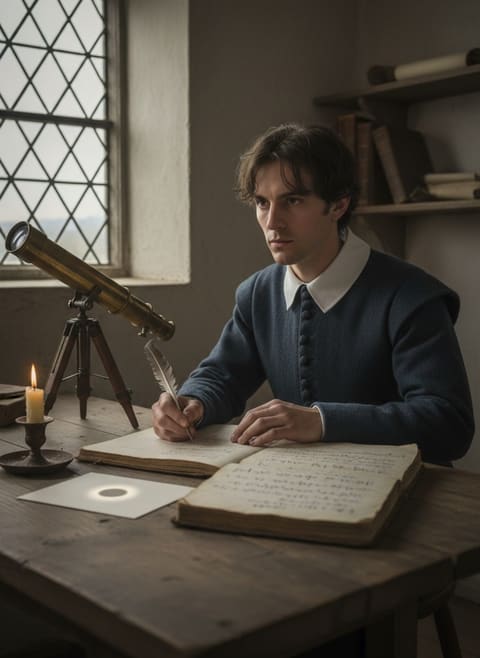
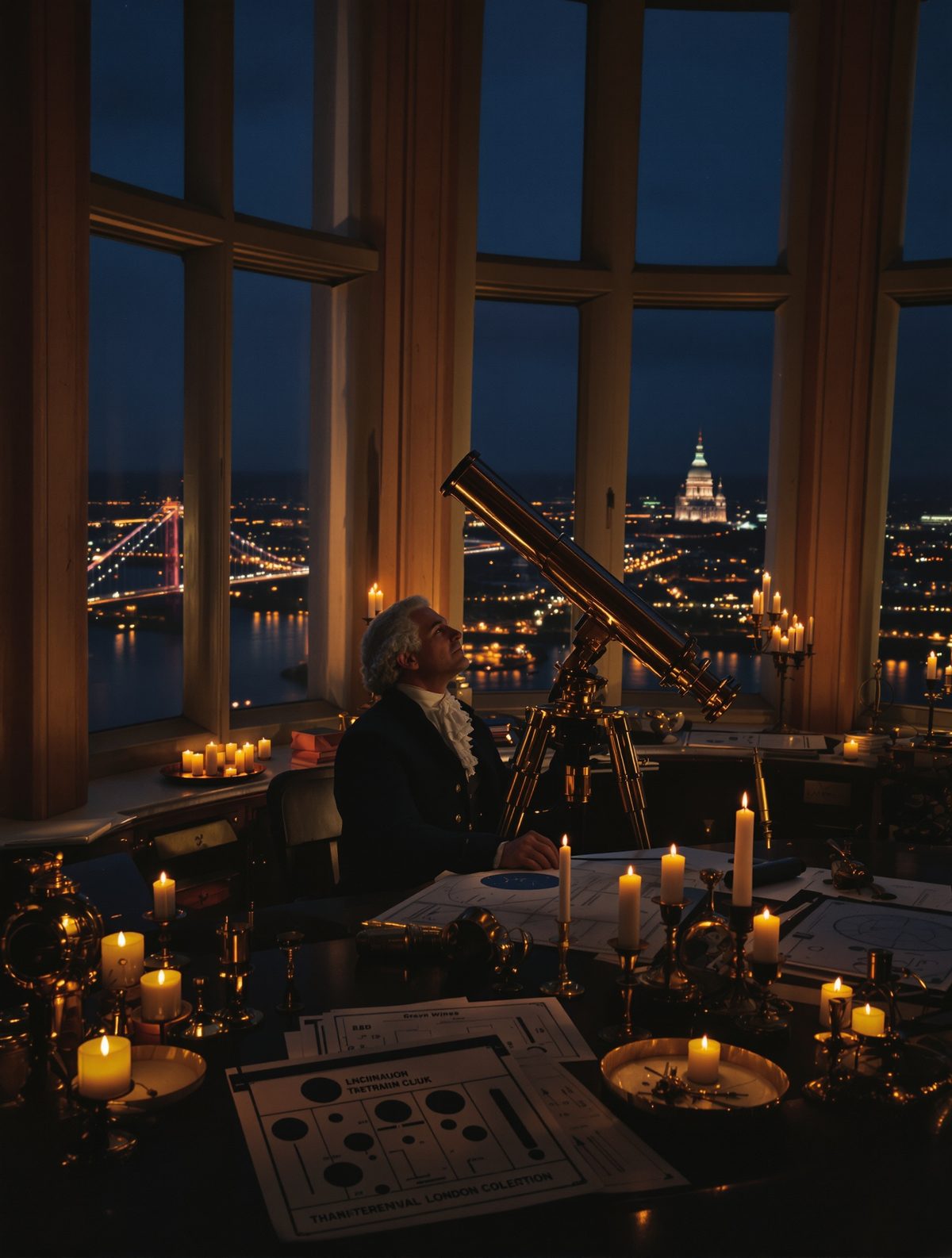
What followed was perhaps the most methodical and painstaking scientific endeavor of the Georgian era. Night after night, Maskelyne and his small team of assistants climbed to the observatory's octagonal room, where they operated an 8-foot mural quadrant — a massive brass instrument that could measure celestial positions to unprecedented accuracy.
The work was mind-numbingly precise. Every clear night, they tracked the moon's position relative to the zodiacal stars, recording measurements down to arc-seconds. A single error could send a ship hundreds of miles off course, so every observation was checked, double-checked, and verified against mathematical models.
Maskelyne's dedication bordered on obsession. He worked through bitter winter nights when the metal instruments were so cold they burned his fingers, and sweltering summer evenings when the heat created atmospheric distortions that made stars dance like candle flames. His assistants often found him at dawn, still hunched over his calculations, ink-stained and exhausted but unwilling to rest while ships were at sea.
By day, he performed equally demanding mathematical gymnastics. Each lunar observation had to be corrected for atmospheric refraction, the Earth's orbital motion, lunar parallax, and a dozen other factors. Using logarithm tables and hand calculations — remember, this was 250 years before electronic computers — he transformed raw observations into the precise predictions that would fill his Nautical Almanac.
The Almanac That Changed Everything
In 1767, the first volume of Maskelyne's Nautical Almanac and Astronomical Ephemeris rolled off the presses. At first glance, it looked unremarkable — a modest book filled with dense tables of numbers. But those tables represented something extraordinary: the position of the moon relative to key stars, predicted for every three hours of every day of the year, accurate to within two nautical miles.
The book came with detailed instructions for the "lunar distance method" of navigation. A sailor would use a sextant to measure the angle between the moon and a nearby star, then consult Maskelyne's tables to determine the exact time at Greenwich. Comparing this to his local time gave him his longitude. For the first time in history, any ship's officer with basic mathematical skills could pinpoint his position anywhere on Earth.
The impact was immediate and dramatic. Captain James Cook carried the Almanac on all three of his Pacific voyages, using it to create the first accurate maps of New Zealand, Australia's east coast, and dozens of Pacific islands. "The Nautical Almanac," Cook wrote, "is a work of great utility and accuracy... I had the satisfaction of proving its correctness by our lunar observations."
Read next: The Day a Clockmaker's Son Rewired How We See the Stars
But perhaps the most telling measure of success was simpler: ships stopped getting lost. Maritime insurance rates fell as vessels began arriving at their destinations on schedule. The Royal Navy could plan operations with unprecedented precision, knowing exactly where their fleets were at all times.
The Hidden Army Behind the Stars
What most people don't realize is that Maskelyne's achievement rested on the shoulders of an extraordinary hidden workforce. Unable to handle all the calculations himself, he pioneered what may have been the world's first example of large-scale scientific computing — using humans instead of machines.
He recruited clergymen, schoolteachers, and other educated gentlemen across Britain, sending them sheets of raw astronomical observations to be processed using his standardized methods. These "computers" — as they were actually called — worked in their spare time for modest fees, transforming Maskelyne's Greenwich observations into the polished tables that sailors depended on.
The system was remarkably sophisticated. Different computers would calculate the same data independently, with any discrepancies flagged for investigation. Maskelyne personally checked every page of every Almanac before publication, knowing that a single typographical error could prove fatal to mariners thousands of miles away.
A Legacy Written in the Stars
When Maskelyne died in 1811, he had published 44 volumes of the Nautical Almanac, creating an unbroken chain of celestial predictions that guided ships safely across the world's oceans. His work had transformed Britain into the undisputed master of global navigation — a crucial advantage in the age of empire and international commerce.
But perhaps more importantly, Maskelyne had demonstrated something revolutionary about the relationship between pure science and human welfare. By watching the stars with unprecedented precision, he had saved thousands of lives and opened the world's sea lanes to safe passage. Greenwich Observatory became not just Britain's timekeeper, but the world's — the prime meridian still runs through Maskelyne's observatory, making it longitude zero for the entire planet.
Today, as GPS satellites provide instant positioning data to anyone with a smartphone, it's easy to forget the decades of patient observation that first made global navigation possible. Maskelyne's achievement reminds us that behind every technological revolution lies someone willing to do the painstaking work of getting the details exactly right. In an age of instant everything, perhaps we need more people willing to spend twenty years watching the sky.