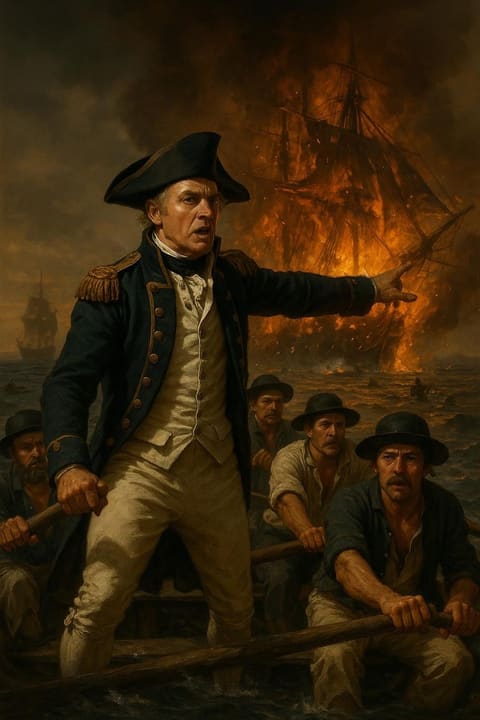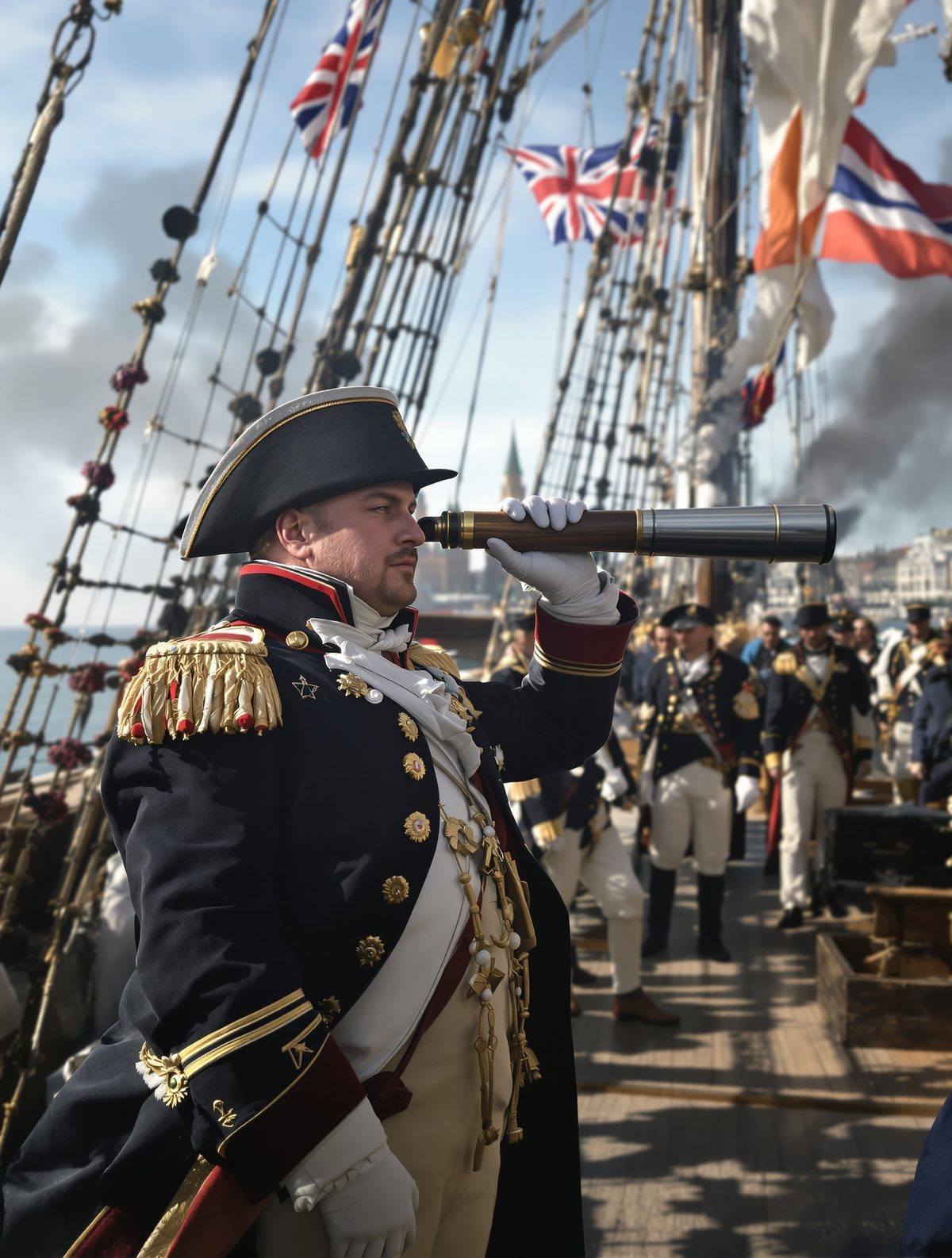
The telescope trembled in Admiral Horatio Nelson's hand as cannonballs screamed overhead, sending splinters of wood flying across the deck of HMS Elephant. The waters of Copenhagen harbour churned red with blood, littered with the broken masts and torn sails of British warships. It was April 2nd, 1801, and what had begun as a calculated assault on the Danish fleet had become a hellish nightmare of smoke, fire, and death.
Then came the signal that would change everything. High above the distant HMS London, a series of coloured flags snapped in the wind—Signal Number 39. The order to discontinue action. Retreat.
Nelson's captain, Thomas Foley, watched in stunned silence as his admiral raised the telescope to his right eye—the eye that had been blinded four years earlier by stone fragments during the siege of Calvi. "I really do not see the signal," Nelson declared with characteristic coolness, before turning to his flag captain. "You know, Foley, I have only one eye. I have a right to be blind sometimes."
What happened next would become one of the most audacious acts of insubordination in naval history—and one of Britain's most crucial victories.
Read next: The Night the British Ate the President's Dinner
The Powder Keg of the Baltic
To understand Nelson's defiance, we must first grasp the precarious situation Britain faced in early 1801. Napoleon's continental blockade was strangling British trade, and now the northern kingdoms—Russia, Prussia, Sweden, and Denmark—had formed the League of Armed Neutrality, threatening to cut off Britain's vital Baltic supply routes.
Denmark held the key. Copenhagen's massive naval base controlled the entrance to the Baltic, and the Danes possessed the second-largest navy among the neutral powers. Their fleet, though smaller than Britain's, was formidable, and their waters were treacherous—a maze of sandbanks and shoals that had claimed countless ships over the centuries.
The British Admiralty's solution was characteristically bold: sail a fleet through the supposedly impregnable Danish defenses and force Copenhagen to withdraw from the League. Command was given to Admiral Sir Hyde Parker, but it was his second-in-command who would prove decisive—the already legendary Horatio Nelson, fresh from his triumph at the Battle of the Nile.
Nelson had studied the Danish defenses obsessively. The enemy had moored eighteen warships in a formidable line along the King's Deep channel, supported by the massive Trekroner fortress and floating batteries bristling with guns. It was a position that should have been impregnable. Should have been.
Into the Jaws of Hell
At 9:30 AM on April 2nd, Nelson led twelve ships-of-the-line into the narrow channel in his flagship HMS Elephant. The morning air was crisp, the Danish flags flew proudly from their vessels, and the citizens of Copenhagen lined the shores to watch what they assumed would be the destruction of the British fleet.
They were almost right. Within minutes of the first shots being fired, the battle descended into chaos. The British ship HMS Agamemnon ran aground on the treacherous Outer Middle shoal, her 64 guns suddenly useless. HMS Bellona and HMS Russell followed suit, their hulls grinding against the sand as Danish shot pounded their immobilized forms.
From his distant position, Admiral Parker watched in growing horror as three of Nelson's ships became sitting targets. The Danish gunners, fighting for their homeland, displayed a ferocity that stunned even veteran British sailors. The Dannebrog, the Danish flagship, continued firing even as flames consumed her hull, her crew choosing death over surrender.
Captain Edward Riou of HMS Amazon would later describe the scene: "The fire was terrific, and the ship was much cut up." But this understated British account barely captures the reality. Cannonballs weighing 32 pounds smashed through oak hulls three feet thick. Men were cut down by splinters moving faster than bullets. The screams of the wounded mixed with the thunderous roar of over 2,000 guns firing simultaneously.
The Signal That Could Have Changed History
By 1:15 PM, Admiral Parker had seen enough. Three British ships were aground, others were taking devastating damage, and the Danish line showed no signs of breaking. From the safety of his position beyond the shoals, Parker could see only disaster unfolding. His signal flags conveyed a simple message: Signal Number 39—discontinue action and retreat while you still can.
But Parker couldn't see what Nelson could see. Up close, the Danish fire was indeed weakening. Several enemy vessels had struck their colours, and others were clearly in distress. The Dannebrog was a floating inferno, her crew finally abandoning ship. Most crucially, the massive Trekroner fortress had largely fallen silent, its guns either dismounted or their crews killed.
When Nelson's signal lieutenant, Frederick Langford, spotted Parker's retreat signal and dutifully reported it, the one-eyed admiral made his famous gesture. Raising his telescope to his blind right eye, he claimed he could not see the signal to withdraw. But this wasn't mere theatrics—Nelson understood that retreating now, with ships aground and under heavy fire, would result in catastrophic losses. The only way out was through.
What many don't realize is that Nelson's act of "blindness" was legally justified under naval regulations of the time. A subordinate commander who believed his superior couldn't see the full tactical situation was permitted to use his discretion. Nelson wasn't just being defiant—he was being strategically brilliant.
Victory Snatched from the Jaws of Defeat
Nelson's decision to ignore the retreat signal proved inspired. By 2:30 PM, the Danish resistance was crumbling. The Holsteen had struck her colours, the Indfodsretten was sinking, and white flags of surrender were appearing along the Danish line. The massive floating battery Sjaelland, which had seemed impregnable that morning, was now a smoking ruin.
Read next: The Day a One-Eyed Admiral Sailed Into the Line of Fire
But Nelson's masterstroke wasn't just military—it was diplomatic. Even as victory became clear, he sent a message to the Danish Crown Prince under a flag of truce: "Lord Nelson has directions to spare Denmark when no longer resisting, but if the firing is continued on the part of Denmark, Lord Nelson will be obliged to set on fire all the floating batteries he has taken, without having the power of saving the brave Danes who have defended them."
This wasn't an empty threat. The waters around the grounded Danish ships were too shallow for boats to approach safely. If the battle continued, the wounded Danes aboard their captured vessels would indeed burn alive. The message achieved its intended effect—Crown Prince Frederik ordered a ceasefire.
The battle was over, but the consequences were just beginning. Denmark agreed to suspend its participation in the League of Armed Neutrality for fourteen weeks, effectively breaking the coalition. When Tsar Paul I of Russia was assassinated just weeks later, his successor withdrew from the League entirely. Napoleon's attempt to strangle British trade through northern Europe had failed, largely because one admiral had placed a telescope to his blind eye and declared he could see no signal to retreat.
The Price of Audacity
The victory came at a terrible cost. The British suffered 264 dead and 689 wounded, while Danish casualties were even higher—perhaps 2,000 men killed, wounded, or missing. Captain Riou, who had so eloquently described the battle's ferocity, was among the British dead, cut down by grapeshot just as he began to obey Parker's retreat signal.
Nelson himself was deeply affected by the carnage. Unlike his other great victories at the Nile and Trafalgar, Copenhagen brought him no joy. "It was a hard-fought battle," he wrote, "and I have never fought in a harder." The sight of so many brave Danes dying in defense of their homeland haunted him for years.
Yet the strategic implications were immense. By keeping the Baltic open to British trade, Copenhagen helped ensure that Britain could continue financing the coalitions that would eventually bring down Napoleon. The timber, tar, and hemp that flowed from Baltic ports kept the Royal Navy afloat, while Baltic grain helped feed Britain's growing population.
Today, Nelson's moment of strategic "blindness" reminds us that sometimes the most important decisions are made not by following orders, but by understanding when those orders no longer serve their intended purpose. In an age of instant communication and micromanagement, there's something profoundly modern about a subordinate commander trusting his judgment over distant authority. Nelson's telescope to his blind eye wasn't just an act of defiance—it was a masterclass in leadership under pressure, where victory hung not on following the playbook, but on knowing when to close it and trust in experience, intuition, and the courage to act when others counsel retreat.