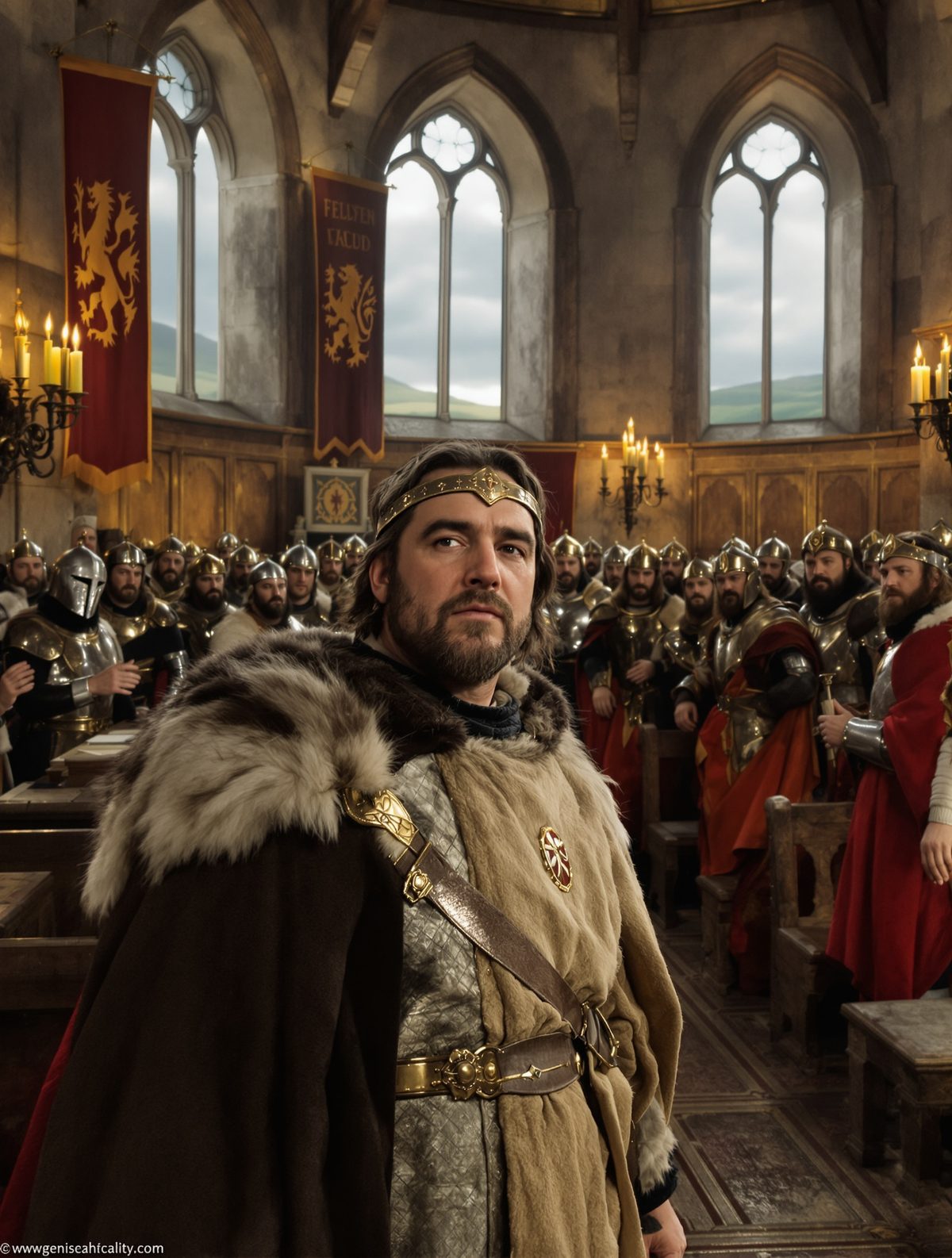
The hooves of a hundred horses thundered across the cobblestones of Machynlleth on a crisp April morning in 1404. Welsh lords dismounted in the shadow of the ancient market town's stone buildings, their breath visible in the mountain air, their faces bearing the weathered determination of men who had spent four years fighting for their freedom. They had come from every corner of Wales—from the wild reaches of Snowdonia to the fertile valleys of Powys—summoned by their self-proclaimed Prince to witness something extraordinary: the birth of a Welsh parliament.
For the first time in centuries, Wales would govern itself. Not as English subjects, not as conquered vassals, but as free Welshmen making their own laws in their own tongue. The man who had made this miracle possible stood waiting for them in the town's great hall: Owain Glyndŵr, the last Prince of Wales, architect of the most successful Welsh rebellion in history.
The Reluctant Revolutionary Who Shook an Empire
Owain Glyndŵr never intended to become a revolutionary. Born around 1354 into Welsh nobility, he was educated at the Inns of Court in London and served in the English army. He owned vast estates, spoke fluent English and French, and seemed the perfect example of an anglicized Welsh lord. But a land dispute with his English neighbor, Lord Grey of Ruthin, would change the course of Welsh history forever.
When Grey deliberately withheld crucial military summons from Glyndŵr in 1400, causing him to appear treasonous to King Henry IV, the Welsh lord realized his position was untenable. On September 16, 1400, a small group of supporters proclaimed him Prince of Wales at his manor house in Glyndyfrdwy. What began as a personal grievance exploded into a national uprising that would rage for over a decade.
Read next: The Day an English King Drowned an Army in a Marsh
By 1404, Glyndŵr controlled virtually all of Wales. His forces had captured the mighty Harlech Castle, defeated English armies in the field, and formed alliances with Scotland and France. Most remarkably, the French had formally recognized him as the rightful Prince of Wales and were sending military aid. For the first time since 1282, when Edward I had conquered Wales and executed the last native prince, the Welsh were masters of their own destiny.
When Diplomacy Spoke Louder Than Swords
The parliament at Machynlleth wasn't just a symbolic gesture—it was a calculated diplomatic masterstroke. Glyndŵr understood that military success meant nothing without legitimacy, and nothing conferred legitimacy like a functioning government. The choice of Machynlleth itself was brilliant: this ancient town in Powys sat at the heart of Wales, equally accessible to lords from north and south.
The parliament building, likely a wooden structure near the town's center, witnessed scenes that would have been unthinkable just years before. Welsh was the language of government, not Latin or French. Ancient Welsh laws, not English statutes, guided deliberations. Lords who had spent decades bowing to English authority now debated as equals, their voices carrying the weight of a sovereign nation.
Perhaps most remarkably, foreign ambassadors attended these sessions. Representatives from France and Scotland sat alongside Welsh nobles, negotiating treaties and trade agreements. The Tripartite Indenture, signed in 1405, carved up England itself between Glyndŵr, the Earl of Northumberland, and Edmund Mortimer, with Glyndŵr claiming territory extending deep into what is now England. It was an audacious document that treated the mighty English crown as a conquered territory to be divided among its enemies.
The Dream of Two Universities and a Welsh Church
What emerged from those parliamentary sessions reveals the scope of Glyndŵr's vision. This wasn't merely a military rebellion—it was a blueprint for a modern Welsh nation. The parliament approved plans for two universities, one in the north and one in the south, that would rival Oxford and Cambridge. These weren't pipe dreams: Glyndŵr had studied at both Oxford and Cambridge himself and understood education's power.
Even more revolutionary was the plan for an independent Welsh church. For centuries, the Welsh church had been subordinate to Canterbury and, ultimately, to English control. Glyndŵr's parliament declared its intention to establish a Welsh archbishopric answerable only to Rome, with services conducted in Welsh. This religious independence would have completed Wales's break from English control.
The parliament also addressed practical governance. They established a rudimentary civil service, appointed justices to administer Welsh law, and created systems for taxation and military levies. Remarkably, they even issued their own currency—Welsh coins bearing Glyndŵr's image have been discovered by archaeologists, tangible proof of this brief experiment in independence.
The Six Months That Changed Everything
From April to September 1404, Wales experienced something it hadn't known for over a century: self-rule. Trade flowed freely along Welsh roads without English interference. Welsh merchants negotiated directly with foreign traders. Courts operated under ancient Welsh legal traditions that recognized different concepts of justice and property than English law.
French military advisors worked alongside Welsh commanders, sharing the latest military technologies and tactics. Scottish envoys discussed coordinated attacks against their mutual English enemy. In the halls of European courts, Wales was spoken of as a sovereign nation, its prince as legitimate as any monarch.
But this golden period existed in the eye of a storm. Even as the parliament met, English armies were regrouping. Henry IV, initially dismissive of what he saw as another Welsh uprising, now recognized the existential threat Glyndŵr posed. The successful Welsh rebellion was inspiring similar movements in Ireland and Scotland. If Wales could break free, the entire English empire might crumble.
When the Dream Collided with Reality
The autumn of 1404 brought harsh realities. English forces, reinforced and better supplied, began systematic campaigns to retake Welsh territory. Castle by castle, valley by valley, they ground down Welsh resistance. The French aid, while significant, proved insufficient against English determination and resources.
By 1405, the parliament could no longer safely convene in Machynlleth. English forces controlled the roads, making travel dangerous for Welsh lords. The apparatus of government that had functioned so promisingly began to collapse under military pressure. Lords who had proudly attended parliament sessions now faced impossible choices: continued resistance meant exile and death, while submission meant survival but subjugation.
The dream universities were never built. The independent Welsh church remained a vision. The coins bearing Glyndŵr's image became curiosities buried in Welsh soil. By 1409, most major Welsh castles had fallen back into English hands, and by 1412, the rebellion was effectively over. Glyndŵr himself disappeared into the mountains, becoming more legend than man, his final fate unknown.
The Voice That Still Echoes
Why should we remember six months in medieval Machynlleth? Because they prove that Welsh independence wasn't just a romantic dream—it was a functioning reality. The parliament of 1404 demonstrated that Wales could govern itself, conduct diplomacy, and take its place among European nations. These weren't wild-eyed revolutionaries playing at government; they were experienced administrators creating institutions that worked.
The parliament also established a template that would echo through Welsh history. When the Welsh Assembly met for the first time in 1999, many observers noted the symbolic significance: after 595 years, Wales once again had its own parliament. The building in Machynlleth where Glyndŵr's parliament likely met is now a museum, a reminder that self-governance isn't foreign to Welsh tradition—it's the natural state briefly interrupted by conquest.
Perhaps most importantly, those six months in 1404 preserved something precious: the knowledge that it was possible. Through the darkest periods of English rule, through the suppression of Welsh language and law, through centuries of being told they were too small, too poor, too backward to govern themselves, the Welsh could remember Machynlleth. They could remember the day their ancestors proved that Wales had a voice—and the wisdom to use it.