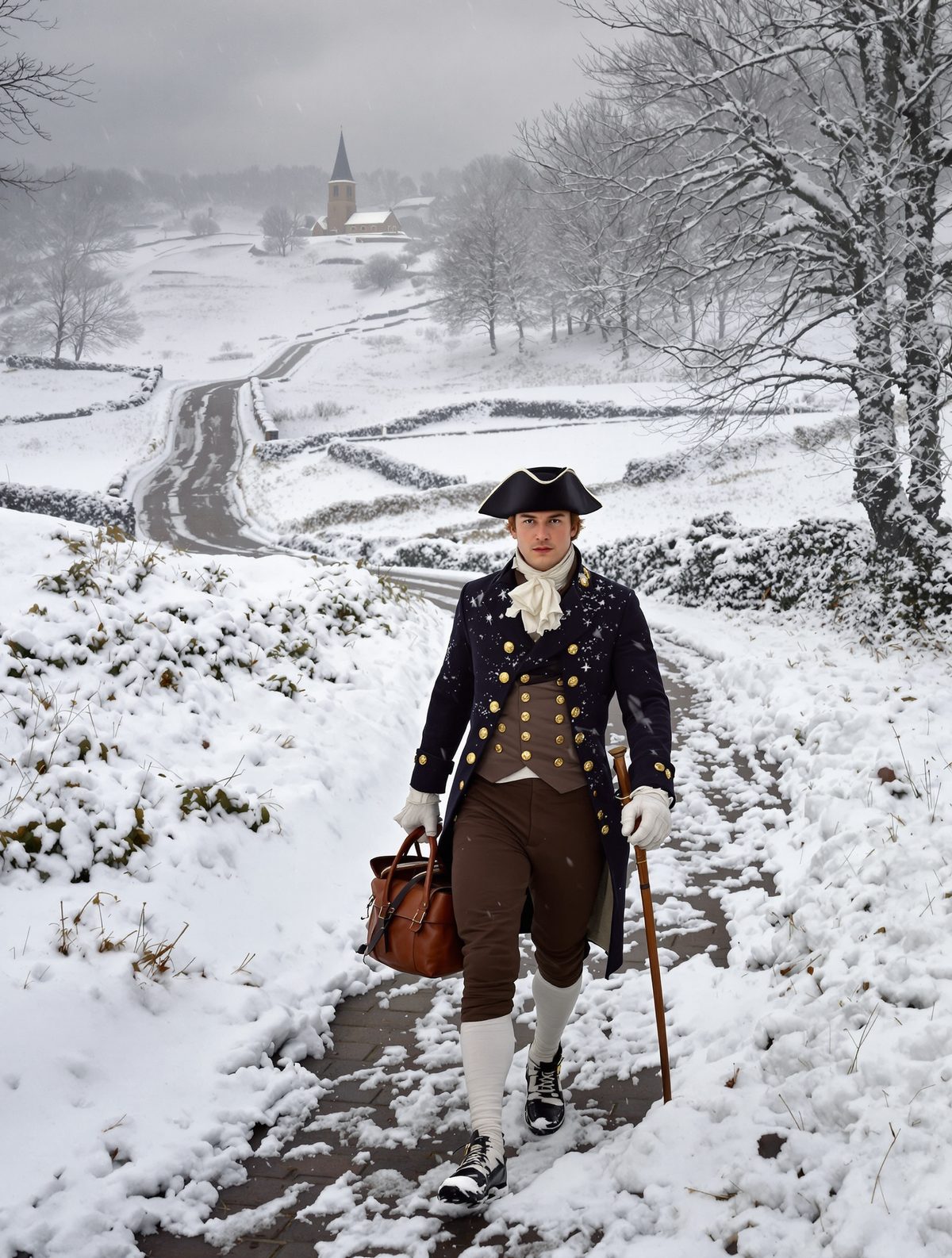
The snow bit at his face like a thousand tiny daggers as Robert Burns pulled his threadbare coat tighter around his shoulders. November 1786 had delivered one of the harshest early winters Scotland had seen in decades, and here he was, a 27-year-old farmer's son, trudging through knee-deep drifts with nothing but hope and his last few shillings burning a hole in his pocket. Behind him lay Mauchline and a life of backbreaking labour. Ahead, somewhere through the swirling white curtain, lay Kilmarnock—and quite possibly his salvation.
Burns had walked these roads before, but never with stakes this high. In his mind's eye, he could see them: 612 copies of his poems, bound in simple covers, waiting for him at John Wilson's print shop. The Kilmarnock Edition, as it would later be known to literary scholars worldwide, represented everything Burns had left to gamble. If it failed, he'd already booked passage to Jamaica to work on a sugar plantation. If it succeeded... well, that was a dream he barely dared entertain.
A Ploughman's Desperate Gamble
The journey that would transform Scottish literature began not with noble inspiration, but with crushing debt and heartbreak. Burns's farm at Mossgiel was failing spectacularly—the family owed their landlord £7, a sum that might as well have been £700 to people scraping by on barley and hope. Worse still, Jean Armour, the woman carrying his child, had been whisked away by her horrified parents when news of the pregnancy broke. The local church was preparing to haul him before the congregation for public shaming.
But Burns had a secret weapon: a collection of poems written by flickering candlelight after fourteen-hour days behind the plough. These weren't the refined verses of Edinburgh drawing rooms, but raw, passionate works that captured the authentic voice of rural Scotland. "The Cotter's Saturday Night," "To a Mouse," "Holy Willie's Prayer"—poems that would later be memorised by schoolchildren across the globe were still just ink scratches on paper, bundled in his father's cottage.
Read next: The Day a Scots Girl Thrust Her Arm Through a Door to Save a King
The idea of publishing them had come from his friend Gavin Hamilton, who'd listened to Burns recite at the local tavern and declared them worthy of print. But worthy and profitable were two different things entirely. Burns would have to fund the publication himself, and John Wilson's quote of £90 for 612 copies represented nearly every penny the young poet could scrape together.
The Printer's Promise
John Wilson's print shop on Star Inn Close was hardly an impressive operation—a cramped, ink-stained workspace where the proprietor cranked out everything from funeral notices to political pamphlets. But Wilson had something Burns desperately needed: faith in the project. While other printers had turned their noses up at dialect poetry from an unknown farmer, Wilson recognised something special in Burns's work.
The printing process had taken weeks longer than expected. Wilson's ancient press kept jamming, and securing enough quality paper during the harsh winter had proven nearly impossible. Each delay cost Burns precious time and money he couldn't afford to lose. His ship to Jamaica was scheduled to depart in December, and every day the books remained unfinished brought him closer to a life of exile in the Caribbean heat.
Burns had already arranged for advance subscriptions—friends, neighbours, and local gentry who'd agreed to purchase copies sight unseen. But would 612 books be enough to clear his debts and change his fortunes? The arithmetic was brutal: he needed to sell every single copy just to break even, and that was assuming Wilson's cost estimates held firm.
Through the Highland Blizzard
The storm that struck Ayrshire on November 27th, 1786, was the kind that seasoned Highlanders spoke of in hushed tones years later. Winds howled down from Ben Lomond with the fury of ancient gods, carrying snow that stung like buckshot and cold that could stop a man's heart in his chest. Sensible folk barricaded themselves indoors with whatever provisions they had and prayed for dawn.
Burns was not sensible folk. Word had reached him that morning: the books were ready. After months of delays and false starts, John Wilson had completed the print run of Poems, Chiefly in the Scottish Dialect. The 36-mile journey from Mauchline to Kilmarnock normally took a hardy walker about eight hours. In this weather, it would be an odyssey.
He set out before sunrise, carrying bread, cheese, and a small flask of whisky that would prove inadequate against the bitter cold. The roads, such as they were in 18th-century Scotland, disappeared entirely under the snow. Burns navigated by memory and instinct, following stone walls and familiar landmarks when visibility dropped to mere yards. More than once, he stumbled into hidden ditches or found himself walking in circles, his frozen feet unable to feel the ground beneath them.
What drove him forward through that hellish journey wasn't just desperation—it was an unshakeable belief that his words mattered. These weren't just poems to Burns; they were the authentic voice of Scotland's common people, finally given form and substance. He carried with him the laughter of tavern patrons who'd wept at "The Cotter's Saturday Night" and the approving nods of farmers who recognised their own struggles in his verses.
Triumph in Ice and Ink
When Burns finally staggered into Wilson's shop late that evening, the printer barely recognised the ice-crusted figure in the doorway. Burns's eyebrows were white with frost, his hands so numb he could barely feel the coins he'd carried in his pocket. But his eyes blazed with an intensity that cut through the winter darkness like a beacon.
There they were: 612 copies of his life's work, stacked in neat piles and bound in humble brown covers. The title page bore his name—not "Anonymous" or "By a Gentleman," but "Robert Burns." For a farmer's son in 18th-century Scotland, seeing his name in print was almost as revolutionary as the poems themselves.
Wilson later recalled that Burns stood speechless for nearly ten minutes, simply staring at the books as if afraid they might vanish like a mirage. When he finally spoke, it was to ask for one copy—just one—to hold and examine. His frozen fingers traced the letters of his name, turned each page with the reverence of a monk handling sacred scripture.
The books were priced at three shillings each—expensive for working folk but accessible enough to reach Burns's intended audience. Within days of his return to Mauchline, advance subscribers began collecting their copies. The response was immediate and electric. Here was poetry that spoke in the voice of ordinary Scots, that captured both the hardship and the dignity of rural life with unprecedented authenticity.
The Legend That Almost Wasn't
What Burns couldn't have known during that frozen trudge to Kilmarnock was that he was carrying the foundation of Scottish literary identity in his pocket. The Kilmarnock Edition would sell out within a month, launching the ploughman poet to national fame and eventually saving him from exile in Jamaica. Within a year, Edinburgh's literary elite would be toasting him in their drawing rooms, and his poems would be quoted from Glasgow to London.
But perhaps even more remarkable than Burns's meteoric rise was how close it came to never happening at all. Had Wilson's press broken down completely, had the winter been even harsher, had Burns lost his nerve during those brutal hours in the snow, Scotland's national poet might have vanished into the sugar plantations of the Caribbean, his genius lost forever to history.
The man who wrote "A Man's a Man for A' That" and gave Scotland its unofficial national anthem in "Auld Lang Syne" was saved by a 36-mile walk through a blizzard and an unshakeable faith that ordinary voices deserved to be heard. In our age of instant digital publishing and viral fame, Burns's desperate journey reminds us that great art often emerges not from comfort and certainty, but from the willingness to risk everything on the belief that authentic voices matter—even when the odds seem impossibly stacked against them.