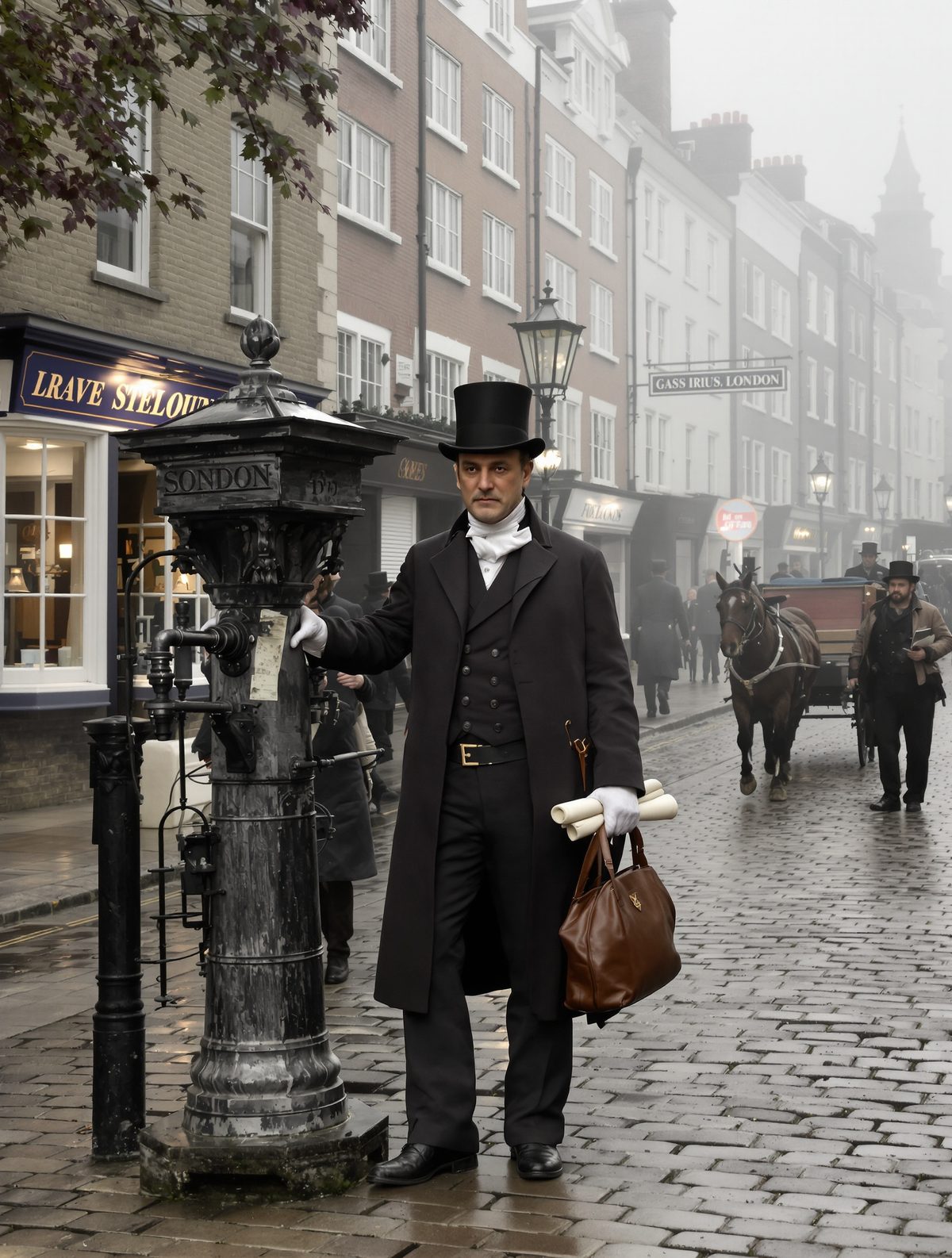
The stench hit you first. In the sweltering heat of September 1854, the narrow streets of Soho reeked of human waste, rotting vegetables, and something far worse—death itself. Bodies were piling up faster than coffins could be made. Entire families were wiping out in a matter of hours. And in the midst of this medieval nightmare stalking through Victorian London, one stubborn doctor was about to make a discovery that would save millions of lives—by removing a simple pump handle.
When Death Came Calling in Golden Square
It began on August 31st, 1854, in a cramped tenement at 40 Broad Street. Baby Frances Lewis fell violently ill with what her mother assumed was a stomach upset. By evening, the infant was dead. Her mother, Sarah, washed the soiled cloth diapers in a bucket and tossed the contaminated water into the cesspit behind their building—a cesspit that leaked directly into the neighborhood's water supply.
Within 72 hours, the disease had exploded through Soho like wildfire. Cholera—the "blue death" that could kill a healthy adult in six hours—was back in London with a vengeance. Victims suffered agonizing cramps as their bodies expelled every drop of fluid through violent vomiting and diarrhea. Their skin turned blue-black from dehydration. Most terrifying of all, they remained conscious until the very end.
By September 3rd, the death toll had reached 127. By September 10th, it was over 500. The wealthy fled to the countryside, abandoning their Mayfair mansions. Those too poor to escape huddled in their homes, praying the invisible killer would pass them by. The government's solution? More prayers. Parliament declared a national day of fasting to appease God's wrath.
Read next: The Day a Victorian Nurse Walked Into a Fever Ward Alone
But Dr. John Snow wasn't interested in divine intervention. He was interested in data.
The Doctor Who Saw Patterns Where Others Saw Chaos
At 41 years old, John Snow was already considered something of an oddball in medical circles. The son of a Yorkshire laborer, he'd clawed his way up from poverty through sheer brilliance and stubborn determination. He was a teetotaler in an age of heavy drinking, a vegetarian when meat was king, and worst of all—he questioned authority.
While his colleagues blamed cholera on "miasma"—poisonous air arising from rotting organic matter—Snow had developed a radical theory. He believed cholera spread through contaminated water, not bad air. It was medical heresy. The entire British establishment, from the government's Board of Health to the editor of The Times, ridiculed his ideas.
But as bodies piled up in Soho's narrow streets, Snow saw an opportunity to prove his theory once and for all. He grabbed his top hat and walking stick, and began the most important door-to-door investigation in medical history.
Working 18-hour days, Snow methodically mapped every death in the neighborhood. He knocked on doors, interviewed grieving families, and recorded precise addresses. Where did the victims live? What did they drink? Where did they work? His assistant, Reverend Henry Whitehead, initially skeptical of Snow's water theory, helped gather crucial intelligence from the tight-knit community.
The pattern that emerged was startling. Nearly every death clustered around a single location: the public water pump on Broad Street.
The Map That Changed Everything
Snow's famous cholera map—a masterpiece of early epidemiology—told a story that was impossible to ignore. Black bars marked each death like tombstones on paper. The closer to the Broad Street pump, the higher the death toll. Some buildings lost entire families. Others, mysteriously, remained untouched.
The evidence was overwhelming, but it was the exceptions that proved Snow's theory. The Workhouse on Poland Street, housing 535 inmates, had only five deaths. Why? They had their own private well. The brewery workers on Broad Street—right next to the pump—suffered almost no casualties. Their secret? The brewery provided free beer to employees, and the brewing process involved boiling water, killing cholera bacteria.
Most telling of all was the case of Susannah Eley, a widow from Hampstead who died of cholera on September 2nd—miles from Soho. Snow discovered that Eley had lived in Broad Street years earlier and loved the taste of its water so much that she had a large bottle delivered to her Hampstead home weekly. Her last delivery arrived on August 31st, the same day baby Frances Lewis died.
The pump water wasn't just contaminated—it was literally liquid death.
The Battle for the Board of Guardians
Armed with his evidence, Snow faced his greatest challenge: convincing the St. James Parish Board of Guardians to remove the pump handle. These weren't scientists—they were local businessmen, clergymen, and property owners who believed cholera spread through "bad air" and moral corruption.
The meeting on the evening of September 7th was contentious. Board members scoffed at Snow's water theory. How could something as pure and essential as water—especially from a pump renowned for its sweet taste—be the culprit? The miasma theory made intuitive sense: cholera struck the poor neighborhoods with open sewers and rotting refuse. Surely the foul-smelling air was to blame.
But Snow was persuasive, and the death toll was mounting. More importantly, several board members lived uncomfortably close to Broad Street. On September 8th, 1854, they voted to remove the pump handle.
The epidemic didn't end "overnight" as legend suggests—by then, most residents had either died or fled, and the natural course of the outbreak was already waning. But the symbolism was profound. For the first time in history, a disease outbreak had been stopped through scientific investigation rather than prayer, superstition, or blind luck.
The Skeptics Fight Back
You might expect Snow's triumph to be celebrated, but the opposite occurred. The medical establishment doubled down on their miasma theory. The Times dismissed Snow's findings. The Board of Health published reports ridiculing his water theory. Even after Snow presented his evidence to a government inquiry, the official conclusion blamed cholera on atmospheric conditions.
The pump handle was quietly replaced a few months later.
Snow spent the rest of his life fighting for acceptance of his discoveries. He refined his research, published detailed reports, and mapped additional outbreaks. But recognition remained elusive. When he died suddenly in 1858 at age 45—ironically, from a stroke, not cholera—his revolutionary ideas died with him.
It would take another major cholera outbreak in the 1860s, and the gradual acceptance of germ theory, before the medical community finally acknowledged that John Snow had been right all along. By then, it was too late to thank him.
The Handle That Changed the World
Today, a replica of the Broad Street pump stands on Broadwick Street (the street was later renamed) in Soho, marked by a pink granite kerbstone. Nearby, the John Snow pub honors the man who is now celebrated as the father of epidemiology. The original pump handle sits in a place of honor at the London School of Hygiene and Tropical Medicine.
But Snow's legacy extends far beyond a single street in London. His methodical approach to disease investigation—mapping cases, identifying patterns, testing hypotheses—became the foundation of modern public health. Every time epidemiologists trace the source of a disease outbreak, they're following in Snow's footsteps.
The COVID-19 pandemic reminded us just how relevant Snow's work remains. Contact tracing, cluster identification, and data visualization—all tools pioneered by a Victorian doctor walking door-to-door through cholera-ravaged Soho—became our primary weapons against a 21st-century plague.
The removal of the Broad Street pump handle wasn't just about stopping one cholera outbreak—it was about proving that science, not superstition, holds the key to human survival. In our age of vaccine hesitancy and conspiracy theories, John Snow's story serves as a powerful reminder that evidence-based medicine doesn't just save lives—it saves civilizations.
Sometimes the most profound revolutions begin with the simplest actions: a doctor with a theory, a map with black marks, and the courage to remove a pump handle when the whole world thinks you're wrong.