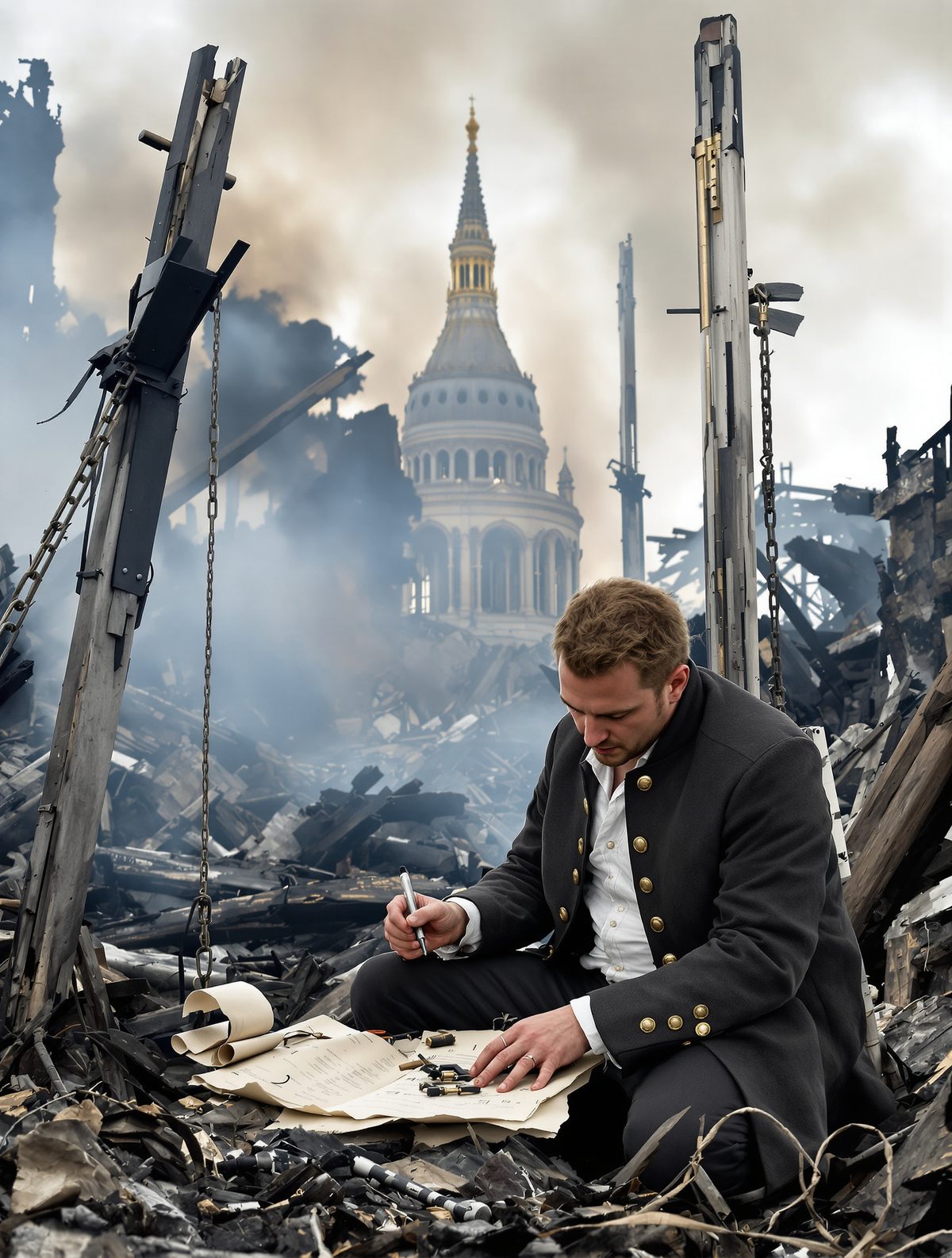
Picture this: a hunchbacked man with wild hair trudges through the smoking ruins of London, dragging a heavy surveyor's chain behind him. The year is 1666, and the Great Fire has just devoured four-fifths of the medieval City of London. While others despair at the devastation, Robert Hooke sees opportunity. In his brilliant mind, he's already rebuilding an entire city—one precise measurement at a time.
Most people know Christopher Wren as the genius who rebuilt London's churches after the Great Fire. But Wren's magnificent spires would never have risen without his closest friend and collaborator, a man whose name history has criminally forgotten. Robert Hooke didn't just help rebuild London—he quite literally laid the foundations for every single building that would rise from the ashes.
The Polymath Who Measured Everything
Robert Hooke was that rarest of creatures: a man whose curiosity knew no bounds. By 1666, at just 31 years old, he had already revolutionised microscopy, discovered the law of elasticity that bears his name, and served as Curator of Experiments to the Royal Society. He was the kind of person who would examine a flea under his microscope in the morning, design a new clock escapement after lunch, and spend his evening debating the nature of gravity with Isaac Newton (whom he cordially detested).
But when London burned for four terrible days in September 1666, consuming 13,200 houses, 87 churches, and countless livings, Hooke found his greatest challenge yet. The fire had destroyed not just buildings, but something far more precious: the very knowledge of where those buildings had stood. Property deeds had burned with their owners' homes. Ancient boundary stones had cracked in the heat. Landmarks that had existed since medieval times were now just ash and memory.
Read next: The Day a Tudor Chancellor Chose Death Over a Royal Lie
Without accurate surveys, London faced chaos. How could anyone prove they owned a particular plot? How could builders know where one property ended and another began? The city needed someone with an extraordinary combination of skills: the technical precision of a surveyor, the stamina of an explorer, and a memory that could reconstruct a lost world from fragments.
Walking Through Hell with a Chain and Notebook
In March 1667, six months after the flames died down, the City of London Corporation made one of the smartest decisions in urban planning history. They appointed Robert Hooke as one of three official City Surveyors, alongside Christopher Wren and Peter Mills. While Wren would focus on the grand churches and Mills on civic buildings, Hooke took on the most daunting task: surveying every single plot where a house had once stood.
What followed was an epic of endurance that lasted six grueling years. Every morning, Hooke would shoulder his surveyor's chain—a 66-foot length of iron links that weighed nearly as much as a small child—and set out into the ruins. His measuring rod in one hand, his notebook in the other, he began the impossible task of reconstructing medieval London from rubble and memory.
The physical challenges were immense. Much of the City was still a moonscape of collapsed walls and debris-choked streets. Cellars had caved in, creating hidden traps for the unwary. The stench of burned timber, rotting food, and worse things still hung in the air. Yet day after day, Hooke dragged his chain through this wasteland, measuring, calculating, and sketching.
But the mental challenge was even greater. Hooke had to survey over 8,000 individual properties, most with irregular medieval boundaries that followed no logical pattern. A typical plot might be 20 feet wide at the street, narrow to 15 feet in the middle, then flare out to 25 feet at the back, following property lines established centuries before anyone thought to write them down.
The Art of Forensic Archaeology
How do you survey a property that no longer exists? Hooke became London's first forensic archaeologist, developing techniques that wouldn't seem out of place on a modern crime scene investigation. He learned to read the landscape like a book written in ash and stone.
A foundation stone poking through the rubble might mark a corner of a house. The pattern of nails in a burned beam could reveal where a property partition had stood. Even the color of ash told stories—darker patches marked where hearths had been, giving away the locations of interior walls. Hooke's extraordinary eye for detail, honed by years of microscopic observation, now served him on a vast scale.
When physical evidence failed, Hooke turned detective. He interviewed survivors, tracking down former neighbors who might remember where one garden ended and another began. He consulted pre-fire maps, though few existed and fewer still survived. He even studied old legal documents, searching for clues in property disputes that had seemed trivial before the fire but now held the keys to reconstruction.
Perhaps most remarkably, Hooke often had to make educated guesses—and convince property owners that his guesses were correct. Imagine the pressure: a man's life savings, his family's future, might depend on whether Hooke placed a boundary marker three feet to the left or right. Yet complaints about his surveys were remarkably rare, testament to both his accuracy and his diplomatic skills.
Racing Against Time and Human Nature
As Hooke worked, London was rebuilding around him. The city couldn't wait for perfect surveys—people needed homes, businesses needed premises, and every day of delay meant more economic hardship. This created a constant race between measurement and construction, with Hooke often surveying plots just hours before builders broke ground.
The human drama was intense. Property owners, having lost everything in the fire, were desperate to rebuild and recoup their losses. Some tried to grab extra land, hoping to expand their plots in the confusion. Others had fled London entirely, leaving their property rights unclear. Meanwhile, speculative builders circled like vultures, ready to snap up any unclaimed land.
Hooke found himself not just a surveyor but a mediator, diplomat, and sometimes referee. His surviving correspondence reveals a man under enormous pressure, fielding complaints, resolving disputes, and working impossible hours. In one letter, he mentions surveying from dawn to dusk for weeks on end, so exhausted he could barely hold his pen to record the day's measurements.
Yet he persevered with almost superhuman determination. By 1672, Hooke had surveyed and marked the boundaries of over 8,000 properties—roughly two-thirds of all the plots destroyed in the fire. His surveys became the legal foundation for London's reconstruction, accepted by property owners, builders, and courts alike.
Read next: The Day a Tudor Bishop Refused to Crown a Usurper
The Unsung Foundation of Modern London
The scale of Hooke's achievement becomes clear when you walk through the City of London today. Every street, every building plot, every property boundary in the historic core traces back to his surveys. The irregular medieval street pattern that survived the fire—and gives modern London much of its character—exists because Hooke painstakingly mapped it back into existence.
But Hooke's contribution went far beyond measurement. His surveys enabled the single largest reconstruction project in European history. Within a decade of the fire, London had not just rebuilt but transformed itself into the most modern city in Europe. New building regulations, enforced through Hooke's precise plot boundaries, replaced medieval timber construction with brick and stone. Wider streets, better drainage, and improved fire safety all flowed from his foundational work.
The economic impact was staggering. London's rapid reconstruction helped establish it as Europe's leading commercial center, setting the stage for Britain's later dominance in global trade. The confidence that property rights would be respected—guaranteed by Hooke's surveys—attracted investment from across Europe. In a very real sense, Hooke's measuring chain helped forge the modern global economy.
Why the Forgotten Surveyor Still Matters
Today, as cities worldwide grapple with urban renewal, climate adaptation, and post-disaster reconstruction, Robert Hooke's achievement resonates powerfully. He showed that successful rebuilding requires more than grand architectural vision—it demands meticulous attention to the mundane details of property rights, boundaries, and legal clarity.
Modern urban planners facing the aftermath of earthquakes, floods, or wars still encounter the same fundamental challenge Hooke faced: how do you rebuild a community when the physical markers of ownership have vanished? His solution—combining scientific precision with human diplomacy, forensic investigation with educated guesswork—remains relevant today.
Perhaps most importantly, Hooke's story reminds us that history's greatest achievements often depend on unsung heroes willing to do unglamorous but essential work. While Christopher Wren's churches still inspire awe, and his name adorns streets across London, Robert Hooke—who made those churches possible—lies in an unmarked grave somewhere in the city he rebuilt.
The next time you walk through London, remember the hunchbacked genius with the surveyor's chain. Every step you take follows paths he measured, every building you pass sits on foundations he laid out. Robert Hooke didn't just rebuild London—he built the invisible framework that let a great city rise from its own ashes, stronger and more beautiful than ever before.