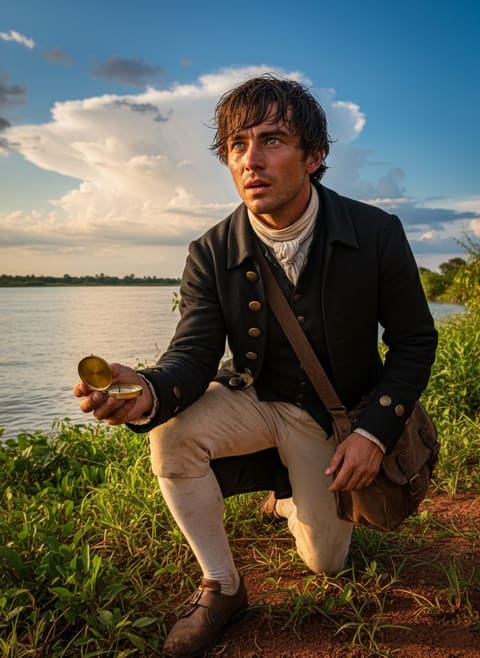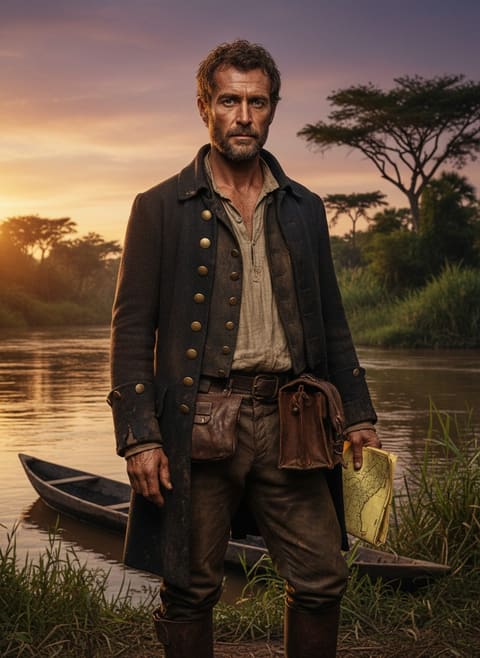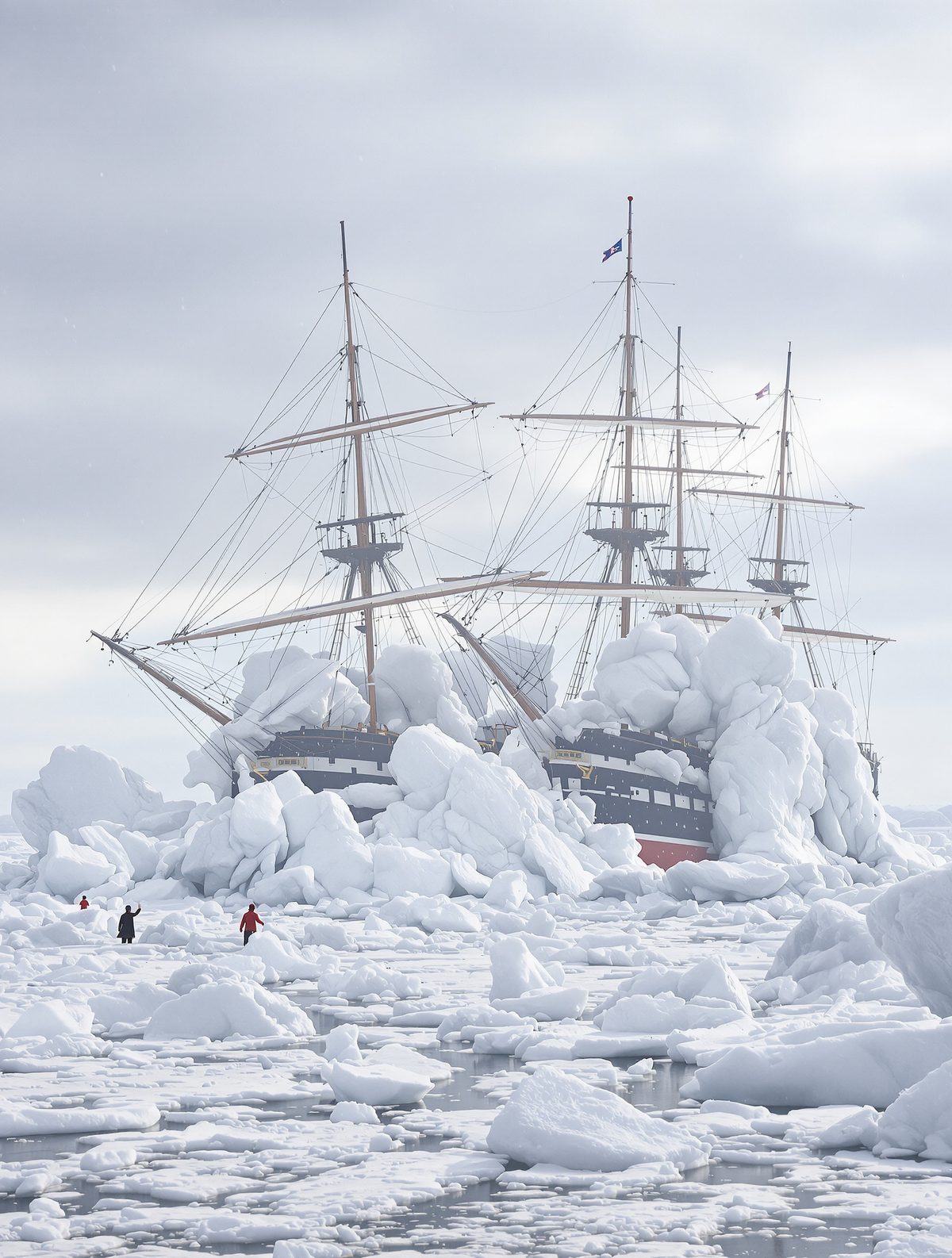
On a crisp May morning in 1845, two massive warships cut through the grey waters of the Thames, their black hulls gleaming with fresh paint and their steam engines belching confident clouds into the London sky. Crowds lined the riverbanks, waving handkerchiefs at the 129 souls aboard HMS Erebus and HMS Terror. These weren't just any ships—they were floating fortresses packed with three years of tinned beef, 8,000 pounds of chocolate, a daguerreotype camera, and even a hand organ that could play 50 different tunes. The Royal Navy had spared no expense in outfitting what would become the most technologically advanced polar expedition in history.
What those cheering spectators couldn't know was that they were witnessing the last time any of these men would be seen alive by the civilized world. Within months, both ships and every soul aboard would vanish into the Arctic ice as completely as if the earth had opened up and swallowed them whole.
The Knight of the Frozen Seas
At the helm of this ambitious venture stood Sir John Franklin, a man whose very name had become synonymous with Arctic exploration. At 59, Franklin was no fresh-faced adventurer seeking glory—he was a battle-hardened veteran who had survived the carnage of Trafalgar, mapped thousands of miles of Canada's northern coastline, and earned his knighthood through sheer perseverance in some of the world's most hostile environments. His previous Arctic expeditions had earned him the romantic nickname "the man who ate his boots" after surviving 11 months in the Canadian wilderness on a diet that included leather footwear, lichen, and eventually, according to whispered rumors, something far more grisly.
The Admiralty chose Franklin not just for his experience, but for his unshakeable faith in British ingenuity and naval supremacy. This expedition would be different from the desperate, improvised affairs of the past. This time, they would conquer the Northwest Passage—that legendary sea route connecting the Atlantic and Pacific through the Arctic—with overwhelming technological superiority.
Read next: The Day a Devon Captain Charted the Pacific and Changed the World
But Franklin's age concerned some observers. "He's too old," muttered critics in the gentlemen's clubs of London. The Admiralty had actually offered the command to a younger man first, but when he declined, they turned to their reliable old lion. Franklin himself harbored no such doubts. "I might find it difficult to start again," he told his wife Jane, "should I decline the offer."
Floating Palaces of the Ice Age
HMS Erebus and HMS Terror were marvels of Victorian engineering, bomb ships originally built to withstand the tremendous recoil of heavy mortars. Their hulls, reinforced with iron plating and triple-thick oak timbers, could theoretically punch through ice that would crush lesser vessels like eggshells. Each ship bristled with cutting-edge technology that would have seemed like science fiction to earlier generations of explorers.
The crews enjoyed luxuries that would have astounded their predecessors: steam-powered heating systems that could warm the entire ship, railway locomotive engines adapted for ice-breaking, and even primitive hot water systems for washing. The ships' libraries contained over 1,000 books, including everything from Charles Dickens novels to detailed scientific treatises. Franklin's personal cabin was fitted with mahogany furniture and his wife's portrait hanging above his desk.
Perhaps most remarkably, the expedition carried more than 8,000 tins of preserved food—a relatively new technology that the Admiralty believed would solve the age-old problem of scurvy and starvation that had plagued previous Arctic ventures. The contractor, Stephen Goldner, had been awarded the massive supply contract at the last minute, forcing him to rush production in facilities that may not have maintained proper quality control. This detail would later prove more significant than anyone could have imagined.
Into the White Silence
The last confirmed sighting of Franklin's expedition came in July 1845, when the whaling captain Dannett of the ship Prince of Wales encountered both vessels moored to an iceberg in Baffin Bay. Dannett reported that all appeared well—the crews were in good spirits, the ships were undamaged, and Franklin himself seemed confident about their prospects. The expedition was waiting for favorable conditions to attempt the passage through Lancaster Sound into the maze of islands and channels that form the Canadian Arctic archipelago.
What happened next remains one of the greatest mysteries in exploration history. The ships sailed into Lancaster Sound and simply... disappeared. For two years, the outside world heard nothing. This wasn't initially cause for alarm—Arctic expeditions routinely lost contact for extended periods, and Franklin carried supplies for three years. The Admiralty expected him to emerge victorious from either the Atlantic or Pacific side of the continent sometime in 1848.
But 1848 came and went with no word. By 1849, Jane Franklin was pressing the government to launch search expeditions. Her husband had vanished into a white void so complete that it seemed to mock the very notion of British naval supremacy.
The Greatest Search in Naval History
What followed was an unprecedented search effort that would consume the Royal Navy for the next decade. More than 30 separate expeditions were launched to find Franklin, involving dozens of ships and thousands of men. The search covered an area larger than Western Europe, from Greenland to Alaska, with rescue ships probing every inlet, sound, and channel in the Arctic archipelago.
The first breakthrough came in 1850 when searchers discovered Franklin's winter camp on Beechey Island—three graves marked with wooden headboards and the remnants of a substantial settlement. The graves belonged to John Torrington, John Hartnell, and William Braine, crew members who had died during the expedition's first winter. When modern scientists exhumed these bodies in the 1980s, they found them perfectly preserved in the permafrost, their faces still bearing expressions of peaceful repose after nearly 140 years.
But the Beechey Island camp raised more questions than answers. The graves contained no record of what had killed the men or where the expedition planned to go next. The site showed evidence of extensive activity—workshops, storage areas, and the remains of scientific observations—but no indication of distress. It was as if 129 men had simply packed up one morning and walked into oblivion.
Whispers from the Ice
The truth, when it finally emerged through a combination of Inuit testimony, scattered artifacts, and written records found years later, was more horrifying than anyone had imagined. Franklin himself died in June 1847, two years after the expedition began, along with eight other men. The ships became trapped in pack ice near King William Island, and for nearly two years, the surviving crew waited for the ice to release them.
Read next: The Day a Devon Sailor Mapped the Roof of the World Alone
It never did. By April 1848, the 105 survivors made the desperate decision to abandon their ships and march overland toward a Hudson's Bay Company outpost hundreds of miles to the south. They hauled heavy sledges loaded with supplies across the brutal Arctic landscape, but they were already weakened by cold, hunger, and what modern analysis suggests was lead poisoning from the solder used in their tinned food.
The final, devastating piece of evidence came from Inuit witnesses who described encountering groups of starving white men dragging sledges and boats across the ice. Some Inuit reported finding bodies with evidence that the starving sailors had resorted to cannibalism in their final, desperate weeks. Victorian Britain recoiled from these accounts, but modern forensic analysis of recovered bones has confirmed cut marks consistent with the removal of flesh.
Not a single member of Franklin's expedition survived to tell their story in their own words.
Legacy Written in Ice
The Franklin expedition's disappearance marked the end of an era—the last time Britain would attempt to conquer the Arctic through sheer technological superiority and naval tradition. The disaster revealed the hubris underlying Victorian confidence in progress and empire, showing that no amount of tinned beef and steam engines could overcome the fundamental indifference of nature to human ambition.
Yet the search for Franklin achieved something the expedition itself could not: it mapped vast areas of the Arctic and proved that a Northwest Passage did exist, though not where Franklin had sought it. The decades-long search effort advanced polar science, navigation, and survival techniques far beyond what Franklin's successful return might have accomplished.
In our age of GPS satellites and climate change, when cargo ships routinely transit the Northwest Passage that Franklin died seeking, his story serves as a haunting reminder of the price of exploration. The Arctic that swallowed Erebus and Terror whole is disappearing beneath warming seas, but the lesson remains: the natural world still holds mysteries that can humble human ambition, no matter how advanced our technology or how confident our plans.
Sometimes the greatest discoveries come not from those who succeed, but from those who vanish into legend, leaving only questions that echo across the centuries like voices calling through the polar wind.