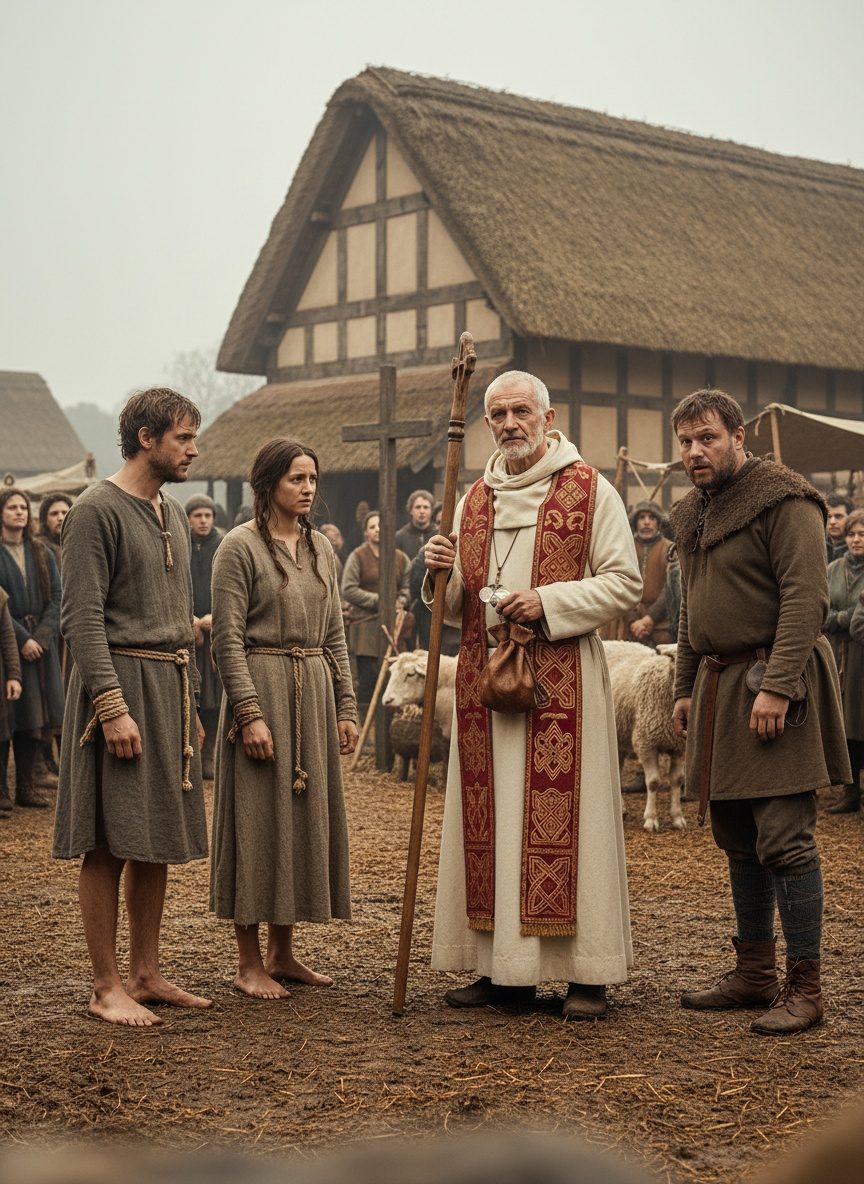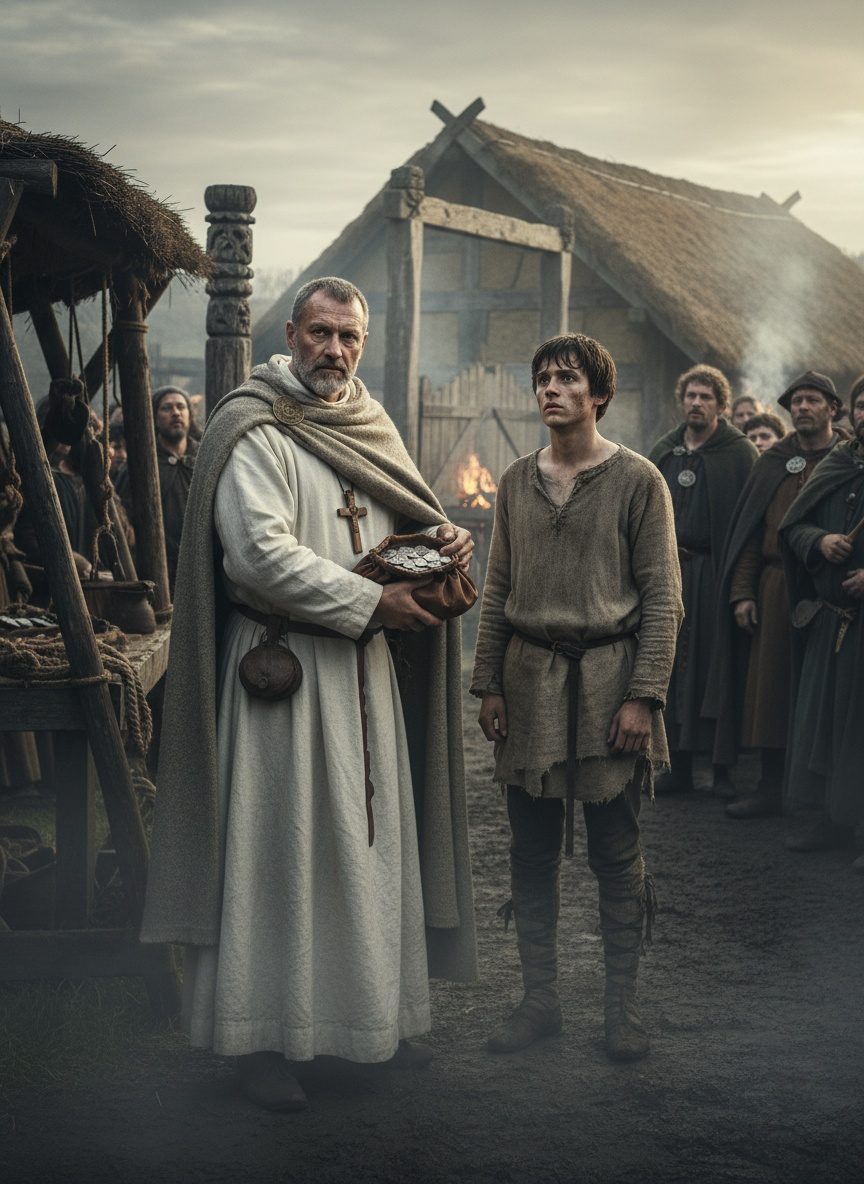
The North Sea wind howled across the Yorkshire cliffs as a determined woman in rough woolen robes raised her wooden staff toward the grey autumn sky. Below her, waves crashed against jagged rocks that had witnessed Viking longships and Roman galleys. Above her, seabirds wheeled and cried, as if announcing something momentous. This was Streanshalch—later known as Whitby—and on this day in 657 AD, Abbess Hilda was about to change the course of English Christianity forever.
What she built here would become more than just another monastery. It would become a beacon of learning where kings sought wisdom, where women held power equal to men, and where a decision made decades later would determine whether England followed Rome or the Celtic church. But first, Hilda had to survive the politics, the elements, and the radical idea that women's souls were worth saving too.
The Noblewoman Who Chose God Over Gold
Hilda's story begins not in Yorkshire, but in the royal courts of East Anglia, where she was born around 614 AD as the great-niece of King Edwin of Northumbria. In an age when noble women were expected to secure political alliances through marriage, Hilda had other plans. For thirty-three years, she lived at court, witnessing the brutal realities of Anglo-Saxon politics—kings murdered by rivals, kingdoms won and lost in single battles, Christianity competing with ancient pagan traditions.
The turning point came in 647 AD when she decided to abandon her life of privilege and become a nun. But here's where Hilda's story takes an unexpected twist: instead of retreating to some quiet convent, she became one of the most politically influential figures of her age. King Oswy of Northumbria didn't just tolerate her ambitions—he actively supported them, granting her the clifftop site at Whitby to build something unprecedented.
Read next: The Day a Saxon King Knelt and Washed a Leper's Feet
Why would a king give such power to a woman? The answer lies in the unique nature of Anglo-Saxon Christianity, where abbesses wielded authority that would have been unthinkable in later medieval periods. Hilda wasn't just founding a religious house—she was establishing what would become the Oxford or Cambridge of 7th-century England.
The Revolutionary Idea of Learning for All
When Hilda's builders began laying the first stones of Whitby Abbey in 657 AD, they were constructing something that had never been seen before in England: a double monastery where men and women lived, worked, and studied together. The complex sprawled across the clifftop, with separate living quarters but shared churches, libraries, and scriptoriums.
In an era when perhaps one person in a thousand could read, Whitby became a powerhouse of education. Monks and nuns copied manuscripts by candlelight, preserving everything from the Gospels to classical Roman texts. The abbey's library grew to contain hundreds of volumes—a fortune in knowledge when a single book might cost more than a farm.
But Hilda's most radical innovation was insisting that education be available to both sexes. While most monasteries were strictly segregated, Whitby's nuns could access the same texts, participate in the same theological debates, and develop the same scholarly skills as their male counterparts. This wasn't just progressive—it was revolutionary.
The results speak for themselves: Whitby produced five bishops during Hilda's lifetime, along with countless scholars, poets, and political advisors. Among them was a humble cowherd named Cædmon, who became England's first known named poet after receiving, according to the Venerable Bede, divine inspiration in a dream.
The Abbess Who Counseled Kings
By the 660s, Hilda had transformed from a noble refugee into one of the most powerful figures in Northumbria. Kings didn't just respect her—they needed her. When political crises erupted, when succession disputes threatened civil war, when military campaigns required divine blessing, rulers made the journey to Whitby's windswept cliffs to seek the abbess's counsel.
This wasn't mere superstition. Hilda possessed something invaluable in the violent world of Anglo-Saxon politics: neutrality backed by moral authority. As an abbess, she had no hereditary claims to press, no armies to deploy, no territorial ambitions to pursue. What she offered was wisdom, education, and the kind of long-term thinking that warrior-kings often lacked.
Her influence extended far beyond Northumbria. When disputes arose between neighboring kingdoms, Hilda often served as mediator. Her abbey became neutral ground where enemies could meet, negotiate, and find solutions that preserved both honor and peace. In an age of constant warfare, Whitby offered something precious: stability.
But Hilda's greatest test as a political figure was yet to come, and it would involve a dispute that would echo through English history for centuries.
The Synod That Chose Rome Over Celtic Tradition
In 664 AD, seven years after Hilda's abbey was founded, King Oswy called together the most important church leaders in his kingdom for a gathering that would be remembered as the Synod of Whitby. The location was no accident—Hilda's abbey had become renowned as a place of learning and neutrality, making it the perfect venue for resolving a crisis that threatened to tear English Christianity apart.
The dispute seemed technical but carried enormous implications: should the English church follow Celtic traditions or Roman practices? The immediate issue was the date of Easter, but beneath this lay fundamental questions about authority, independence, and England's relationship with continental Europe.
Celtic Christianity, which had sustained British believers through the dark centuries after Roman withdrawal, emphasized local autonomy and ancient traditions. Roman Christianity offered connection to the wider Christian world and the prestige of papal authority. Each side had passionate advocates, and both had shaped Northumbrian religious life.
Here's what most histories don't tell you: Hilda herself supported the Celtic position. Having been educated by Celtic missionaries and having built her abbey according to Celtic traditions, she believed in maintaining England's spiritual independence. But when King Oswy ultimately chose to follow Rome—reportedly swayed by arguments about St. Peter holding "the keys to heaven"—Hilda accepted the decision with grace that impressed even her opponents.
The Synod of Whitby didn't just settle a calendar dispute. It aligned English Christianity with Rome for the next nine centuries, paving the way for everything from Thomas Becket to the English Reformation.
The Legacy Written in Stone and Spirit
Hilda died in 680 AD, after ruling Whitby for twenty-three years. But her influence continued long after her body was laid to rest in the abbey church. Under her successors, Whitby remained a center of learning and political influence well into the 8th century. The abbey survived Viking raids, Norman conquest, and centuries of political upheaval before finally falling to Henry VIII's dissolution of the monasteries in 1539.
Today, visitors to Whitby can still see the haunting ruins of Hilda's abbey perched on the clifftop, though the stones they're looking at are mostly from the later medieval rebuilding. What they're really seeing is the ghost of an idea: that women could lead, that learning could flourish even in dark times, and that wisdom sometimes mattered more than warfare.
The artifacts tell the story too. Archaeological excavations have revealed the foundations of Hilda's original wooden buildings, along with fragments of glass, metalwork, and carved stone that speak to the abbey's wealth and sophistication. In the local museum, you can see the remains of manuscripts copied in Whitby's scriptorium—tangible links to a time when this clifftop was one of Europe's most important intellectual centers.
Perhaps most remarkably, Hilda's approach to education lived on. The tradition of women religious exercising real authority, of scholarship being valued alongside prayer, of monasteries serving as centers of learning—all of this can be traced back to the windswept clifftop where an determined abbess raised her staff and declared that this place would be different.
In our own age of educational inequality and gender disparity in leadership, Hilda's vision seems remarkably modern. She understood something that took the wider world centuries to rediscover: that societies flourish when they educate everyone, when they value wisdom over strength, and when they create spaces where different ideas can meet and mingle. On a Yorkshire clifftop thirteen centuries ago, one woman proved that saving souls and changing the world weren't mutually exclusive—sometimes they were the same thing.