The screaming began before dawn. Across the dark waters of the Menai Strait, Roman soldiers could hear them—wild voices chanting in a language that seemed to twist the very air. As the first light of that fateful morning in AD 60 illuminated the mists, the legionaries saw something that would haunt their dreams forever: druids in white robes dancing between blazing sacred groves, their arms raised to ancient gods, calling down curses upon the steel-clad invaders waiting on the opposite shore.
What happened next would echo through British history for two millennia. General Suetonius Paulinus was about to give an order that would silence Britain's oldest religion forever and scatter its priests to the four winds. But getting to this moment had required crossing one of the most treacherous waterways in Britain—and overcoming terror so profound that even Rome's battle-hardened veterans hesitated at the water's edge.
The Last Sacred Stronghold
Anglesey wasn't just another island to be conquered—it was the beating heart of British resistance to Rome. Known to the Celts as Ynys Môn and to the Romans as Mona, this windswept island off the Welsh coast served as the spiritual headquarters of the druids, the priest-class that bound together the fractious British tribes with shared religion, law, and hatred of Roman occupation.
For seventeen years since Claudius's invasion in AD 43, Rome had steadily consumed southern and central Britain. Legions had marched through Kent, crushed Caratacus in Wales, and established gleaming new towns where British warriors once held sway. But Anglesey remained unconquered—a thorn in the empire's side that grew more dangerous with each passing year.
Read next: The Day a Yorkshire Valley Swallowed a Roman Legion
Here's what the textbooks rarely tell you: Anglesey wasn't just a religious center—it was a sophisticated military-industrial complex. The island's rich agricultural lands fed British resistance movements across Wales, while its gold mines provided the wealth to buy weapons and mercenaries. Most crucially, it served as a training ground where young druids learned not just religious rites, but the arts of war, law, and tribal diplomacy that held the British confederation together.
Suetonius Paulinus understood this better than most. A veteran of African campaigns and one of Rome's most ruthless generals, he knew that cutting off the head of British resistance meant more than defeating armies—it meant destroying the druids who gave those armies purpose and unity.
Terror at the Water's Edge
The sight that greeted the XIV Gemina and XX Valeria Victrix legions that morning would have broken lesser men. According to Tacitus, our primary source for these events, the Menai Strait seemed to writhe with supernatural menace. The druids had prepared their defense not just with spears and swords, but with psychological warfare that struck at the very souls of the Roman invaders.
Women dressed as Furies—the avenging spirits of Roman nightmares—ran between the warriors with flaming torches, their hair streaming wild in the salt wind. They carried brands dipped in pitch and fat, creating towering pillars of black smoke that seemed to reach toward the heavens like grasping fingers. The druids themselves, clad in white robes that seemed to glow against the dark landscape, moved in ritual formations while chanting curses in ancient British dialects that predated Latin by centuries.
But perhaps most terrifying of all were the sounds. The druids possessed bronze carnyx—long war trumpets shaped like serpents or boars—whose haunting calls could be heard for miles. Mixed with the chanting, the crackling of sacred fires, and the rhythmic beating of shields, the cacophony created what one Roman writer later described as "the very voice of the underworld."
For a crucial moment, Rome's professional soldiers—men who had faced Germanic berserkers and Gallic cavalry without flinching—stood paralyzed. Tacitus tells us they were "struck motionless by the unfamiliar sight" and seemed frozen "as though their limbs were paralyzed."
Paulinus's Gamble
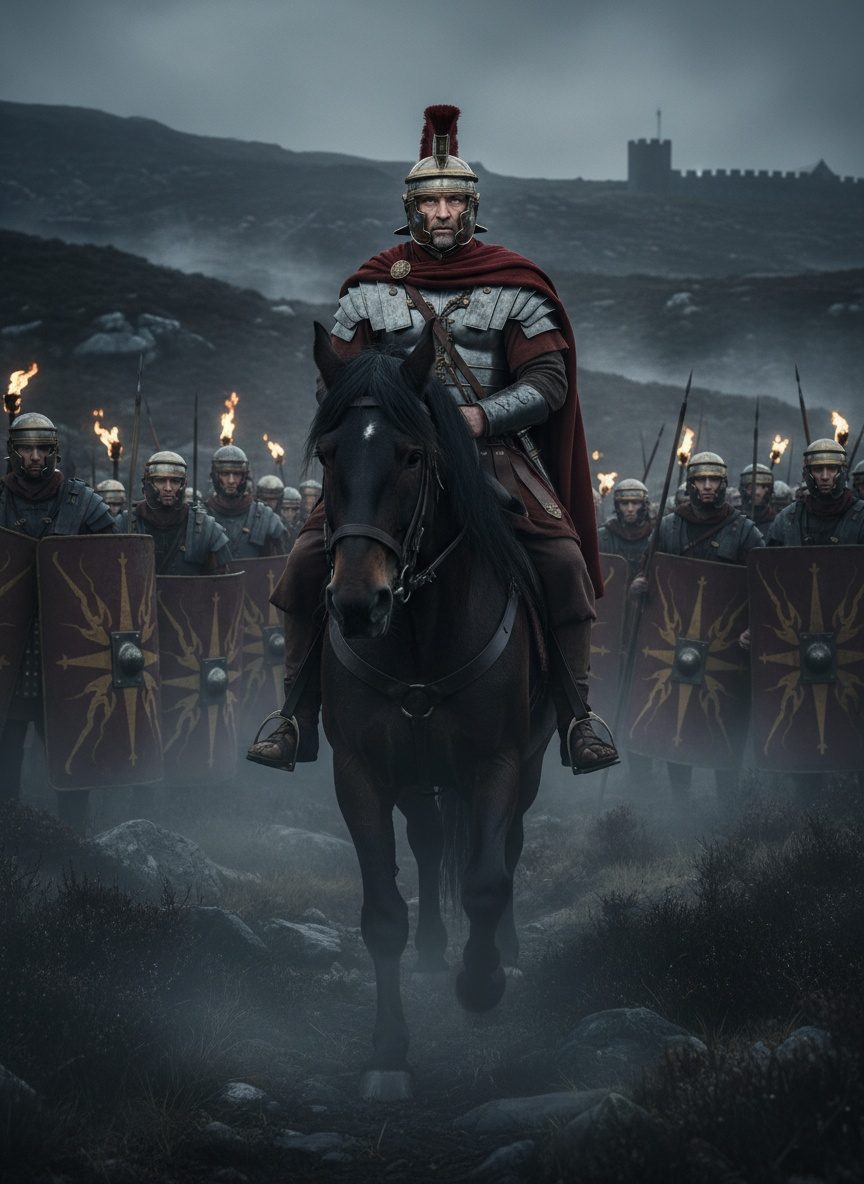
It was Suetonius Paulinus himself who broke the spell. Riding among his hesitant troops, the general delivered what may have been one of the most consequential speeches in British history—though sadly, its exact words are lost to time. What we know is that he reminded his men of their training, their discipline, and their duty to Rome. More pragmatically, he pointed out that for all their theatrical terror, the druids were still just men and women armed with bronze weapons facing Roman steel.
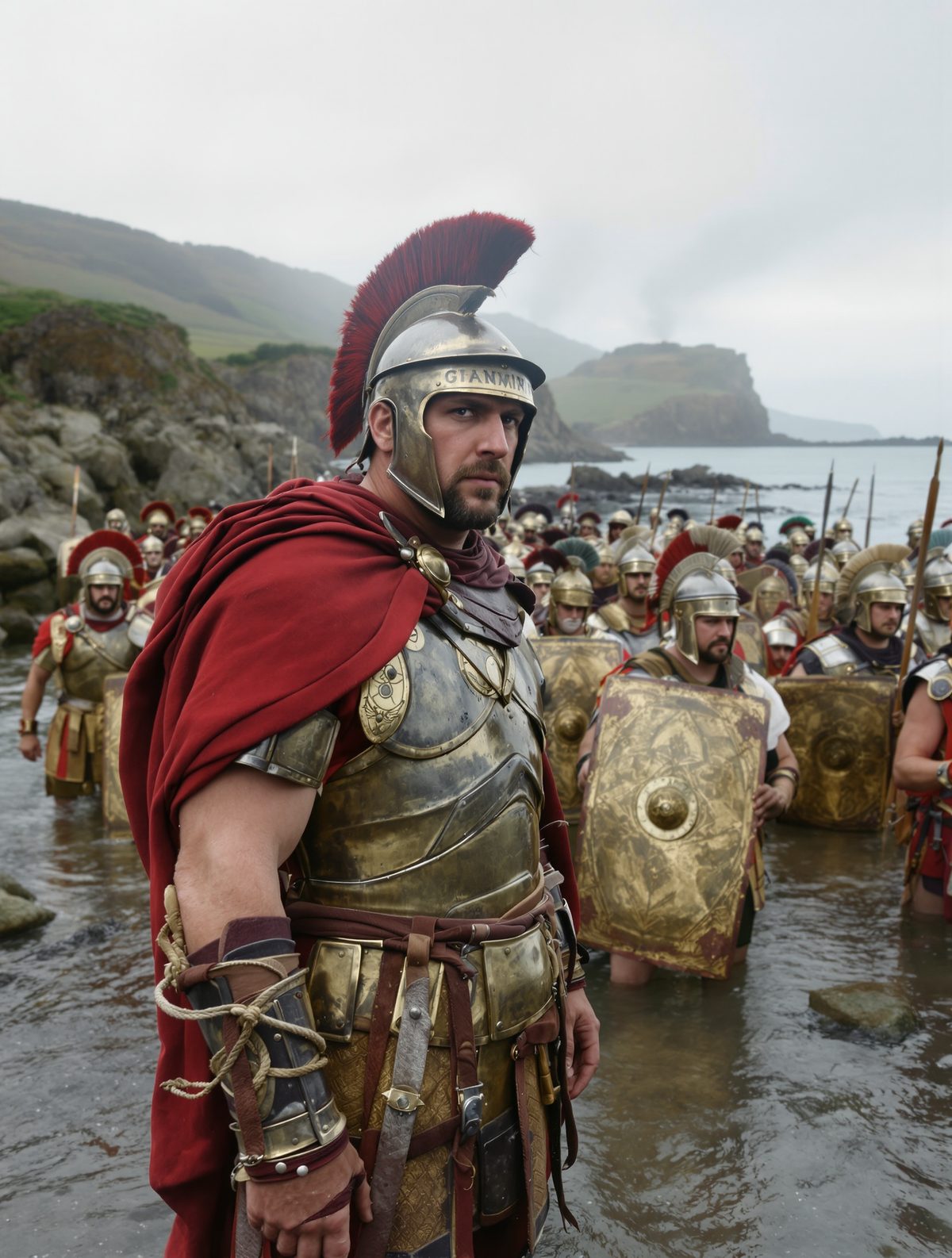
The crossing of the Menai Strait represented a masterpiece of Roman engineering and tactical innovation. The strait, which separates Anglesey from the Welsh mainland, was notorious for its treacherous currents and quicksand-like mudflats. But Paulinus had prepared for months. His engineers had studied the tides, identified the safest crossing points, and constructed specialized flat-bottomed boats that could navigate the shallow, shifting waters.
The attack came at low tide when the strait was at its narrowest. While the main force crossed in boats, Paulinus made a brilliant tactical decision that showcased Roman adaptability: he ordered his auxiliary cavalry—many of them recruited from British tribes already allied with Rome—to swim their horses across at the shallowest points. This created multiple simultaneous landings that the druids couldn't hope to repel.
Here's a detail that will surprise many readers: some of Paulinus's cavalry were likely Iceni horsemen—members of the same tribe that would soon rally to Boudica's rebellion while Paulinus was occupied on Anglesey. The irony is profound: British warriors helped destroy the religious heart of British resistance, only to rise in revolt themselves just months later.
When Ancient Gods Met Roman Steel
The battle for Anglesey was less a military engagement than a cultural annihilation. Once the Romans established their beachheads, the outcome was never in doubt. The druids and their warrior-protectors, armed primarily with bronze weapons and wooden shields, stood no chance against legionaries equipped with steel gladii, heavy scuta, and decades of professional training.
But Paulinus's orders went far beyond mere military victory. In a decision that would reverberate through history, the general commanded the systematic destruction of everything that made Anglesey sacred. His soldiers cut down the ancient oak groves where druids had conducted rituals for centuries. They smashed the stone circles and wooden temples that dotted the island. Most horrifically, they discovered evidence of human sacrifice—something that gave Romans, for all their own brutality, a profound sense of moral superiority.
Tacitus describes the aftermath with characteristic Roman efficiency: "The groves devoted to inhuman superstitions were destroyed. They used to drench their altars with the blood of prisoners and consult their gods by means of human entrails." Whether this was accurate reporting or Roman propaganda designed to justify the massacre remains debated by historians today.
What's undeniable is the thoroughness of the destruction. Paulinus ordered that not just the druids themselves be killed, but that their entire knowledge system be obliterated. Sacred texts were burned, ritual objects smashed, and the elaborate schools where druids spent twenty years learning their craft were torn down stone by stone.
The Silence That Followed
The massacre at Anglesey accomplished exactly what Paulinus intended—and created consequences he never anticipated. Within months, the destruction of the druidic center contributed to the massive uprising led by Boudica, Queen of the Iceni. With their spiritual leaders dead or scattered, British tribes that might have maintained an uneasy peace with Rome instead exploded in desperate fury. Londinium, Verulamium, and Camulodunum were sacked, and an estimated 70,000 Romans and Romano-British civilians were slaughtered before Paulinus could return from Wales to restore order.
But the long-term impact was even more profound. The destruction of Anglesey marked the effective end of druidism as an organized religion in Britain. While individual druids certainly survived, and some practices continued in remote areas for centuries, the sophisticated knowledge system that had bound British tribes together for generations was broken beyond repair.
In its place, Rome gradually introduced not just Roman law and Latin language, but Roman gods and, eventually, Christianity. The transition wasn't immediate—many Romano-British continued to worship local deities alongside Roman ones—but the cultural shift was irreversible. The Britain that emerged from Roman rule four centuries later was fundamentally different from the one Paulinus encountered in AD 60.
Echoes in Modern Britain
Why does this ancient massacre still matter? The destruction of Anglesey represents one of history's most successful examples of what we might today call cultural genocide—the deliberate erasure of a people's knowledge, beliefs, and identity. When Paulinus's legions finished their work, they had eliminated not just political opposition but an entire way of understanding the world.
Modern archaeology has revealed tantalizing glimpses of what was lost. Recent excavations on Anglesey have uncovered evidence of sophisticated astronomical knowledge, advanced metallurgy, and complex legal traditions that the druids preserved through oral tradition. We'll never fully know what wisdom died with them, but we're beginning to appreciate that it was far more than the "barbarous superstition" dismissed by Roman writers.
Perhaps most poignantly, the druids' emphasis on oral rather than written tradition—which Romans saw as primitive—ensured that their destruction was nearly complete. Unlike the libraries of Alexandria or the texts of classical authors, druidic knowledge couldn't be preserved in books hidden in monastery walls. When the druids died, centuries of accumulated wisdom died with them, leaving us with only fragments preserved in later Welsh and Irish literature.
Today, as we grapple with questions about cultural preservation, indigenous rights, and the value of different ways of knowing, the massacre at Anglesey serves as a stark reminder of how much human wisdom can vanish in a single day—and how the conqueror's version of history isn't always the only truth worth remembering.