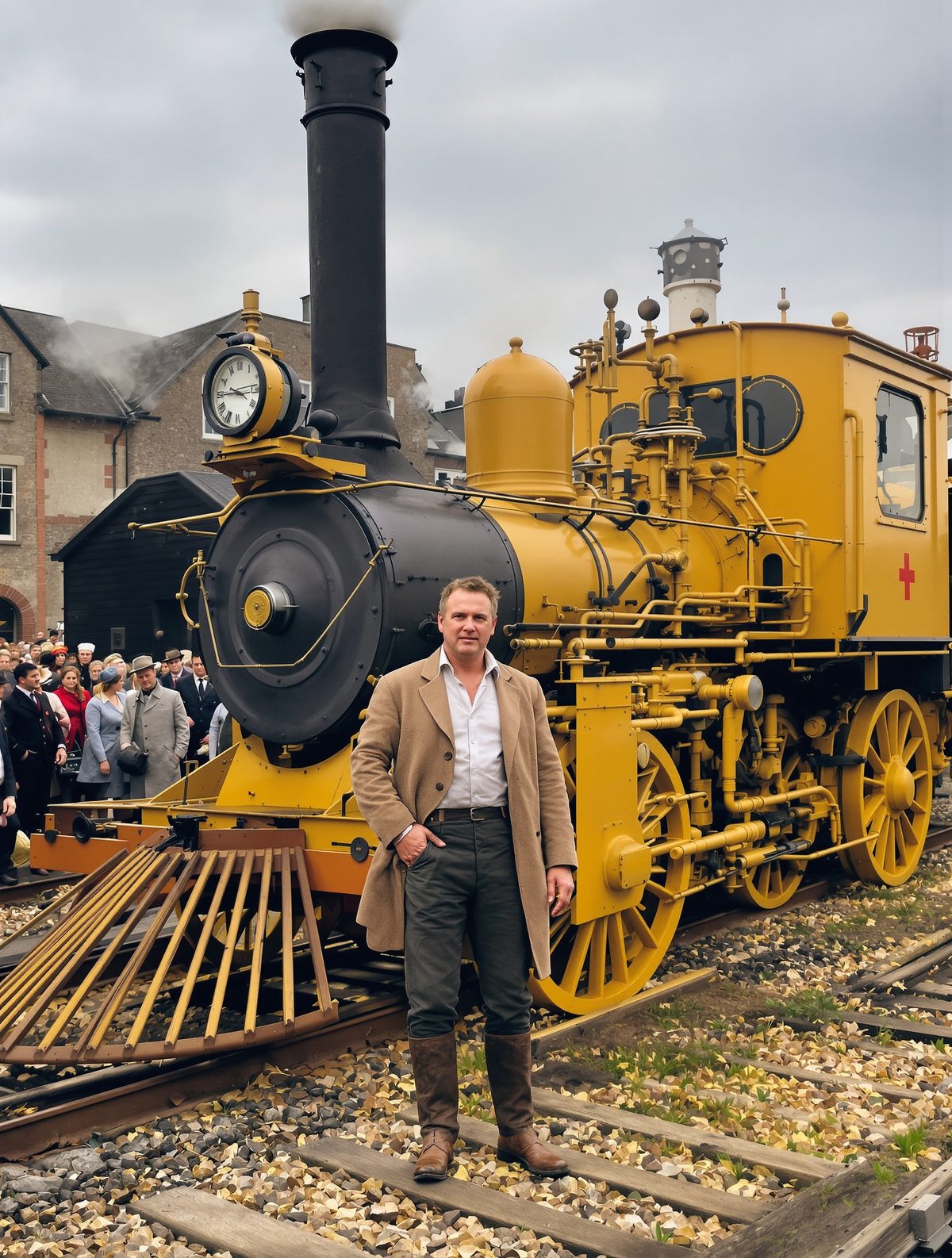
The yellow locomotive belched steam and smoke as it thundered past the astonished crowd at nearly thirty miles per hour—faster than any human being had ever travelled on land. Women clutched their bonnets, men removed their top hats in wonder, and children pointed in amazement as George Stephenson's Rocket streaked across the Lancashire countryside on that crisp October morning in 1829. What they witnessed wasn't just a machine winning a competition—it was the precise moment when the modern world began.
The Rainhill Trials would last just five days, but those five days would compress centuries of human progress into a single, explosive leap forward. Before October 6th, 1829, the fastest anyone had ever moved was at the gallop of a horse. By October 14th, everything had changed forever.
When the World Came to Rainhill
The Liverpool and Manchester Railway Company faced a problem that would define the future of human transportation. They needed to move people and goods the thirty-one miles between England's greatest port and its greatest industrial city, but nobody knew if steam locomotives could do the job safely. The company's directors were split—some favoured the newfangled steam engines, others trusted only horses or stationary steam engines that would haul carriages along cables.
Their solution was brilliantly simple: a public competition. On a straight stretch of track near the village of Rainhill, they would test any locomotive that dared to enter. The winner would claim not only the £500 prize—worth about £50,000 today—but the contract to power the world's first passenger railway.
Read next: The Day a Weaver's Son Mapped the Invisible World
Word spread like wildfire. By early October 1829, nearly 15,000 spectators had descended upon this quiet corner of Lancashire. Temporary stands groaned under the weight of curious onlookers. Vendors hawked pies and ale. Gentlemen placed bets while ladies peered through opera glasses at the strange mechanical beasts preparing for battle.
Ten locomotives initially entered, but only five made it to the starting line. Among them was the Novelty, built by John Braithwaite and John Ericsson—a sleek machine that looked more like a modern locomotive than its competitors. Timothy Hackworth entered Sans Pareil (French for "Without Equal"), while Perseverance arrived so damaged from its journey that it could barely move. The oddest entry was Cycloped, which wasn't really a steam locomotive at all—it was powered by a horse walking on a treadmill.
The Yellow Thunder from Newcastle
George Stephenson's Rocket looked almost primitive compared to some of its rivals, but appearances deceived. This yellow locomotive, built with his son Robert in their Newcastle works, incorporated three revolutionary innovations that would define steam locomotion for the next century.
First, the Rocket featured a multi-tube boiler—twenty-five copper tubes carried hot gases through the water, dramatically increasing the heating surface and steam production. Second, it employed a blast pipe that used exhaust steam to draw air through the fire, creating a powerful draft that made the flames burn white-hot. Third, the cylinders were angled and connected directly to the driving wheels, eliminating the complex beam arrangements of earlier engines.
These weren't just technical improvements—they were the DNA of every steam locomotive that would follow. But on that October morning, as George Stephenson's son Robert prepared to drive the Rocket in competition, nobody quite knew if genius or disaster awaited.
The rules were deceptively simple yet brutally demanding. Each locomotive had to haul three times its own weight back and forth over a 1.75-mile course, completing seventy miles total—equivalent to the Liverpool-Manchester journey. They had to maintain an average speed of ten miles per hour and prove they could reach thirty miles per hour when required. Any engine that broke down or failed to meet these requirements would be disqualified.
Five Days That Shook the World
The trials began with disaster. Cycloped's horse-powered concept proved so ridiculous that it was quickly withdrawn amid laughter from the crowd. Perseverance struggled to reach even six miles per hour before grinding to a halt with mechanical failures. The real competition would be between three serious contenders: Novelty, Sans Pareil, and Rocket.
Novelty captured the crowd's imagination first. Lighter and faster than its rivals, it reached an astounding thirty-six miles per hour during demonstrations, prompting wild cheering from spectators who had never seen anything move so fast. But when the serious testing began, Novelty's copper boiler tubes began to fail under the intense heat and pressure. The sleek favourite limped out of competition with a mechanical breakdown that couldn't be repaired in time.
Sans Pareil proved more reliable but suffered from a fatal flaw—it was simply too heavy for the track. At nearly five tons, it exceeded the weight limit and, worse, its violent motion threatened to shake the rails apart. After completing eight successful trips, cylinder problems forced Hackworth's engine to withdraw.
That left the Rocket alone on the track, but George Stephenson wasn't content with victory by default. On the morning of October 8th, with thousands watching, he opened the throttle and gave the world a glimpse of its future.
The Moment Everything Changed
The Rocket didn't just complete its required seventy miles—it did so with a performance that left spectators speechless. Hauling a coach packed with passengers, it sustained speeds of twenty-four to thirty miles per hour for hours at a time. During one demonstration run, it touched thirty-six miles per hour, matching Novelty's record while pulling a full load.
But the most extraordinary moment came when the locomotive completed its final run. As the Rocket crossed the finish line, completing every requirement without a single breakdown, the crowd erupted. Hats flew into the air, women waved handkerchiefs, and men who had arrived as skeptics found themselves cheering for a machine that had just rewritten the laws of human possibility.
Read next: The Day a Clockmaker's Son Rewired How We See the Stars
Among the spectators was French engineer Marc Seguin, who later wrote: "I have seen the future, and it moves at thirty miles per hour." The actor William Macready noted in his diary: "The power of the engine was perfectly wonderful; when it reached its greatest speed, I felt as if it were flying."
The Rocket had done more than win a competition—it had proved that steam railways could carry passengers safely at speeds that would revolutionize society. Distance would never mean the same thing again. News that took days to travel could now move in hours. People could live in one city and work in another. The very concept of time would be transformed.
The Rocket's Revolutionary Legacy
Within months of the Rainhill Trials, railway mania gripped Britain. The Liverpool-Manchester Railway opened in September 1830, and despite a tragic accident on opening day that killed local MP William Huskisson, it proved an immediate success. Passengers flocked to experience the miracle of steam travel, and goods moved between the two cities faster and cheaper than ever before.
The Rocket itself continued working on the Liverpool-Manchester line until 1836, when it was sold to the Brampton Railway in Cumberland. After retirement, it found its way to the Science Museum in London, where visitors can still marvel at the machine that changed everything.
But the real legacy wasn't the locomotive itself—it was the principle it proved. Within a generation, railways spanned continents. By 1869, the Transcontinental Railroad crossed America. By 1891, the Trans-Siberian Railway connected Moscow to Vladivostok. The Rocket's descendants carried troops to wars, immigrants to new lives, and goods to global markets.
When Speed Changed Everything
Today, as we debate autonomous vehicles and hyperloop transport, it's worth remembering that cool October morning in 1829 when a yellow locomotive named Rocket first proved that humans could safely travel faster than a galloping horse. Every high-speed train, every subway system, every moment when we take rapid transit for granted—it all traces back to those five extraordinary days at Rainhill.
The crowd that gasped at thirty miles per hour couldn't imagine a world of bullet trains reaching 200 mph, but they witnessed the fundamental breakthrough that made such speeds possible. They saw the moment when human ingenuity conquered the ancient limitations of distance and time. In our age of instant communication and global connection, we might ask: what would George Stephenson think of a world where information travels at the speed of light, but where we still struggle to move our bodies as efficiently as his Rocket moved its passengers nearly two centuries ago?