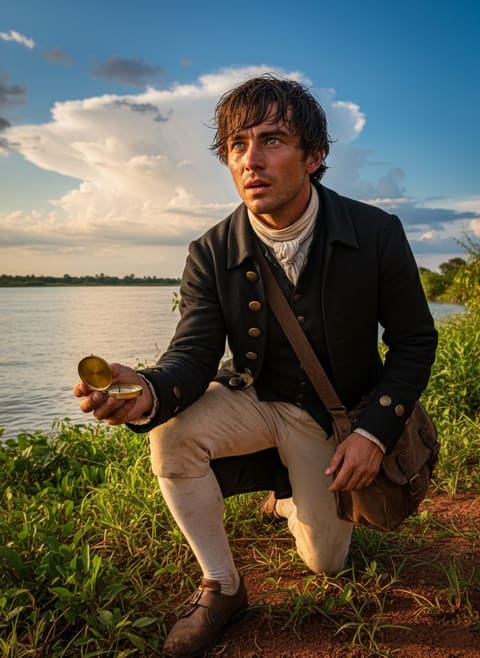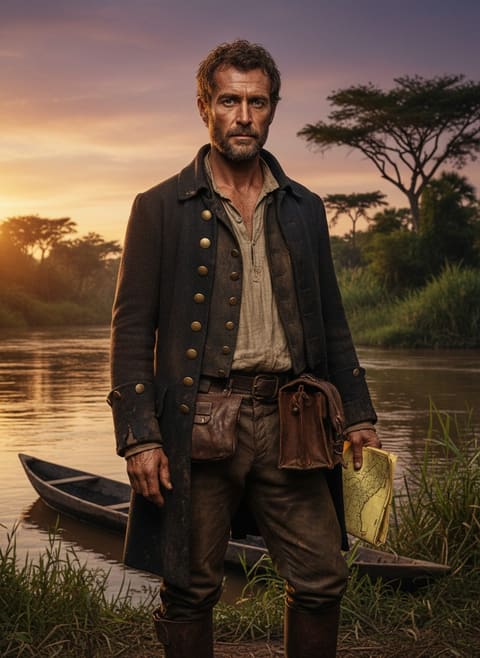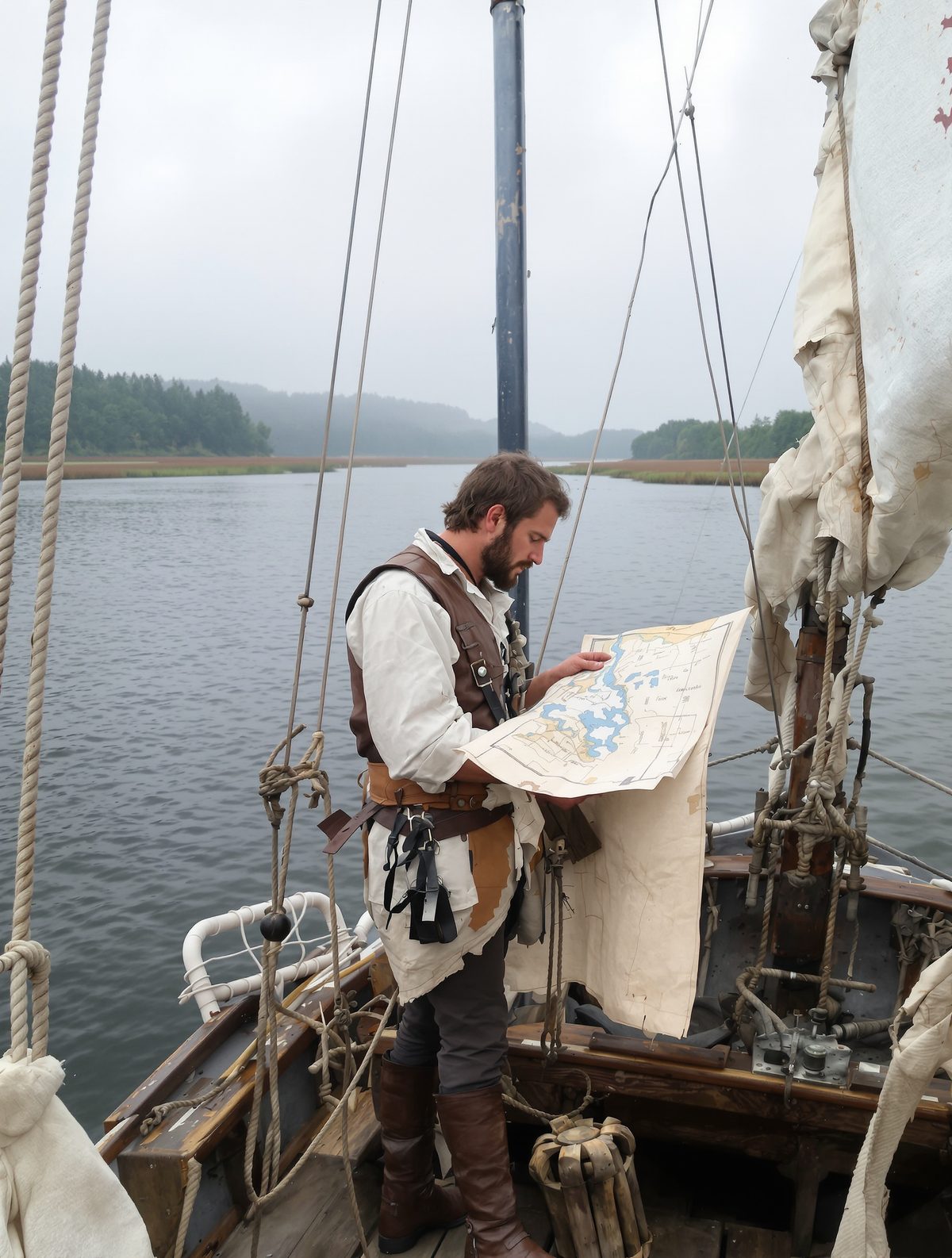
The morning mist clung to the water like a shroud as Captain John Smith pushed his tiny shallop into the murky depths of what would become known as Chesapeake Bay. It was June 2, 1608, and the 28-year-old soldier-turned-explorer was about to embark on one of history's most audacious mapping expeditions. Behind him lay Jamestown—a struggling settlement where men died faster than ships could bring replacements. Ahead stretched 4,000 square miles of uncharted waters, inhabited by unknown tribes who might trade peacefully one day and launch arrows the next.
Smith's vessel was laughably small for such an enormous task—a shallow-draft boat barely large enough for his crew of fourteen men, their weapons, and enough hardtack and salt pork to last weeks. Yet this cramped wooden shell would cover over 3,000 miles of coastline in the coming months, producing a map so accurate that sea captains would still be using it when George Washington was born.
Into the Labyrinth of Waters
What Smith encountered as he sailed north from the James River mouth was a mariner's nightmare and a cartographer's dream. The Chesapeake—derived from the Algonquian word "Tschiswapeki" meaning "great shellfish bay"—was a maze of rivers, creeks, and inlets that seemed to multiply with every tide. The bay stretched nearly 200 miles from north to south, with a shoreline so convoluted that if straightened, it would span the distance from London to Rome.
Unlike the grand expeditions of Spanish conquistadors with their galleons and armies, Smith's venture was startlingly modest. His crew consisted of gentlemen-adventurers, common soldiers, and a ship's doctor—hardly the stuff of legends. Yet what they lacked in numbers, they made up for in audacity. Smith had already survived enslavement by Turks, battles across Europe, and the political intrigue of early Jamestown. This bay, no matter how vast, would not intimidate him.
Read next: The Day a Devon Captain Charted the Pacific and Changed the World
The first revelation came quickly: the bay teemed with life. Oysters grew so thick they formed underwater reefs that could ground a careless navigator. Sturgeon "leaped so thicke with their heads above the water, as for want of nets we attempted to catch them with a frying pan," Smith later wrote with characteristic wit. His men witnessed clouds of waterfowl so dense they darkened the sky, and forests that pressed to the water's edge, untouched by European axes.
The Mapmaker's Dangerous Dance
Smith's mapping technique was both primitive and remarkably effective. Using a compass, an astrolabe for celestial navigation, and careful dead reckoning, he plotted each twist of coastline. More importantly, he possessed something that couldn't be bought or taught: an intuitive understanding of how water moved through landscape. The former soldier could read the subtle signs that revealed which channels ran deep and which were mere tidal flats.
But this wasn't simply a surveying exercise. Every landing brought potential conflict with indigenous peoples who had watched European ships probe their waters with growing unease. Smith's diplomatic skills proved as crucial as his navigation. Unlike many of his contemporaries who saw Native Americans as obstacles to be overcome, Smith approached them as sources of geographic intelligence.
The Potomac River expedition in July 1608 nearly ended in disaster. When Smith's party encountered the Patawomeck tribe, tensions escalated quickly. Warriors appeared on the riverbank, their bodies painted for war, arrows nocked and ready. Smith made a calculated gamble—instead of retreating, he ordered his men to fire their muskets into the air while he stood prominently in the bow, arms outstretched in a gesture of peace. The psychological effect was immediate: the thunderous noise convinced the Patawomeck that these strangers commanded the very elements.
Secrets Hidden in Plain Sight
What Smith discovered during those summer months of 1608 challenged everything Europeans thought they knew about North America. The prevailing theory held that a navigable waterway—the fabled Northwest Passage—must exist somewhere to connect Atlantic and Pacific waters. As Smith pushed up the Susquehanna River, local Susquehannock guides told him of great waters beyond the mountains. For tantalizing weeks, Smith believed he might be approaching the Pacific Ocean itself.
The reality proved both disappointing and remarkable. There was no ocean passage, but Smith had stumbled upon something potentially more valuable: the richest ecosystem on the eastern seaboard. His detailed notes described seemingly inexhaustible forests of oak, pine, and cedar—perfect for shipbuilding. Iron ore deposits glinted from stream beds. Salt marshes stretched for miles, ideal for preserving meat. Most intriguingly, his indigenous guides spoke of mountains to the west where yellow metal could be found.
Smith's map, completed after two separate expeditions, contained a level of geographic detail that wouldn't be matched until the 19th century. He correctly identified the bay's major tributaries: the Potomac, Rappahannock, York, and James rivers. His depth soundings were so accurate that colonial pilots used them for generations. But perhaps most remarkably, Smith understood the bay's seasonal rhythms—how spring freshets changed river channels, where winter storms created the most dangerous conditions, and which harbors offered the best protection.
The Pocahontas Connection
While Smith mapped the northern reaches of the bay, events were unfolding in Jamestown that would cement his place in American mythology. His previous encounters with Pocahontas, daughter of the powerful chief Powhatan, had already become the stuff of legend—though the romantic elements were largely fabricated by later writers. The real relationship was far more complex and politically significant.
Pocahontas served as a crucial cultural interpreter, helping Smith understand not just the geography of the region but its invisible political boundaries. Through her intelligence, Smith learned which tribes were allies, which were enemies, and crucially, which waterways were considered sacred or off-limits to outsiders. This knowledge proved invaluable as his small expedition navigated between dozens of different tribal territories.
The famous "rescue" story—where Pocahontas supposedly saved Smith from execution—likely occurred, if at all, during this period of active exploration and negotiation. Smith's own account, written years later, may have misunderstood a ritual adoption ceremony as a near-death experience. Regardless of the truth, Pocahontas's intervention, whether real or symbolic, represented the delicate diplomacy that kept Smith's mapping mission from ending in bloodshed.
Read next: The Day a Devon Sailor Mapped the Roof of the World Alone
Legacy Written in Water
Smith's completed map of Chesapeake Bay was more than a navigational tool—it was a masterpiece of early American cartography that would shape colonial development for centuries. Published in 1612 as part of his "Map of Virginia," it contained an accuracy rate of over 90% when compared to modern satellite imagery. Royal Navy charts used Smith's work as their foundation well into the 1800s.
But the map's true importance lay in what it represented: the transformation of an unknown wilderness into a comprehensible, exploitable resource. Smith's meticulous notations—"Here the water deepens suddenly," "Oyster beds extend two miles offshore," "Fresh water available at high tide"—provided future colonists with the intelligence they needed to survive and prosper.
The economic implications were staggering. Smith's map guided the tobacco ships that would make Virginia wealthy, the fishing fleets that would feed growing colonial populations, and the merchant vessels that would establish Baltimore and Annapolis as major ports. Without Smith's exhaustive charting of safe channels and hidden shoals, England's colonial experiment in the Chesapeake might have foundered as completely as the ill-fated Roanoke colony.
The Captain's Final Current
Today, as satellites map every square inch of Earth's surface in real-time, it's difficult to imagine the courage required to sail into truly unknown waters with nothing but a compass and an astrolabe. John Smith's 1608 expedition represents one of history's last great leaps into the cartographic unknown—a time when a determined individual with a small boat could still add vast new territories to human knowledge.
The irony is profound: while Smith's contemporaries searched for cities of gold and fountains of youth, he discovered something far more valuable—a detailed understanding of one of North America's most important natural harbors. His map didn't just chart water and land; it charted the future of English colonization. In an age when information itself was the ultimate treasure, Captain John Smith's three months on Chesapeake Bay may have been the most successful treasure hunt in American history.
The next time you see a satellite image of Chesapeake Bay—with its familiar outline of rivers and inlets—remember that this geographic knowledge was first won by fourteen men in an open boat, navigating by courage, curiosity, and the kindness of strangers in a new world.