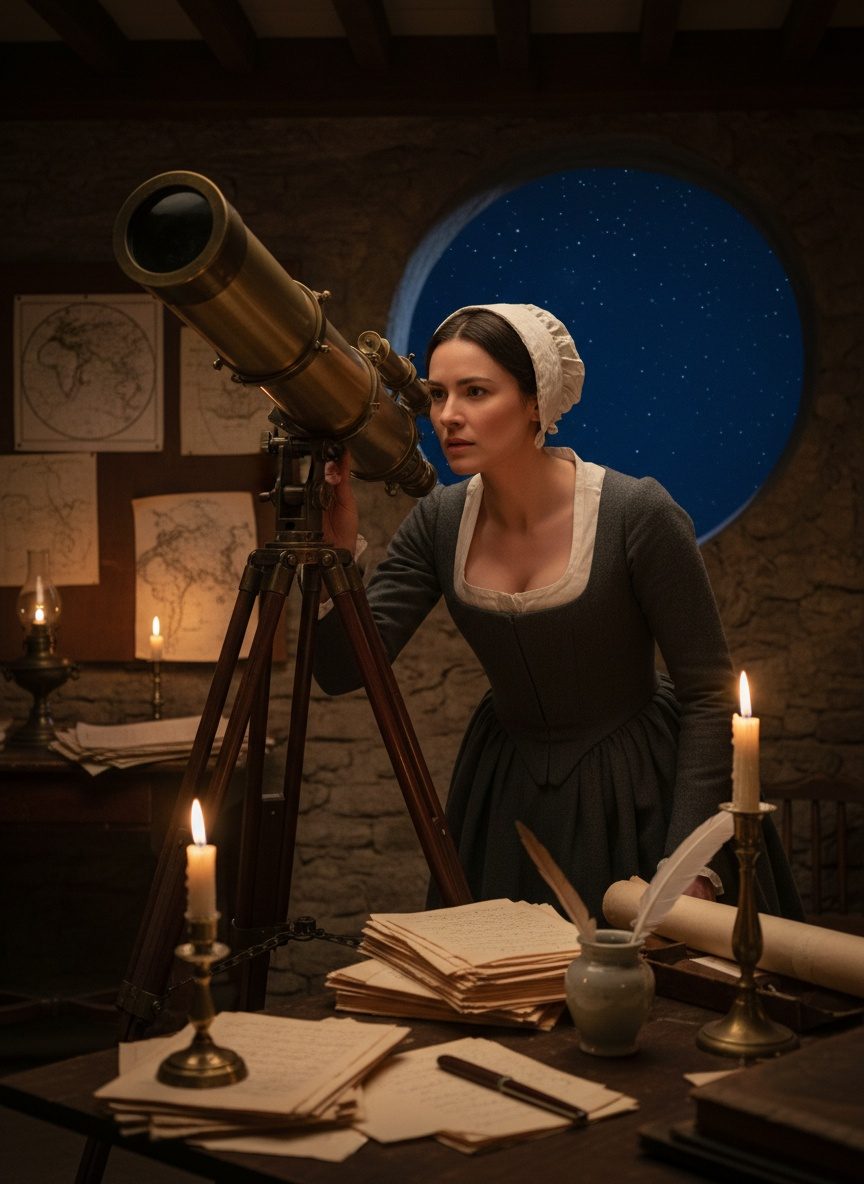
In the spring of 1786, as twilight painted the Georgian skyline with hues of lavender and rose, a remarkable scene unfolded in the English city of Bath. Beneath the vast and mysterious expanse of the universe, a German-born woman stood alone, her eye affixed to the end of a telescope. She was not meant to be there; the telescope was not meant for her use. Yet on that night when she looked to the heavens, something extraordinary would happen. Caroline Herschel, in the quietude of the evening sky, saw what no one else had—a comet racing across the cosmic canvas, signaling the start of a celestial legacy.
The Astronomer’s Sister
Caroline Herschel was born on March 16, 1750, in Hanover, Germany. She was one of ten children in a family that valued music but harbored the talents of its future astronomers. Her brother, William Herschel, would come to be a notable figure in the scientific community, famed for his discovery of the planet Uranus. It was in the role of housekeeper that Caroline first accompanied William to England in 1772. While she tended to domestic duties, William pursued his passion for astronomy and music. Yet Caroline's destiny was not confined to the corners of the kitchen; a relationship of mutual curiosity and intellect flourished between the siblings.
The telescope William constructed for his stargazing applications became an unexpected touchstone in Caroline’s life. William encouraged her intellectual aspirations and taught her to grind and polish telescope mirrors—a skill that helped lay the foundation for her astronomical observations. She became more than a sister; she was an indispensable assistant in his endeavors. But when William was away, Caroline had the opportunity to claim the night skies for herself.
A Night of Discovery
As she gazed upward on that fateful evening in 1786, Caroline did more than witness the silent choreography of the stars; she discovered a new comet. The date was August 1, 1786, and the comet she unveiled was the first of its kind to be attributed to a woman. Her discovery marked the onset of a groundbreaking series of observations that would some years later include eight comets, each inextricably linked to her name.
Read next: The Day a Miner's Son Gave the World Safe Light
It might surprise the modern reader to know that contemporaries often viewed the academic world as inhospitable to women. Yet, Caroline Herschel’s achievements quietly but effectively challenged these norms and rocked the scientific community of the time. Her accuracy and meticulous nature in recording her observations earned her considerable respect; she was a woman who, against all odds, carved her mark into the historical annals of astronomy.
From Housekeeper to Paid Astronomer
In 1796, with a comet trail leading back through her discoveries, the scale of Caroline’s work began to draw deserved attention. Such achievements could not go unnoticed, even by the internationally renowned Royal Society. In a landmark decision, the British Crown awarded her a stipend of £50 per year—an unprecedented recognition making her the first woman in history to receive a salary for scientific work.
This development was more than a financial acknowledgment; it was a seismic shift in the acknowledgement of women in science. As an official astronomer, Caroline Herschel achieved a hitherto unseen legitimacy that transcended societal expectations, revealing the limitless possibilities that awaited women with minds yearning to study the stars.
The Silent Constellations
Caroline's contributions to astronomy extended beyond the discoveries of comets. She painstakingly completed a catalogue of nebulae that, although overshadowed in William’s name, bore the hallmarks of her dedication and precision. Over 2,500 nebulae were compiled, a feat of systematic excellence that would support and guide astronomers for generations.
Yet, despite her tireless contributions, she remained humble, often describing herself solely as an observer or assistant. But to those who paid attention, her legacy reached into the celestial void, tracing patterns that told stories of passion and resilience interwoven with starlight.
Legacy Among the Stars
Caroline Herschel passed away in 1848, her life illuminated by the stars she loved so dearly. But the light of her contributions did not dim; it continued to inspire future generations of women in science. Her story serves as a beacon shining brightly in the history of astronomy—and indeed, humanity—reminding us that paths less traveled can lead to discoveries beyond imagination.
Why does this tale of a woman gazing up at the Georgian sky still matter today? It signifies the daring break from traditional roles, the profound courage to seek knowledge without waiting for permission. Caroline Herschel’s journey from domesticity to the cosmic stage exemplifies the indomitable spirit of those who dare to observe, to question, and to explore uncharted realms. As we look to our future where untold mysteries of the universe await, her story provides a hopeful reminder: sometimes, the path to understanding the cosmos begins in the quiet moments when we dare to observe the something extraordinary that nobody else sees.