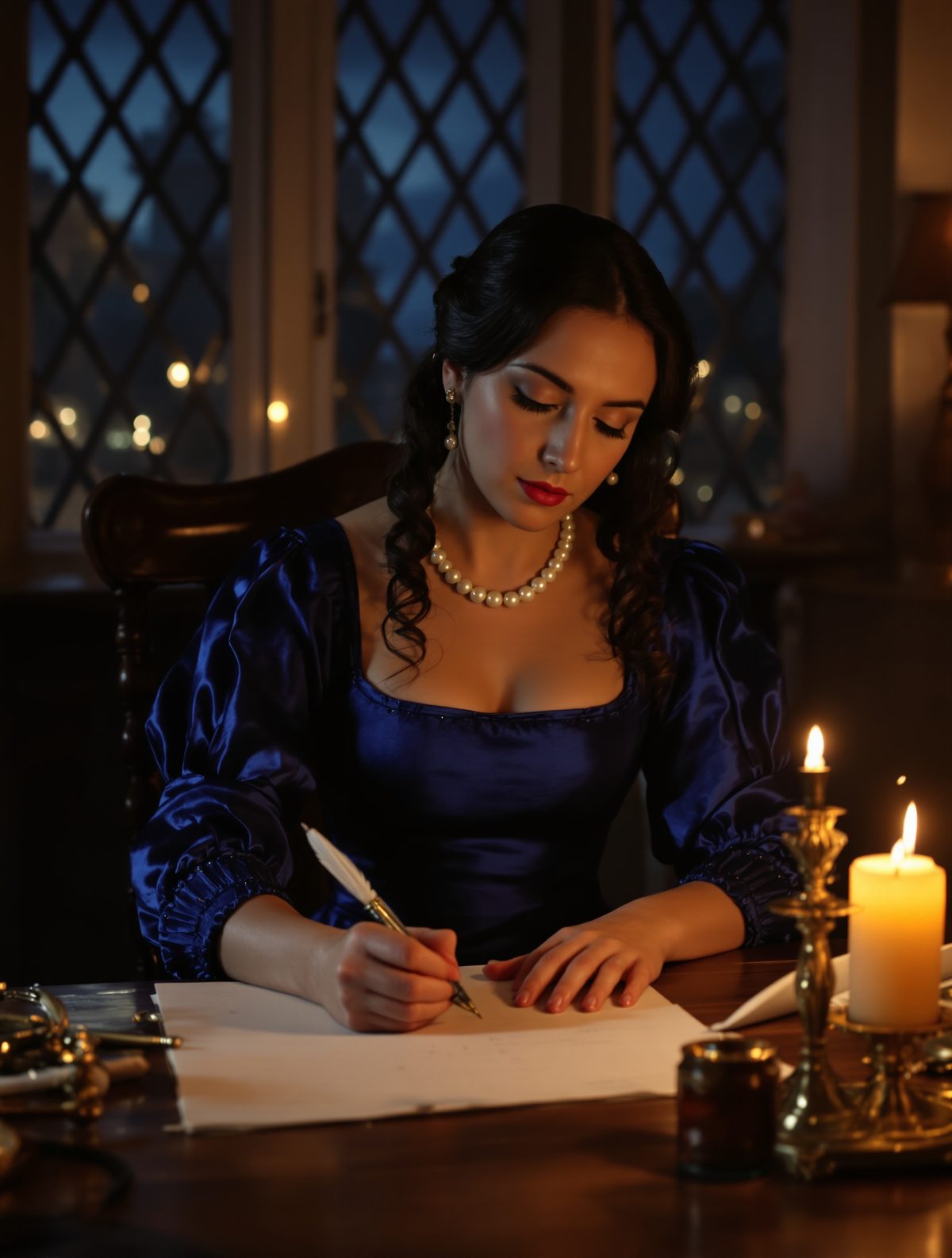
The quill trembled slightly in her hand as Aphra Behn dipped it into the inkwell one final time. Outside her modest lodgings near Covent Garden, London's streets echoed with the clip-clop of late-night carriages and the distant laughter from taverns. Inside, by the flickering light of a single candle, she penned the last lines of what would become her most scandalous comedy yet. Tomorrow night, September 1670, The Rover would premiere at the Duke's Theatre. If it succeeded, she would achieve something no British woman had ever accomplished: earning her living entirely by her pen.
But this was no ordinary playwright hunched over her manuscript. Just five years earlier, Aphra Behn had been prowling the coffee houses of Antwerp, not as a writer, but as a spy for King Charles II. Now, at thirty, she was about to shatter the glass ceiling of Restoration England in the most unexpected way possible.
From Plantation Girl to Royal Spy
Born around 1640 in Kent, Aphra Johnson's early years read like the plot of one of her future plays. Her father, a barber with grand ambitions, secured an appointment as lieutenant-general of Surinam, then a British colony. When Aphra was barely eighteen, the family set sail for South America, where she would witness the brutal realities of plantation life and slavery—experiences that would later fuel her groundbreaking novella Oroonoko.
The tropical adventure ended abruptly when her father died during the voyage. But young Aphra's sharp wit and natural charm caught the attention of colonial society. She moved freely between planters' mansions and indigenous communities, absorbing stories and languages with the keen eye of a born storyteller. More importantly, she learned something revolutionary for a woman of her era: how to navigate male-dominated spaces with intelligence and audacity.
Read next: The Day a Tudor Chancellor Chose Death Over a Royal Lie
Returning to London around 1663, she married Johan Behn, a Dutch merchant of German extraction. The marriage was brief—Johan died within two years, possibly from the plague that swept through London in 1665. But widowhood, rather than limiting her prospects, opened an extraordinary door. Someone in Charles II's court had noticed the quick-witted young woman who spoke multiple languages and moved effortlessly through different social circles.
Agent 160: The Spy Who Came in From the Cold War
In 1666, as the Great Fire still smoldered in London's ruins, Aphra Behn received a most unusual commission. King Charles II's spymaster, Arlington, recruited her for a dangerous mission to Antwerp. Her assignment: to flip William Scot, son of a regicide, who was plotting with Dutch republicans against the English crown.
Operating under the code name "Agent 160," Behn spent months in the shadowy world of Restoration espionage. She frequented the coffee houses where exiled English republicans gathered, carefully cultivating relationships and extracting secrets. Her correspondence with London reveals a sharp political mind analyzing Dutch naval preparations and tracking assassination plots against the king.
But the government that had sent her on this perilous mission proved less reliable than the intelligence she provided. Months passed without payment. Behn found herself stranded in Antwerp, pawning her jewelry to survive and sending increasingly desperate letters to her handlers. When she finally returned to London in 1667, she was so destitute that she was briefly imprisoned for debt.
It was this betrayal by the very system she had served that would transform Aphra Behn from loyal agent into revolutionary writer. If the king's government wouldn't pay her for risking her life, she would find another way to earn her independence.
The Dangerous Art of Making Men Laugh
In 1670, Behn made her theatrical debut with The Forc'd Marriage at Lincoln's Inn Fields. The play ran for six nights—a respectable success that announced the arrival of a bold new voice in Restoration comedy. But it was her second play, The Amorous Prince, that revealed her true artistic DNA: sharp wit, sexual frankness, and a woman's perspective on the battle of the sexes.
What made Behn's work revolutionary wasn't just that she was writing—it was what she was writing about. While male playwrights of the era treated women as either saints or whores, Behn created female characters who were sexually autonomous, intellectually sharp, and morally complex. Her heroines schemed, seduced, and strategized their way through plots with an agency that shocked contemporary audiences.
Take Hellena from The Rover, who disguises herself as a gypsy to pursue the rakish Willmore through the carnival streets of Naples. "I'm resolved to provide myself this Carnival," she declares, "if there be ere a handsome proper Fellow of my Humour above Ground, though I ask first." For 1677 audiences, hearing a woman express such bold sexual desire was both thrilling and scandalous.
The financial model of Restoration theatre worked in Behn's favor. Playwrights typically received the profits from the third night's performance if a play succeeded, and Behn proved remarkably successful. The Rover became one of the most frequently performed comedies of the era, revived regularly well into the eighteenth century.
Quills, Coins, and Controversy
Between 1670 and 1689, Behn wrote at least seventeen plays, making her one of the most prolific dramatists of the Restoration. But playwriting alone couldn't sustain her, so she diversified with the entrepreneurial spirit of a born professional. She penned poetry for aristocratic patrons, translated French novels, and wrote satirical verses that circulated through London's coffee houses.
Her 1688 novella Oroonoko drew on her experiences in Surinam to tell the story of an African prince sold into slavery. Marketed as a true story, it was one of the first English works to present an enslaved person as a complex, noble protagonist rather than a stereotypical figure. The work would later influence the abolition movement and establish Behn as a pioneer of the English novel.
Read next: The Day a Tudor Bishop Refused to Crown a Usurper
But professional success came with a price. Male critics attacked not just her work but her morality, suggesting that no respectable woman could write with such knowledge of sexual matters. The playwright Robert Gould sneered that she was "a meer [sic] Hackney writer" who had "debauch'd" the stage. These attacks revealed the real threat Behn represented: a woman who could earn her independence through her talent.
Behn fought back with characteristic wit. When accused of plagiarism—a charge rarely leveled at male playwrights who freely adapted existing works—she responded: "I value fame as much as if I had been born a Hero; and if you rob me of that, I can retire from the ungrateful World, and scorn its fickle Favours."
The Final Act
Aphra Behn died on April 16, 1689, at the age of forty-nine. She was buried in Westminster Abbey's East Cloister, her gravestone bearing the epitaph: "Here lies a Proof that Wit can never be Defence enough against Mortality." Even in death, she remained defiant, having requested that her tombstone read: "Here lies Proof that Wit can never be / Defence enough against Mortality."
Virginia Woolf would later write: "All women together ought to let flowers fall upon the tomb of Aphra Behn... for it was she who earned them the right to speak their minds." But perhaps more importantly, Behn proved that a woman could transform her experiences—even failure and betrayal—into financial independence through the power of storytelling.
The Revolutionary Who Wrote Her Way to Freedom
In our era of female entrepreneurs and creative independence, Aphra Behn's achievement might seem less remarkable. But consider the world she navigated: women couldn't attend universities, enter most professions, or even legally control their own property after marriage. The idea that a woman could support herself through creative work was not just unusual—it was revolutionary.
Behn didn't just break barriers; she created a entirely new model for female independence. She proved that a woman's experiences, perspectives, and imagination could have commercial value in the literary marketplace. Every female novelist, screenwriter, or playwright who has ever earned her living through words owes a debt to the former spy who lit a candle in a London lodging house and decided to write her way to freedom.
That September night in 1670, as Aphra Behn set down her quill and prepared for her play's debut, she couldn't have known she was making history. She was simply a woman determined to survive by her wits in a world that offered her few alternatives. But sometimes the most profound revolutions begin with such personal acts of defiance—one word, one line, one play at a time.