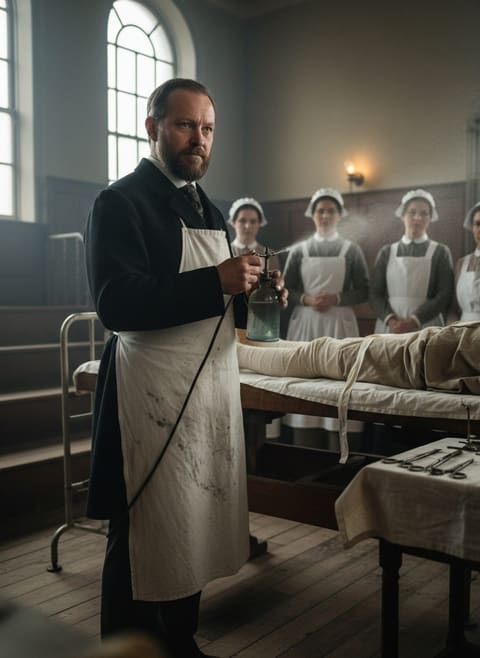
The mercury had climbed to a suffocating 102 degrees Fahrenheit in Apalachicola, Florida, and death hung in the air like morning fog on the Gulf. Dr. John Gorrie pressed a damp cloth to his patient's burning forehead—another yellow fever victim whose skin had taken on the sickly amber hue that gave the disease its name. Around him, the makeshift hospital ward reeked of sweat, carbolic acid, and despair. It was July 1842, and Gorrie was about to embark on an impossible mission: he would steal winter from the very air itself.
What happened next in that sweltering Florida port town would eventually transform every building, vehicle, and home across the globe. But the medical establishment would reject Gorrie's breakthrough, the press would mock him as a madman, and he would die penniless and forgotten. This is the story of how a British-trained physician battled both yellow fever and the laws of thermodynamics—and won.
The Fever Ships and the Scottish Doctor
Apalachicola in 1842 was a boomtown built on cotton and cursed by geography. Ships laden with white gold crowded the harbor, but they brought more than commerce—they carried Aedes aegypti mosquitoes breeding in their water barrels, turning every vessel into a floating incubator for yellow fever. The disease struck with biblical fury: victims suffered explosive headaches, their skin yellowed like autumn leaves, and they vomited black blood before slipping into delirium.
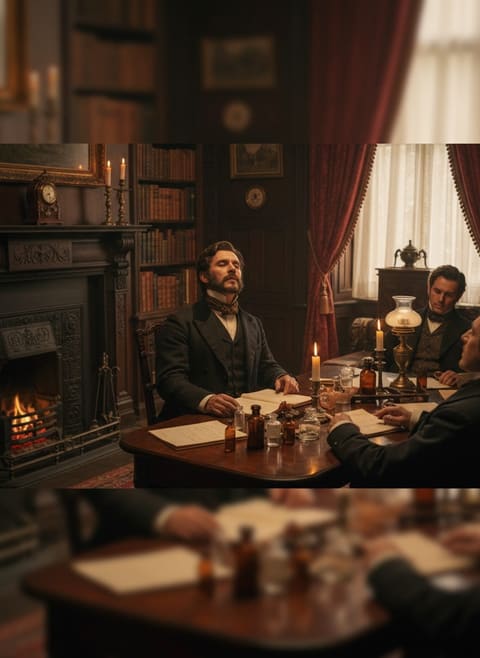
John Gorrie had arrived from Charleston with impeccable credentials. Born in 1803 to Scottish immigrants, he'd studied at the prestigious College of Physicians and Surgeons in New York, where British medical theories dominated the curriculum. The prevailing wisdom held that diseases like yellow fever arose from "miasma"—poisonous vapors that festered in hot, stagnant air. Cool, circulating air, the theory went, could literally blow illness away.
Read next: The Day a Surgeon's Son Chose Death Over Silence
But Florida in summer offered no cool air. Temperatures routinely soared above 95 degrees, and the humidity was so thick you could practically swim through it. Gorrie watched helplessly as patient after patient succumbed, their fevered bodies unable to cope with the double assault of disease and heat. The mortality rate in some outbreaks reached a staggering 60 percent.
Ice in Paradise: A Frozen Lifeline
Desperate times called for desperate measures. Gorrie began ordering ice from the North, having it shipped in sawdust-packed holds on the fastest vessels he could charter. When blocks of precious frozen water arrived—often half-melted and astronomically expensive—he hung them in basins above his patients' beds, allowing the cold air to settle over their burning bodies like a benediction.
The results were remarkable. Patients' fevers broke more quickly. Their breathing eased. Some even sat up and asked for food. But Gorrie's ice-cooled ward came with a crushing problem: a single shipment cost more than most families earned in a year. When yellow fever struck in 1842 with particular vengeance, killing dozens weekly, even the wealthy cotton merchants couldn't afford enough ice to fill the overflowing hospital.
Then came the night that changed everything. A expected ice shipment failed to arrive—the ship had been delayed by storms in the Gulf. Gorrie stood in his sweltering ward, listening to the labored breathing of a dozen patients, and made a decision that would have seemed insane to any rational physician: if he couldn't buy ice, he would make it himself.
The Madman's Machine: Engineering Miracles in Secret
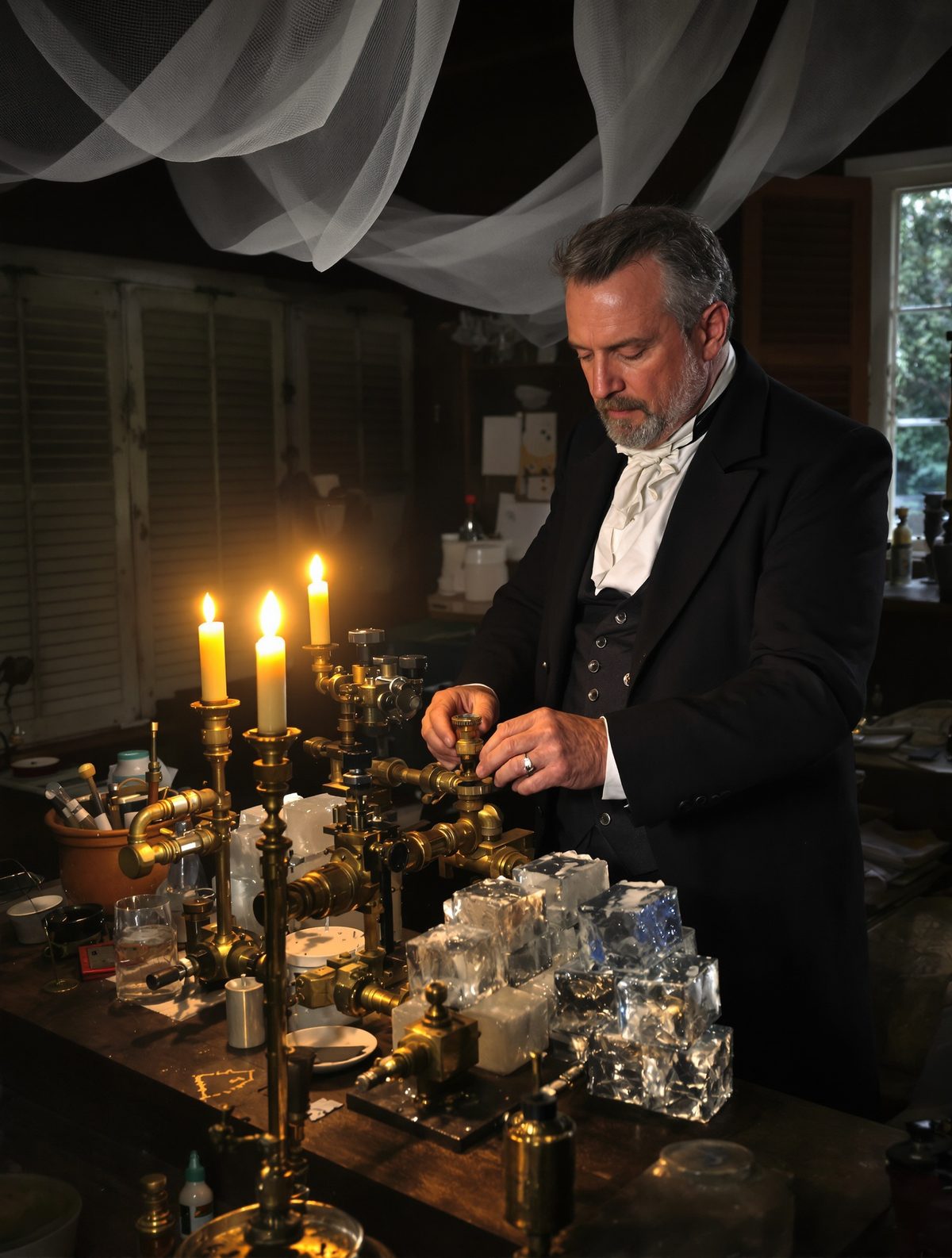
Working by candlelight in a cramped room behind his hospital, Gorrie began constructing what he called his "cold air machine." His design relied on a principle he'd learned from studying James Prescott Joule's early work on thermodynamics: when compressed gas expands rapidly, it absorbs heat from its surroundings, creating intense cold.
The machine Gorrie built looked like something from a steampunk fever dream. A horse-powered compressor forced air into a cylinder, where it was compressed to tremendous pressure. The compressed air was then allowed to expand rapidly through a series of pipes and chambers, each expansion stealing more heat from the air until it became cold enough to freeze water into solid ice.
The engineering challenges were staggering. Gorrie had to hand-forge his own valves, calculate expansion ratios without modern instruments, and solve problems of condensation and pressure regulation that wouldn't be fully understood for decades. He worked through the night, every night, driven by the sounds of suffering that drifted through the hospital walls.
On a sweltering evening in late July 1842, after weeks of failures and modifications, Gorrie's machine coughed to life. The compressor wheezed, the pipes rattled, and then—impossibly—ice began forming in the collection chamber. Not much, perhaps a pound of cloudy, imperfect ice, but it was ice nonetheless. Artificial ice, created from nothing but Florida air and mechanical ingenuity.
The Night Winter Came to Florida
Word spread through Apalachicola like wildfire. Dr. Gorrie had built a machine that made ice—actual ice—in the middle of summer. Skeptical townspeople crowded into his hospital to witness the impossible. They watched in stunned silence as the contraption wheezed and groaned, producing block after block of artificial ice.
But Gorrie had bigger ambitions than ice-making. He repositioned his machine to blow cold air directly into the hospital ward, creating the first artificially cooled medical facility in history. The effect was immediate and dramatic. The ward temperature dropped by fifteen degrees. Patients who had been delirious with fever began speaking coherently. The yellow fever outbreak that had terrorized the town for months began to subside.
Local newspapers proclaimed it a miracle. The Apalachicola Commercial Advertiser reported that Dr. Gorrie had "conquered summer itself" and predicted his invention would "banish yellow fever from the Earth forever." Visiting physicians made pilgrimages to see the machine, though many dismissed it as an expensive novelty with limited practical application.
Patent Wars and Broken Dreams
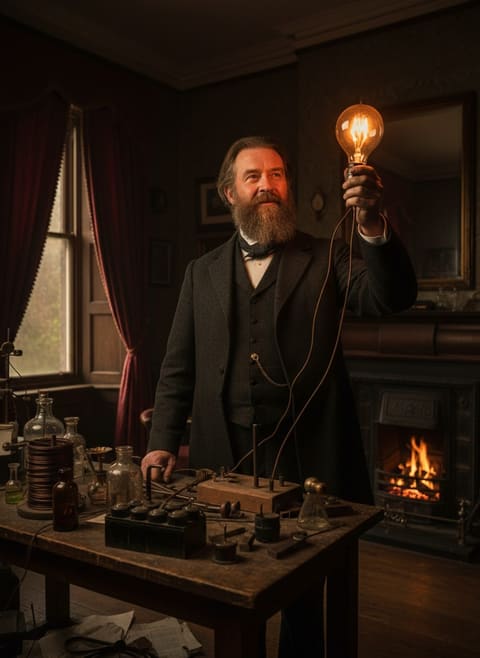
Convinced he had discovered something revolutionary, Gorrie traveled to Washington D.C. in 1850 to secure Patent No. 8080 for his "Machine for Producing Ice in Tropical Climates." The patent application included detailed drawings that showed a machine remarkably similar to modern air conditioning units—compressor, expansion chamber, cooling coils, and all.
Read next: The Day a Chimney Sweep's Son Shamed a Whole Parliament
But the medical establishment was less impressed. The American Medical Association dismissed Gorrie's theories about heat and disease as "unscientific speculation." Critics pointed out that yellow fever also struck in cooler climates, undermining his miasma-based reasoning. When he sought investors to mass-produce his machines, potential backers balked at the enormous costs involved.
The final blow came from an unexpected source: the ice industry itself. Northern ice harvesting had become a massive business, employing thousands of workers who cut blocks from frozen lakes and shipped them worldwide. These "ice barons" saw Gorrie's machine as an existential threat and used their considerable political influence to discredit artificial ice as "unnatural" and potentially dangerous to human health.
Financially ruined and professionally ostracized, Gorrie retreated to a small practice in Florida's rural interior. He died in 1855, largely forgotten, his revolutionary machine gathering dust in an abandoned warehouse.
The Cold Truth: Legacy of a Forgotten Pioneer
Today, John Gorrie's principle drives nearly every air conditioning system on Earth. His basic design—compress air, let it expand, capture the cold—powers the machines that cool our homes, offices, cars, and hospitals. The global air conditioning market generates over $150 billion annually, all stemming from innovations first tested in a yellow fever ward in 1842 Florida.
Ironically, Gorrie was both brilliantly right and tragically wrong. He was right that cooling could help fever patients—though not for the reasons he believed. Modern medicine has shown that reducing body temperature can indeed aid recovery from many illnesses, though yellow fever is caused by viruses, not "bad air." He was wrong about miasma theory, but his solution worked anyway.
Perhaps most remarkably, Gorrie's legacy extends far beyond medicine. Air conditioning didn't just change how we treat disease—it changed where humans can live and work. The Sun Belt's explosive growth, the rise of cities like Phoenix and Dubai, the global expansion of manufacturing into tropical regions—all of this traces back to that desperate night when a Scottish-trained doctor decided to freeze yellow fever with artificial ice.
The next time you step into a cool building on a sweltering summer day, remember John Gorrie: the man who stole winter from the air itself, saved lives with impossible ice, and died poor while creating technologies that would reshape civilization. Some legends, it seems, are too extraordinary for the textbooks.