August 24, 1814. The blistering summer sun beat down mercilessly on Maryland's fields.
As the sweat-drenched British soldiers trudged forward, the air was thick with anticipation and sweltering heat. These were veterans, hardened and steeled by the grueling Napoleonic Wars, recently triumphing over the formidable forces of France. Now, a new challenge lay before them, as they embarked on a pivotal march that would see them cover fifty exhausting miles. Their objective was the heart of American governance, Washington, D.C., where strategies and policies that shaped a burgeoning nation were being crafted.
The War of 1812 had lingered on for two years, a series of maritime disputes and territorial aggressions that plunged America and Britain into conflict once again. Yet, beyond military strategy and geopolitical maneuvering, this war was also one of unexpected twists and colorful anecdotes that would go on to enrich the annals of history. At the core of this particular episode, however, was a dinner—a symbol of hospitality abruptly interrupted by the harsh realities of war.
As the sun began its descent, casting long shadows across the Potomac, the British forces, under orders of Major General Robert Ross, approached the capital. Exhausted and parched, they were still masterfully disciplined, a testament to their experience in the European theater. Awaiting them in Washington was a nervous contingent of American militia, hastily organized and poorly equipped. Despite their numbers and advantage of terrain, the American defense was no match for the seasoned veterans marching their way. Within mere minutes of engaging, panic had ensued, and the American lines faltered, disintegrating into a hastened retreat. Thus, the path to the capital lay open, a vulnerable expanse free for the taking.
Read next: The Day a British Captain Stood Between Slaves and the Sea
Amidst this chaos, in the grand residence at 1600 Pennsylvania Avenue—the President's House, later known as the White House—a scene of incongruity unfolded. Dinner had been laid, a warm, inviting spread that spoke of normalcy and peace, even as the winds of war swept closer. First Lady Dolley Madison, renowned for her grace and poise, had ensured the continuity of hospitality in the face of imminent danger. Despite receiving word of the advancing British, Mrs. Madison was fervent in her efforts to safeguard the President’s residence’s cherished items. Most famously, she oversaw the removal of the Gilbert Stuart portrait of George Washington, a symbolic gesture of preserving the nation’s spirit.
But just as the final preparations were underway, the time for evacuation became imperative. The clangor of the conflict drew nearer, demanding immediate action. As they departed hurriedly, the rich aroma of a prepared feast lingered, abandoned amid the urgency of escape.
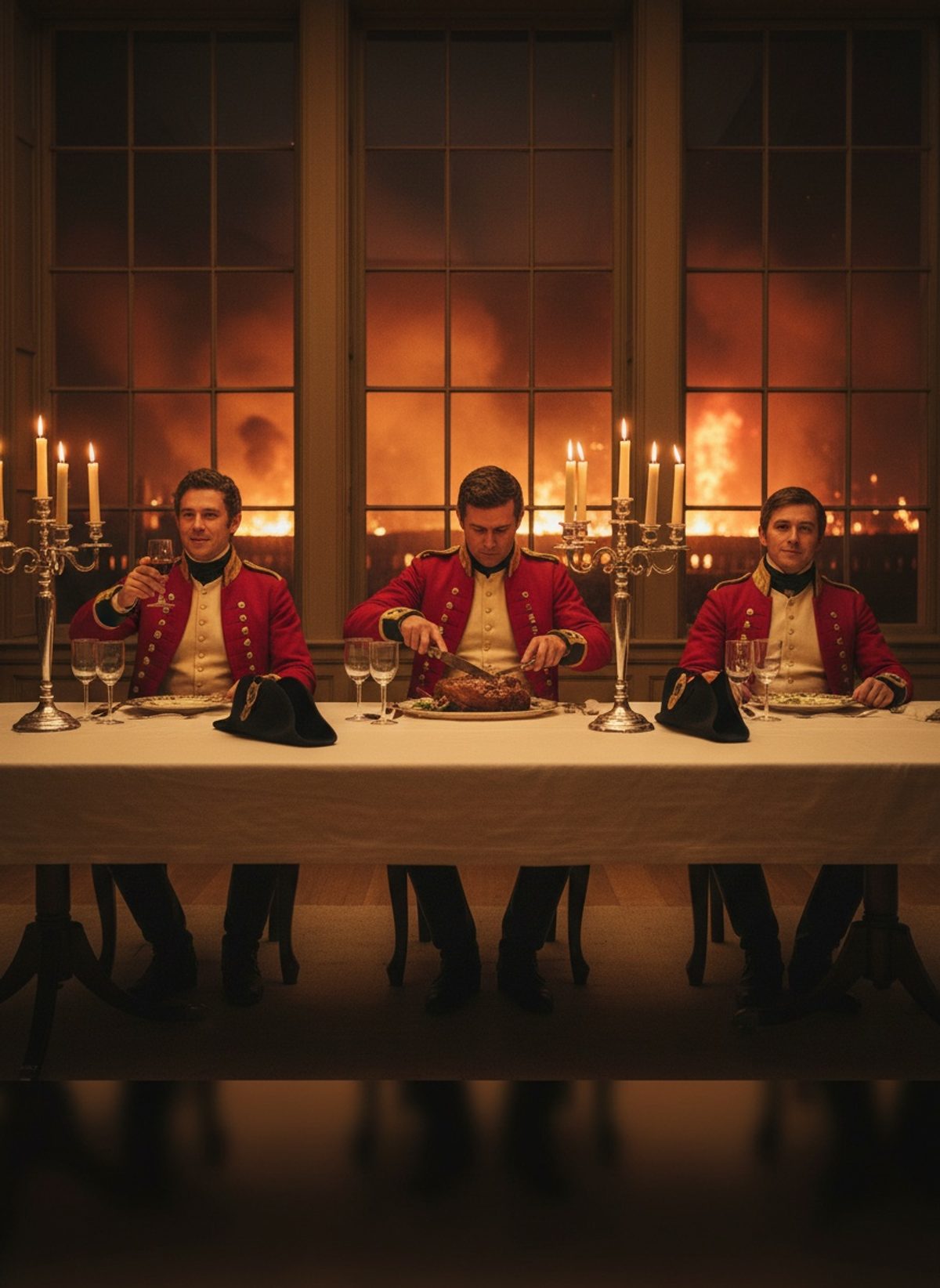
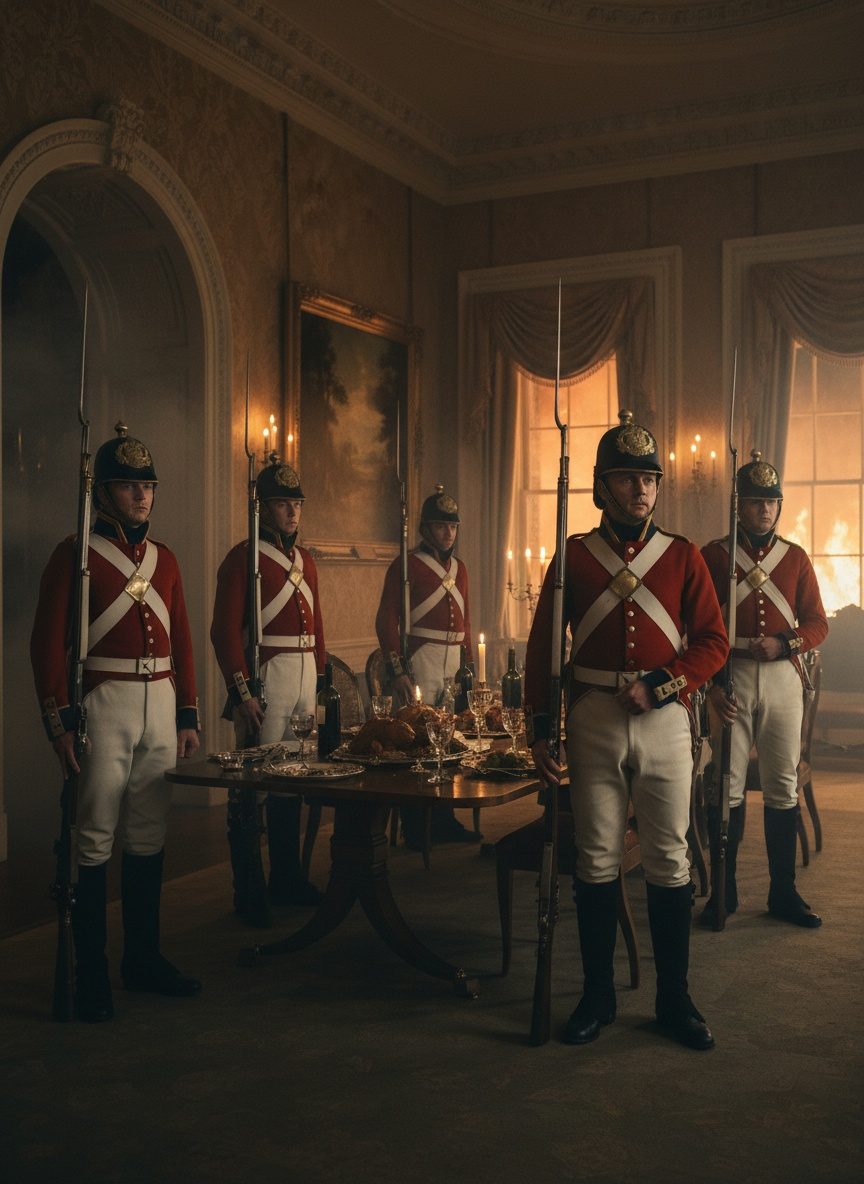
The British troops, weary from their journey, entered the President’s House to an unexpected and bewildering sight—a dinner still warm, its steam rising into the cooling evening air. For these soldiers, it was a surreal twist; war had brought them to the tables of America's highest office, not as marauders but as unexpected guests. Accounts from that night describe how the officers sat down to the meal, indulging in roasted meats and fine wine intended for President Madison and his guests. It was a moment uniquely human, if oddly cordial, in the midst of a fraught campaign.
Beyond the dining room walls, the city stood on the cusp of a historical transformation. As the troops dined, orders were given to proceed with the destruction of public buildings. Soon, fires were set, the night sky over Washington was alight—an ethereal, fiery glow reflected in the glass eyes of its startled citizens. The President’s House, the Capitol, and other symbols of American governance smoldered, their architectural beauty giving way to the crackling fury of flames. These flames did not discriminate; they consumed with a hunger that mirrored the soldiers who had unexpectedly dined moments before.
The burning of Washington profoundly impacted the nation’s psyche, underscoring the vulnerability of the young republic. Yet, the destruction also spurred a determined resilience, a resolve to defend and rebuild—a testament to a nation's indomitable spirit.
In the weeks that followed, the charred ruins of the President's house bore witness to the harsh yet transformative nature of conflict. The walls, enduring as stalwart sentinels, carried the scorch marks that would remain visible for years to come, scars that spoke volumes of a night when titles and positions were momentarily set aside for the simple act of shared humanity over a table of warmed victuals.
Why does this episode, seemingly anecdotal in the grand tapestry of war, resonate with such poignant clarity? Perhaps it serves as a reminder of the interconnectedness of our human experiences, even amidst the divides of nations at war. The British, while advancing an imperial agenda, were themselves instruments of larger unseen forces of history. The meal they partook in was not merely an act of sustenance but a fleeting glimpse into the lives of those across the aisle.
As we reflect on the burned walls of the White House—still faintly marked to this day—we glimpse not only a past of conflict but also a shared heritage of resilience and renewal. War is tragic, an upheaval of society, yet within its narrative are woven moments of striking humanity that transcend borders and differences. The dinner that briefly united foes on that August night stands as a curious footnote in history, reminding us to search for moments of understanding even amidst the ravages of discord. A shared meal, briefly savored within the halls of the American Presidency, may have offered a modicum of solace and civility on a night remembered for both its destruction and its peculiar, unintended hospitality.