Picture this: In a dimly lit workshop in Handsworth, Yorkshire, a frustrated clockmaker holds up yet another broken steel spring. The year is 1740, and Benjamin Huntsman has had enough. The steel available to him is inconsistent, brittle, and utterly inadequate for the precision timepieces he crafts. But instead of accepting defeat, this determined inventor is about to accidentally revolutionize the entire steel industry—using nothing more than clay teacups and an audacious idea.
What Huntsman doesn't yet know is that his quest for better steel will create a product so superior that his own countrymen will reject it as unnecessary, forcing him to sell his revolutionary crucible steel to French competitors. Only when British swords begin snapping like twigs against French blades will Sheffield's proud cutlers come crawling back, begging for forgiveness.
The Clockmaker's Obsession
Benjamin Huntsman wasn't born to be a steel revolutionary. The son of a Lincolnshire farmer, he had established himself as a skilled clockmaker in the market town of Doncaster. But by the 1740s, he was pulling his hair out over the quality of steel available to him. The blister steel and shear steel produced by traditional methods were riddled with inconsistencies—hard in some spots, soft in others, with impurities that made precision work a nightmare.
Traditional steelmaking was more art than science. Iron was heated with charcoal for days, allowing carbon to seep into the metal's surface. The result was blister steel, named for the bubbles that formed on its surface. This could be folded and reheated to create shear steel, but even this improved version was plagued by uneven carbon distribution and stubborn impurities.
Read next: The Day a Collier's Son Gave the Mines a Light
For a clockmaker whose reputation depended on springs that kept perfect time, this simply wouldn't do. Huntsman needed steel that was uniform, reliable, and consistent in its properties. Since no one could provide it, he decided to make it himself.
Teacups and Fire: The Birth of Crucible Steel
Working in secrecy in his Handsworth workshop, Huntsman began experimenting with an entirely different approach. Rather than trying to add carbon to iron, what if he started with steel and melted it completely? This was revolutionary thinking—most steelmakers believed that fully melting steel would ruin it.
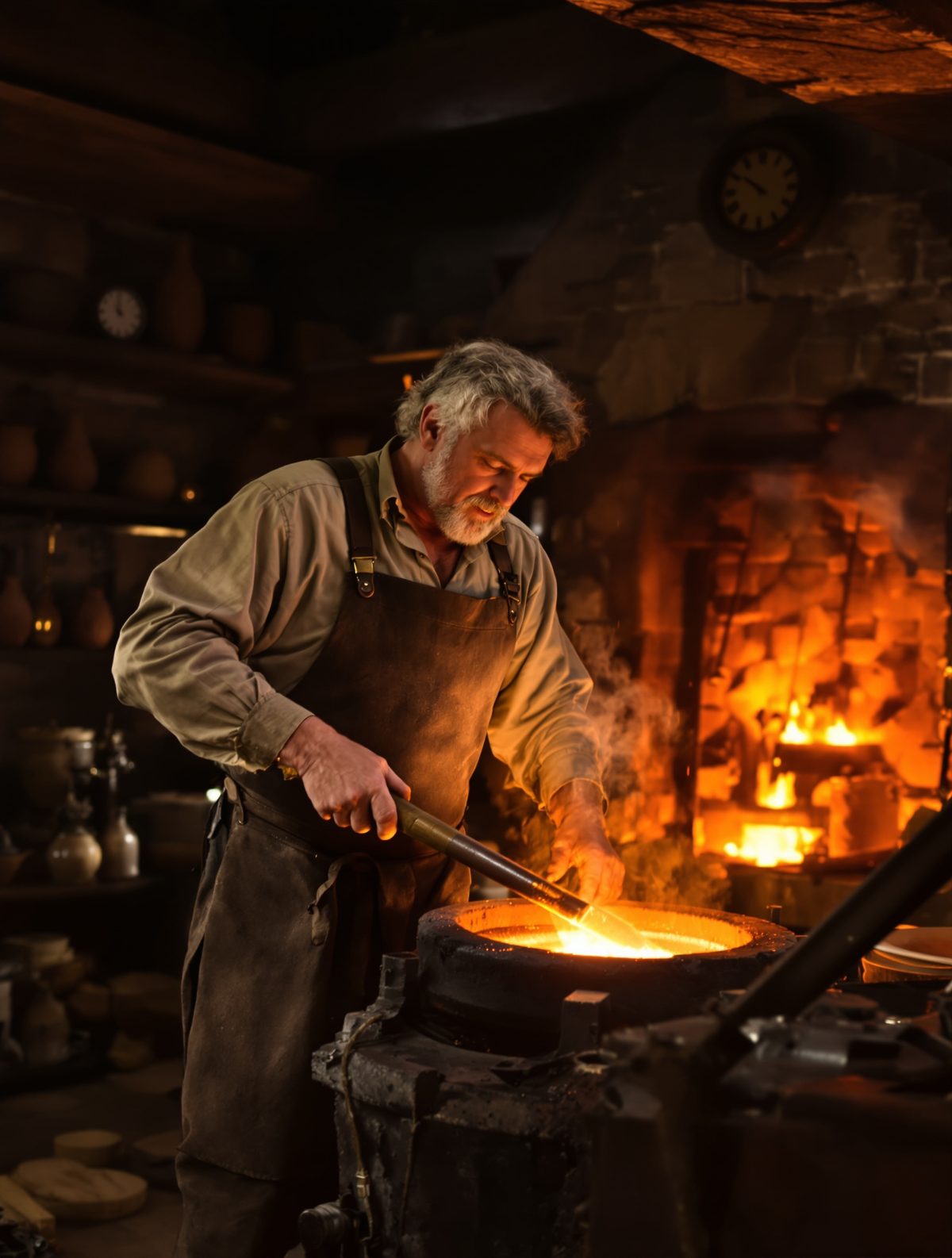
Huntsman's stroke of genius was the crucible—small clay pots that could withstand extreme temperatures. Legend has it that his first crucibles were actually repurposed teacups, though he quickly graduated to specially designed containers about the size of a large flower pot. Into these crucibles went pieces of blister steel, broken up and carefully selected. The crucibles were then sealed and heated in a furnace so hot it could melt copper.
The process required extraordinary skill and patience. The furnace had to reach temperatures of around 1,600°C (2,912°F)—hot enough to completely liquefy the steel. At this temperature, impurities would float to the surface and could be skimmed off, while the carbon distributed itself evenly throughout the molten metal. After several hours of careful temperature control, the crucible was removed and the steel poured into molds.
The result was unlike anything seen before: crucible steel that was uniform in composition, incredibly hard, and capable of holding the finest edge. Huntsman had created what amounted to a primitive form of tool steel, centuries before the term was even coined.
Too Good for Sheffield
You might expect Sheffield's cutlers to have beaten down Huntsman's door when word of his superior steel leaked out. After all, Sheffield was the beating heart of England's blade-making industry, home to craftsmen whose knives and tools were renowned across Europe. But pride, tradition, and short-sighted thinking led to one of industrial history's most spectacular miscalculations.
The Sheffield cutlers took one look at Huntsman's crucible steel and essentially said, "Thanks, but no thanks." Their reasoning seemed sound at the time: the steel was significantly more expensive than traditional varieties, and their existing products were selling perfectly well. Why fix what wasn't broken? Besides, many of these craftsmen had been using the same techniques for generations. This newfangled crucible steel struck them as an unnecessary luxury.
There was also an element of professional skepticism. Huntsman was, after all, just a clockmaker from Doncaster—what could he possibly know about steel that Sheffield's master cutlers didn't? This attitude would prove to be one of the costliest mistakes in British industrial history.
Frustrated but undeterred, Huntsman found customers elsewhere. French cutlers, less bound by tradition and more open to innovation, immediately recognized the superior quality of his steel. Soon, shiploads of crucible steel were crossing the Channel, arming Britain's greatest rival with the finest blades money could buy.
When French Steel Humiliated British Blades
The consequences of Sheffield's short-sightedness became painfully apparent on battlefields and in drawing rooms across Europe. British officers found their swords breaking against French rapiers. English cutlery, once the gold standard, was being outperformed by French knives and tools made from that upstart clockmaker's steel.
The most humiliating incidents occurred during the Seven Years' War (1756-1763), when British cavalry officers discovered their sabers were no match for French blades. Reports filtered back to England of British swords snapping during combat, while French weapons forged from Huntsman's crucible steel held their edge and integrity under the most demanding conditions.
The revelation that this superior French steel was actually made in Yorkshire, sold to France because Sheffield had rejected it, caused an uproar. Here was British innovation literally being used to cut down British soldiers. The irony was as sharp as the French blades themselves.
Military embarrassment was one thing, but when wealthy English gentlemen began preferring French cutlery made from English steel over actual English cutlery, Sheffield's pride finally cracked. The city's cutlers realized they had made a catastrophic error in judgment.
The Prodigal Steel Returns
Swallowing their considerable pride, Sheffield's cutlers finally approached Huntsman in the 1760s. The conversation must have been awkward: "Remember that steel we said we didn't want? Well, it turns out we need it rather badly." By this time, Huntsman had relocated his operation closer to Sheffield to be near better coal supplies and transportation routes.
Read next: The Day a Cornish Engineer Lit the World's First Steam Locomotive
The transformation was immediate and dramatic. Sheffield cutlery made with crucible steel quickly regained its reputation as the finest in the world. The city became synonymous with quality steel, a reputation that persists to this day. Huntsman's process became so closely associated with Sheffield that many people forgot it had been invented by an outsider whom they had initially rejected.
The economic impact was enormous. By the 1770s, Sheffield was producing thousands of tons of crucible steel annually. The city's population swelled as workers flocked to the new steel mills. Huntsman's innovation had essentially created an entire industry, transforming Sheffield from a regional center of traditional cutlery into the steel capital of the world.
But perhaps the most satisfying vindication came in the quality of the products themselves. Sheffield steel became the material of choice for everything from surgical instruments to precision tools. The city's makers could finally offer customers what Huntsman had promised from the beginning: steel that was consistent, reliable, and superior to anything else available.
The Clockmaker's Legacy
Benjamin Huntsman died in 1776, the same year as another revolution that would reshape the world. But his legacy lived on in every piece of crucible steel that emerged from Sheffield's forges. The process he developed in secret, using clay teacups and sheer determination, would go on to build the infrastructure of the Industrial Revolution.
Crucible steel formed the cutting tools that machined the precision parts for steam engines. It became the springs and gears that drove the machinery of textile mills. When Britain began laying railway lines across the empire, it was often Huntsman's steel that formed the rails and the tools that laid them. The very industrial supremacy that made Britain the workshop of the world owed a debt to a frustrated clockmaker who refused to accept mediocrity.
Perhaps most remarkably, Huntsman's basic process remained the standard for high-quality steel production well into the 20th century. Only the development of electric arc furnaces and other modern techniques finally superseded the crucible method he pioneered. For over two centuries, the finest steel in the world was made essentially the same way Huntsman had made it in his Handsworth workshop.
Today, as we grapple with questions of innovation versus tradition, of embracing change versus maintaining the status quo, Benjamin Huntsman's story offers a powerful lesson. Sometimes the greatest breakthroughs come from outsiders who refuse to accept that "good enough" is actually good enough. And sometimes, as Sheffield learned to its cost, rejecting innovation doesn't make it go away—it just ensures your competitors will benefit from it instead.