She lived in a world steeped in empire and conquest, yet her most precious possession was a simple mirror. The young Roman woman buried beneath York was venerated in death as few were in life.
As the bustling streets of modern York pulse above a labyrinth of concrete and cobblestone, below lies a forgotten legacy, unveiled in part when archaeologists stumbled upon a young girl’s resting place. The discovery of her burial site boldly challenges preconceived notions about life in Roman Britain, inviting us to ponder the significance of this long-buried Roman girl's final farewells.
Our journey begins in the fourth century, where Eburacum, known now as York, thrived as a significant Roman settlement blending Latin efficiency with Britannic resilience. It was a city where the clatter of sandals on cobblestones harmonized with trade calls and distant marching legions. However, beneath this vibrant societal façade, the story of a singular soul silently awaited its rediscovery.
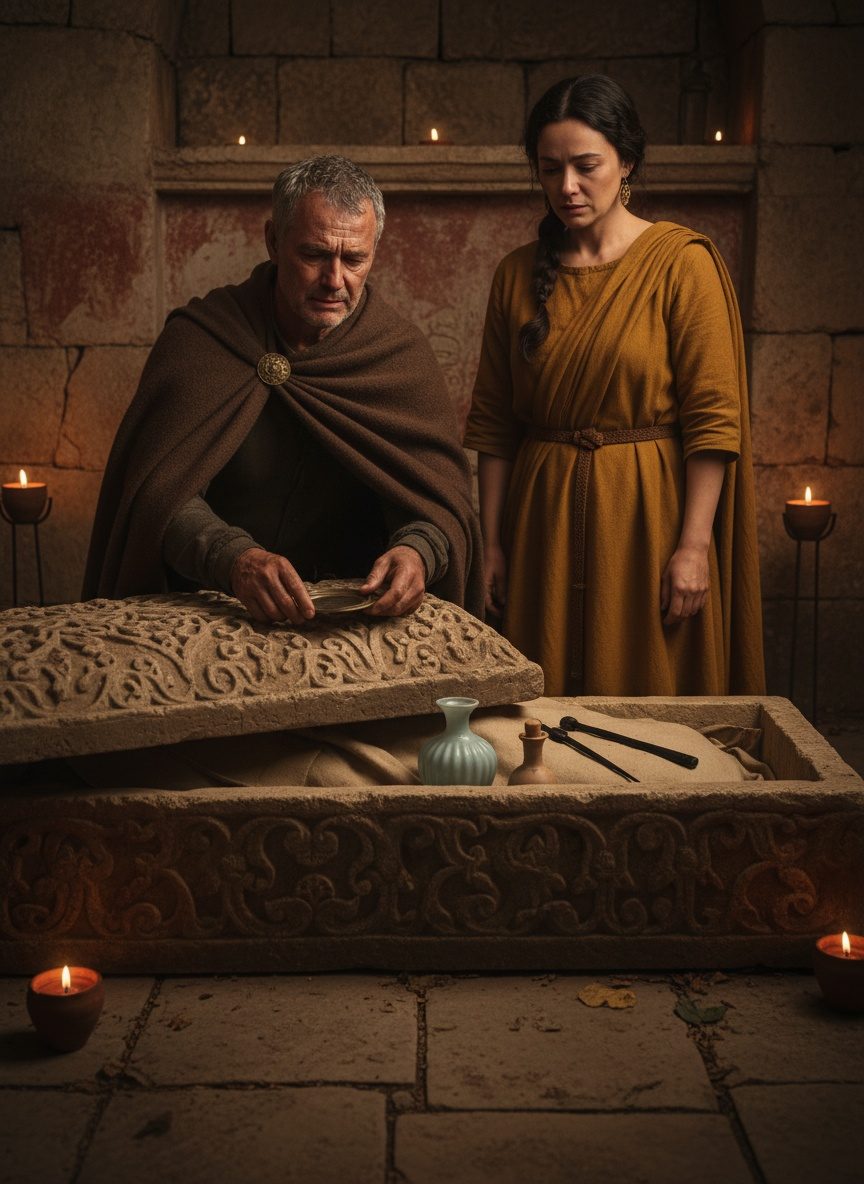
Her burial was unlike any other. Encased in an ivory and jet sarcophagus, she was surrounded by symbols of a life of both beauty and mystery. A polished bronze mirror lay beside her, a utilitarian object by some accounts, yet more likely a cherished relic depicting her gender or status. This was no mere trinket; it represented her identity, a bridge to memories of joy, confidence, and personal reflection. The presence of the mirror defies assumption—it's as if the ancient Roman concept of the anima or "soul" demanded her last tether to life remain unbroken in the afterlife.
Read next: The Day a Roman Soldier Defied an Emperor to Free a Province
Beyond the shimmer of bronze, fragile remnants of a blue glass jug and a perfume flask lay tucked into the crook of her peaceful repose. Such items, emblems of luxury, spoke volumes in silent tongues. They whispered of banquets, beauty rituals, and the delicate arts of femininity respected across all echelons of Roman society. Perfume, as a scented swathe between life and death, signified freedom from the drudgeries of labor, allowing its bearer to transcend the mundane.
The conditions of preservation were fortuitous, permitting specialists to piece together insights not only about the woman but also the world she inhabited. Her carefully prepared tomb suggests she held a place of affection and status in her community, although her exact identity remains masked by time’s veil. Her very existence evokes sequences from old Empires, where ghosts of legionaries intertwined with whispers of forgotten voices across the broadways of York.
What was her name? What soft notes of laughter or impassioned words did those who loved her recall at her internment? Her presence is haunting in its immediacy, abetted by an unyielding curiosity and the knowledge that she embodied the triumph and fragility of human existence.
Time lends gravity even to the humble grave goods—a delicate jug that might have held wine for toasts or cherished libations, fragments of rose-tinted glass that might catch the light of flickering oil lamps during evening rituals. These objects, compositionally fragile yet fundamentally resilient, beckon us closer to the human face of antiquity, echoing everyday scenes celebrated in the poetical traditions from Ovid to Virgil.
For far too long, the narrative of Roman Britain has been dominated by emperors, soldiers, and conquests. Here, however, is a poignant chapter of domesticity, intimacy, and human dignity. The ivory resting place of our mysterious Roman girl reveals a dimension of colonial existence steeped not just in warfare and trade, but in how individual lives were touched, shaped, and mourned. It infuses the factual recountings of stone and grit with the fragrant humanness of a quieter, nurturing aspect of Roman assimilation.
Her journey to York, whether by familial duty or the ebb and flow of merchant seas, underscores the diversity that marked frontier life. It implores us to reconsider the impact of diverse cultures meeting, melding, and sometimes clashing under Rome’s banner. Through her silent lips and unspeaking mirror, she offers a vital testament to lives once lived, ordinary yet extraordinary in their silent testimony.
Rediscovering this Roman girl reminds us that history is as much about the lives of ordinary people as it is about grand events. It's a narrative woven with human threads, transcending time’s erosion. In retaining her mirror, this young Roman challenges us to reflect upon ourselves—our values, our legacy, and our collective memory. As York flourishes above her resting place, it continues to remind us that beneath every stride and structure is a story yearning for the light of day.