An impossible escape seemed just that—until it wasn't. In 1876, a bold journey through the heart of the British Empire defied the oppressive strictures of colonial rule.
A Widow's Silent Despair
The year was 1876, and British India was a swirling mosaic of cultures under the stern gaze of colonial rule. Among the two hundred million Indians was Pandita Ramabai, a woman of remarkable intelligence and inner strength. Observing the plight of a high-caste Brahmin widow, Ramabai's heart seethed with both empathy and indignation. In the rigid strata of Hindu society, Brahmin widows were condemned to a shadowy life of seclusion and ritualistically ordained suffering—a life of utter invisibility in a vibrant world.
Pandita Ramabai herself was no stranger to the constrictions of society, being highly educated yet constrained by strictures that limited the potential of women. It was this encounter with the widow's forlorn existence that lit a fiery determination in her—a realization that she could perhaps turn the very mechanisms of British rule against themselves to subvert a rigid caste system.
The Craft of Disguise
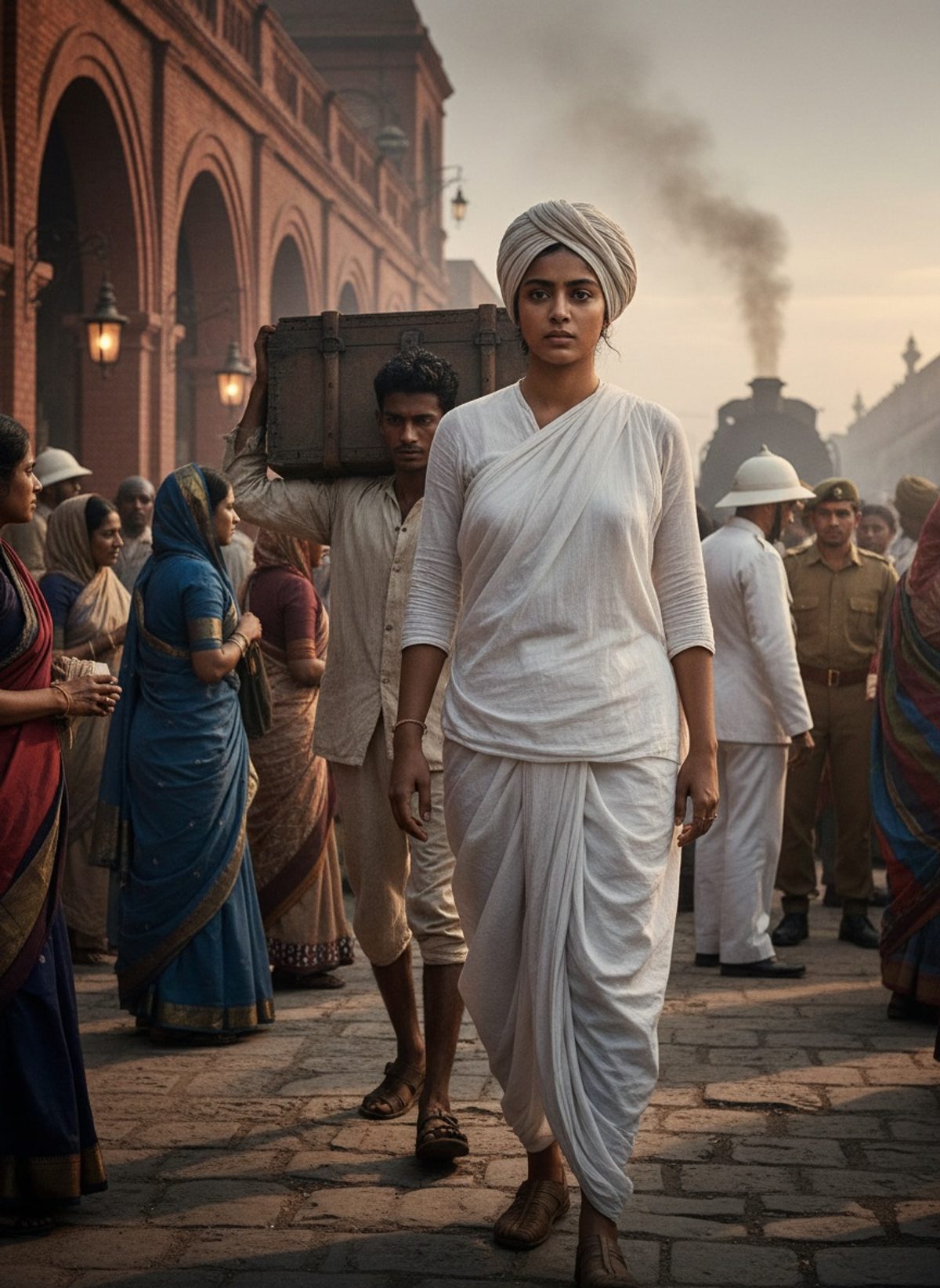
Pandita's plan was audacious. She would traverse British India, dressed as a man, alongside a confidant who posed as her servant. In an era where identity was so stringently defined by class and gender, even the smallest slippage could unravel their perilous journey. Yet, Ramabai's conviction was unwavering; her mastery of disguise and adaptation was to be her greatest disguise yet.
Read next: When Prithipall Singh Crossed the Frontier Disguised, 1897
The vibrancy of the bazaars, the clatter of carriages, and the steady rhythm of the steam engines created an opera of modernity that masked their movements. Her choice of outfit was both modest and meticulous—each garment selected to obscure her identity while fitting seamlessly into the world of men. Her companion, equally adept, played the role of the humble attendant, facilitating their passage through customs and commons alike.
Crossroads and Crossings
The spine of their journey was the British railway network, a marvel of colonial infrastructure that spanned the subcontinent. The railways, designed to streamline control and enhance the economic might of the empire, now paradoxically served as the veins through which these fugitives flowed toward freedom.
With each station they passed, the landscape pulsated with colonial ambitions and local resilience. In this environment, Ramabai's disguise afforded her an unconventional immunity. The British were often blind to the granular distinctions among Indians; they saw caste divisions as quaint cultural relics. This very ignorance became an inadvertent shield.
As they neared their destination, the sprawling, chaotic expanse of Bombay awaited them—a city teeming with merchants, seamen, and colonial officials. The density of the metropolis was both a danger and a sanctuary. In Bombay, anonymity was both easily lost and surprisingly recoverable among the bustling crowds.
From Piers to Freedom
Reaching Bombay marked the precipice of their calculated gamble. From the ports, transport ships teeming with aspirations of far-off lands awaited departure. Now, the final act of their daring deception needed to unfold seamlessly to procure safe passage out of India.
The bustling docks teemed with the scents of spices and the cries of vendors. Here, the British influence was heavily felt, not just in the architecture, but in the very air that mingled with both opportunity and oppression. Ramabai and her companion successfully mingled with this motley tapestry of humanity. One wrong glance or misstep could have culminated in disaster, yet their presence went unchallenged.
Secured on a ship, they found themselves separated not only by distance but in time, from the confines of caste and colonial dominance. The vastness of the ocean was a realm of unrestricted possibilities—one that beckoned freedom.
A Legacy of Defiance and Escape
History has long been told by those in authority, with its myriad nuances lost to those wielding the power of erasure. Yet, stories such as Ramabai's underscore the ways in which subjugated people have consistently navigated through the rigid infrastructural frameworks imposed upon them. It's a stark reminder of the agency wielded by those often deemed powerless.
The story of Pandita Ramabai's bold escape underscores the latent potential within the system itself—the ways in which oppressive forces can be turned on themselves. More than an account of personal survival and cunning, it offers profound insights into the unyielding spirit of resistance, the resourcefulness born of desperation, and a persistent quest for human dignity that knows no boundaries.