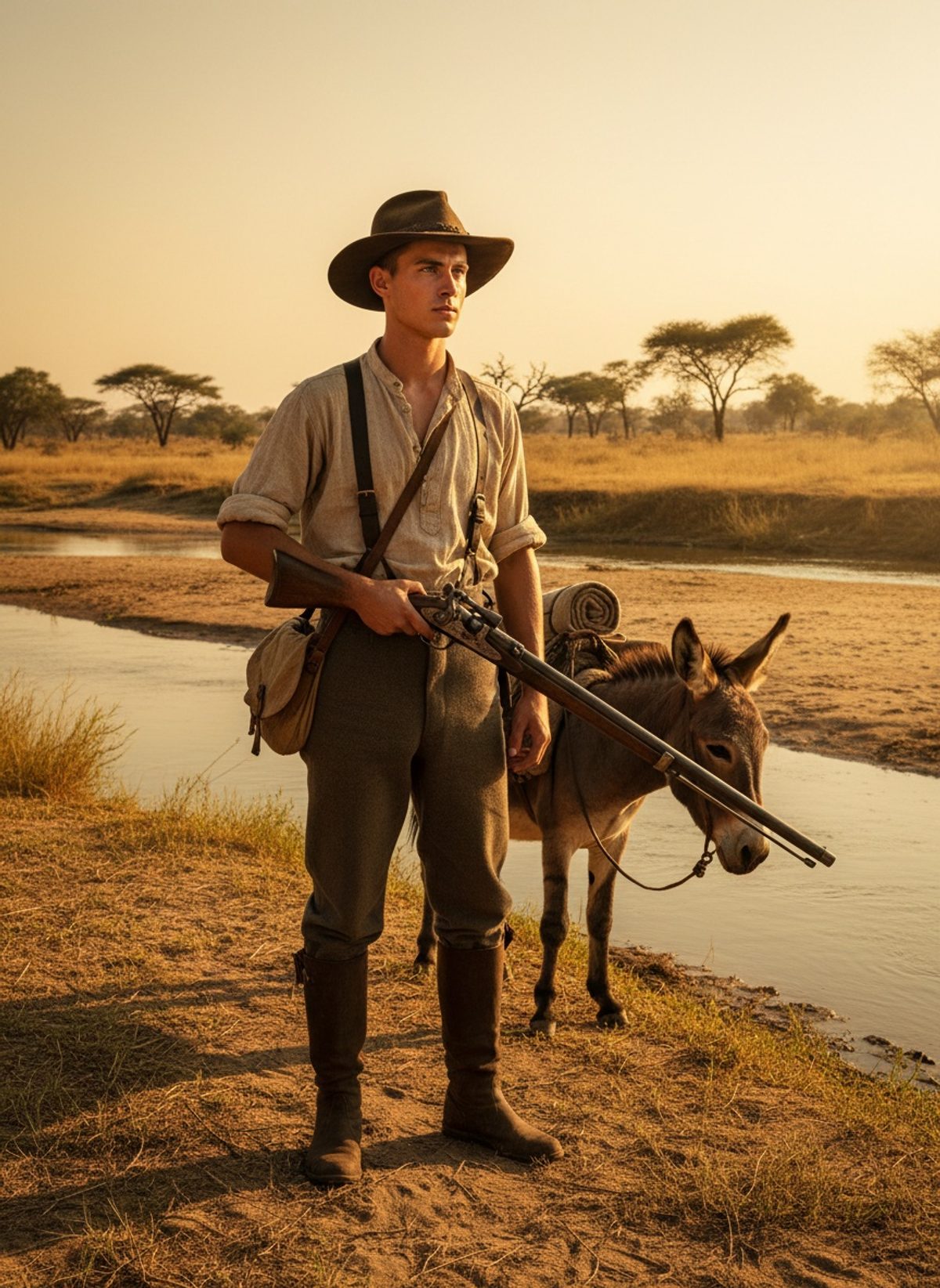
The sun hung low in the sky, casting its vibrant orange hue across the waters of the Limpopo River. The air was thick with humidity, a reminder that the heart of southern Africa lay just beyond. Crickets sang their evening hymns as shadows lengthened on the plateau. It was here, in the summer of 1871, that a lone figure stood poised at the brink of the unknown: a nineteen-year-old Englishman named Frederick Courteney Selous. Equipped with little more than forty pounds sterling, a single-shot rifle, and the kind of youthful audacity that borders on madness, Selous prepared to cross into a land that knew no European map. This crossing was not just a physical boundary but a step into a vast and complex web of cultures, landscapes, and untamed ecosystems, waiting to be charted by the world beyond.
Frederick Selous had arrived in Africa with dreams as broad as the continent itself. The son of a wealthy English family, he listened to tales of adventure even as a child—stories that ignited his imagination and nurtured a fascination for the African wilderness. The Victoria Falls, the savannas teeming with majestic wildlife, and landscapes as varied as the people who inhabited them held a near-mythical allure. Yet he was more than just a dreamer; he possessed a tenacity that defied his youth and inexperience. At a time when European presence on the continent was mostly tethered to coastal cities, Selous harbored ambitions of moving past these boundaries into Africa's largely uncharted interior.
The Limpopo, that fabled river of Kipling's tales, was not merely a geographical barrier but also a psychological one. It marked the threshold between the familiar colonial outposts and the great unknown. With every stroke of his oar, Selous edged closer to his destiny, knowing that he had very little to guide him thereafter. The land beyond flowed with potential and peril in equal measure. Without a map, he relied on his instincts and the scant information provided by indigenous guides. It was this reliance on local knowledge that would become both a strategy for success and a mark of Selous' respect for the native peoples.
What unfolded over the next four decades was an adventure the likes of which could scarcely be imagined in Victorian England. With the unyielding landscapes as his constant companions, Selous traveled extensively across what is today Zimbabwe, Zambia, and Namibia. He did not merely traipse through the land but traversed it with purpose and diligence. Eschewing the hierarchical and often exploitative norms of his era, he displayed a curiosity and humility that informed his interactions with local tribes. This openness would serve him well, enabling him to broker peace and secure friendships crucial for survival and success in uncharted territories.
Read next: When Samuel Ajayi Crowther Stood Before the Asaba Chiefs, 1875
In these early days, Selous' path was often riddled with danger. Disease-carrying tsetse flies, the threat of malaria, and the risk posed by prowling predators were constants in his life. Though armed with a rifle, his true arsenal was knowledge: the art of navigating the terrain, understanding the behavior of animals, and reading the subtleties of human nature in a land brimming with complexity. As he chronicled his journeys, he provided one of the earliest comprehensive accounts of southern Africa's vast diversity, forever changing Europe's perception of the continent.
Among the many lesser-known facts about Selous is his role in opening up hunting grounds that would become crucial for trophies and specimens sent back to England, irrefutably shaping scientific collections and museum exhibits. However, Selous was not a mere hunter; he became a pioneering conservationist of sorts long before such notions were fashionable. Astonished by the sheer abundance and irreplaceability of African wildlife, he urged restraint among hunters, warning of the consequences of heedless slaughter that could lead to the decimation of species.
The story of Frederick Selous is one threaded with the contradictions and complexities of his time. As Europeans raced to carve up Africa, Selous occupied a unique space; one in which he navigated an intricate balance between the imperial powers' demands and the terrain's emerging realities. His expeditions and discoveries came to symbolize the frantic rush of the Scramble for Africa, fueling both colonial ambition and academic curiosity. Indeed, those early steps he took at the Limpopo unknowingly laid a crucial foundation for the later colonization processes that would reshape the continent's geopolitical map.
As tales of his exploits were published back home, Selous captured the imagination of a generation yearning for adventure. His books, filled with detailed narratives and astute observations, offered a glance into a world tantalizingly out of reach yet now accessible through his prose. And as empire builders stamped their authority across Africa, Selous would come to represent both the allure and the agony of European expansion.
The presence of this maverick of the wilds lingered long after he finally left the continent he loved. Even today, his name is etched in the annals of African history, and his shadow graces the lands he once wandered, shaping a rich legacy. Selous Game Reserve in Tanzania, one of the largest protected wildlife reserves in the world, stands as a testament to his enduring impact—and yet his story is rarely told in full, eclipsed by the grand narratives of empire and conquest.
In remembering Frederick Courteney Selous at the moments just before he first crossed the Limpopo, we rediscover not just the epoch's grand drama but the intimate human theater that unfolded on the continent's vast canvas. In his story, we are reminded that exploration and understanding—despite their perils and pitfalls—are quests that continue to reverberate in the restless pulses of our contemporary world, inviting us once again to step beyond the maps we know.