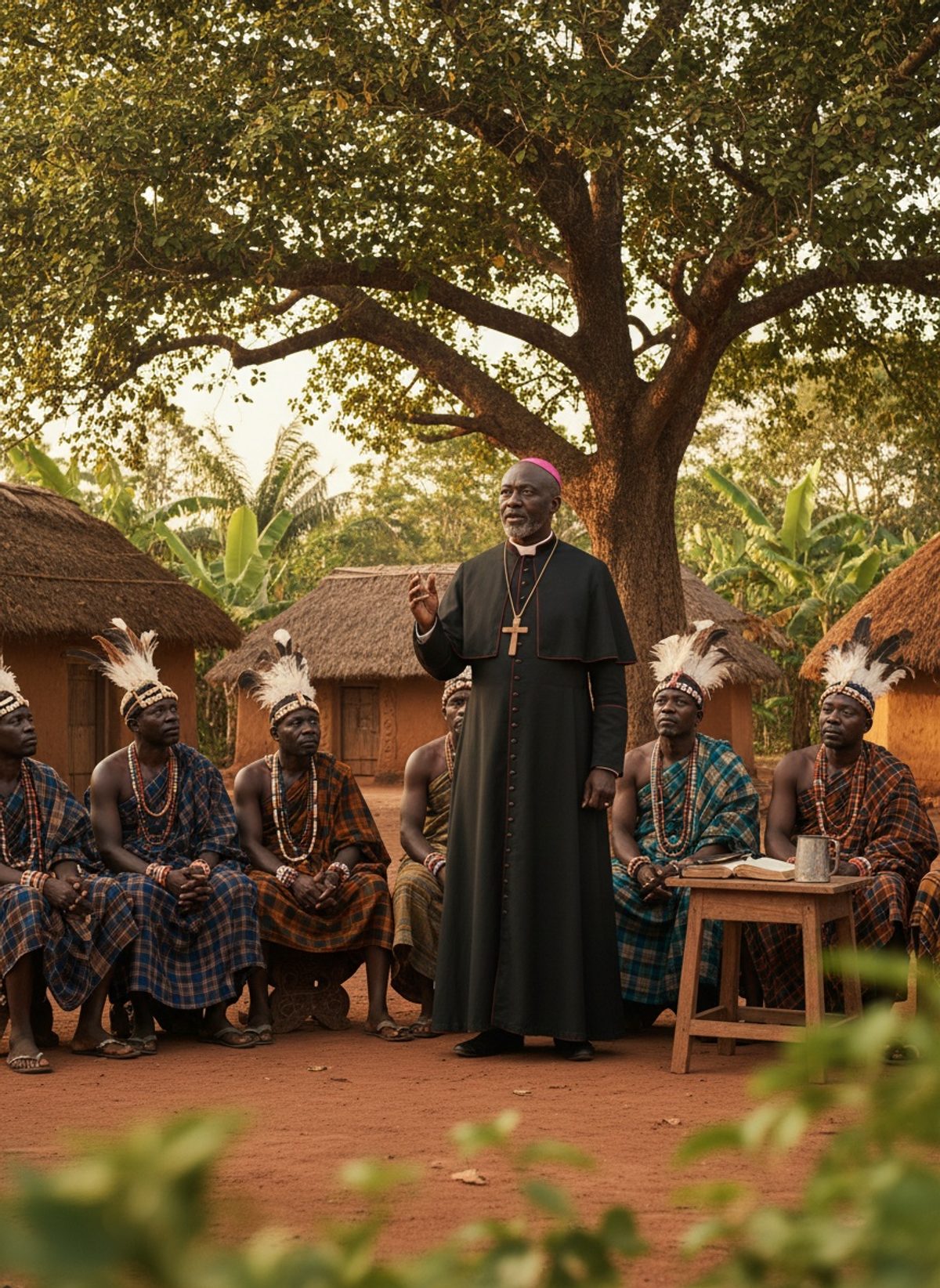
The air hung thick with anticipation and the heavy scent of wood smoke. Ellen and the rest of the chiefs sat in a semi-circle, their expressions curious yet skeptical. In the middle of the circle, standing with quiet confidence in a crisp, white cassock, was Samuel Ajayi Crowther. He was both a familiar face and a stranger to these people of Asaba. As he stood there, the knowledgeable eyes of the chiefs locked onto him, scrutinizing every inch of this man who had come back from foreign lands to speak to them in their own tongue.
The Boy Who Became a Bishop
The story of Samuel Ajayi Crowther's return to the Niger Delta began many years earlier under harrowing circumstances. Imagine being just a boy, seized from your village home, the sun blotted out by the shadow of captivity. Crowther was one of the countless Africans captured by raiders and thrust into the brutal reality of the transatlantic slave trade. Fate intervened when a British Royal Navy ship intercepted his captors' vessel, saving young Crowther from the bondage of a life in chains.
Rescued from the jaws of despair, Crowther found himself in Sierra Leone, a burgeoning colony of freed slaves. It was here, in this haven of liberation, that his path took an extraordinary turn. Educated by the Anglican Church Missionary Society, Samuel displayed an affinity for languages that was nothing short of remarkable. This skill would become his most powerful tool, fundamentally altering the course of his life.
His acumen and unyielding faith led him to be consecrated as a bishop in 1864, making him the first African Anglican bishop. Crowther's heart called him back to the lands of his childhood, where he hoped to use the Bible not as a weapon of colonialism but as a balm of peace. He aimed to bridge two worlds with words borne from his soul.
Read next: When Garnet Wolseley Marched Into Kumasi, 1874
The Gathering at Asaba
Back in the present, the glance of the Asaba chiefs never wavered. They watched as Crowther began to speak, his rich voice cutting through the humid air. He spoke in Yoruba, the language of his people, the language that still danced in his ears as a haunting lullaby from his earliest memories. His words were a tapestry of old folklore and new visions, presenting Christianity not as a foreign imposition but as a familiar story clothed anew.
Crowther knew the intricacies of the beliefs and traditions shared by those seated before him. His message was simple yet profound, full of respect and understanding, an entreaty woven with the threads of shared heritage. This was not the arrogant preaching of an outsider; it was a conversation among kin.
The chiefs, entrenched in tradition and wary of foreign influences, could sense authenticity in Crowther's demeanor. Here stood a man who had walked the corridors of both African jungles and London cathedrals, whose every word was a blend of those journeys—a symphony of unity tempered by the discord of historic discord.
Forging Pathways of Trust
Trust, after all, was the currency of these exchanges. Crowther knew that more than words would be needed to forge enduring bonds. He proposed an idea that was revolutionary: a school for the local children, where they could learn to read and write—skills that would empower them to navigate an ever-changing world.
The potential for mistrust was real; European colonial ambitions hovered like a specter over interactions with Africans during this Scramble for Africa. Yet Crowther's sincerity shone through. He was not an agent of conquest but a bridge-builder. He urged the chiefs to consider the proposition not as an erasure of their culture but as an enhancement of it—a means to equip future generations with the tools to forge their paths.
The air in the room shifted; a tangible electricity seemed to hum between the assembled group. The chiefs whispered among themselves, weighing the weight of Crowther’s words. They saw the opportunity in his vision—a possibility previously obscured by the legacy of chains that had bound their kin.
Turning the Tide
In the days that followed, something remarkable happened. A plan was set into motion, one small step in the unfolding of a larger story. Crowther had sown seeds of change that took root in fertile soil, growing with a vigor that surprised even the most skeptical of the Asaba leaders. Children learned to read script that once seemed like a tangled web of alien symbols. Parents watched with growing pride and curiosity.
Samuel Ajayi Crowther's courageous return to Asaba was a moment of profound significance, where history pivoted on the hinge of possibilities. His life became a living testament—a narrative interwoven with threads of struggle, redemption, and hope. The powerful voice that once spoke as an equal with African leaders was a harbinger of a new dawn rising over the Niger Delta.
Though the broader colonial shadow still loomed over Africa, Crowther’s legacy was a shimmering testament to reconciliation and understanding, a living bridge melding the worlds of ancient heritage and new horizons. The scene of Crowther before the Asaba chiefs remains etched in history as more than just a moment in time but a defining confluence of destiny and courage—a narrative of a man who strode back to his roots and planted seeds for the future.