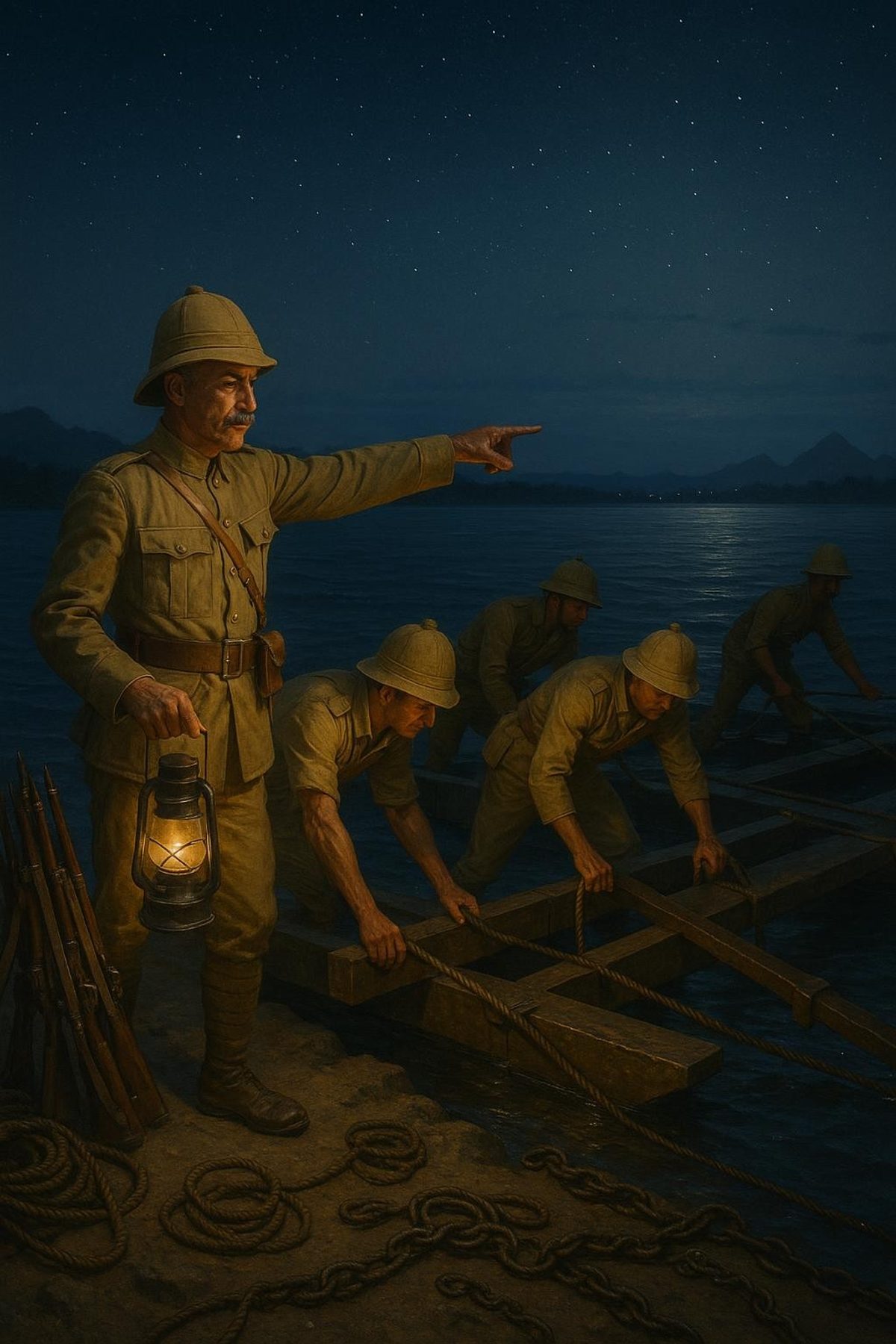
The air was thick with anticipation as the hiss of steam engines waned and the clanking of tools punctuated the night. Men whispered in hushed tones, their words barely audible over the steady rush of the Nile's tumultuous waters lapping against the darkened shore. All eyes were on the Royal Engineers, whose daunting task lay not in the weapons of war, but in constructing a bridge to carry an entire army. In what seemed like madness, they were to defy nature's obstinance and alter the landscape overnight under the cover of darkness.
The Dance of Timber and Iron
As the last embers of the campfires were extinguished, the engineers began their intricate ballet—part science, part sheer audacity, and undeniably a testament to their Victorian ingenuity. The mission was to construct a pontoon bridge across the mighty Nile—a river steeped in legend, relentless in flow, and notorious for its width and power. By the dim light of their lanterns, the sepia shadows of engineering marvels came to life. Pontoon sections, prefabricated in advance, were cautiously floated into position. The sound of metal pins and joints locking pierced the veil of night as the bridge began to take form.
Each component had a role in this mechanical symphony. Sappers waded into waist-deep waters, their bodies sheathed by the indifferent river as they directed the pontoons into place. Cables were flung and chipped across the current, finding their purchase like serpents binding prey. Rapid yet deliberate, the assembly cut into the early hours—a collective pulse driving men to persevere despite fatigue and the incessant whisperings of doubt rising like smoke among them. Midnight masks many sins, but it was only the engineers’ skill that would mask their vulnerability before an enemy still lurking on the opposite bank.
The Nile was a formidable adversary in its own right. It careened onwards, heedless of the colonial ambitions and the empire's need for supremacy. Its depths were a world unto themselves, far from the political theaters these soldiers staged upon its shores. Yet, with each cleverly placed pontoon section, humanity marked its defiance, etching the determination of men gripped by Kitchener's resolute command for morning victory.
Read next: When Piper Muir Played the Gordons Into Omdurman, 1898
Armies Over Water
Come dawn, the first tentative rays of sunlight crept over the horizon, peeling back the curtain of night to reveal a sinewy figure of engineering stretching across the river. There it was—a bridge, a conduit for imperial might, borne of both desperation and necessity, unyieldingly stretched over the water’s expanse. As the first boots touched its timbers, the earth might as well have sighed, for the mechanics of conquest would once again roll forth unchecked.
The army moved methodically but quickly, each soldier a cog in this colossal machine driven to stamp out any remnants of resistance. The presence of the bridge was both a tactical triumph and an emblematic testament to human ingenuity brokering victory over nature. Yet, as each unit parachuted from the eastern bank to the western, expectations and whisperings swirled in their footsteps. The men who had watched as war unfolded beyond them, engaged the bridge with a similar gravity. Everything depended on this crossing—the success was not in the fight already won, but in the submission of the land now spread before them.
Beneath, between the creaking of the planks and the steady patter of boots upon wood, the Nile surged ever forward, seemingly indifferent to the events born upon its surface. Still, its deep currents carried whispers from the past, of ancient pharaohs whose worlds rose and fell, and of invaders both vanquished and victorious across millennia. But for now, the river lent its flow to empire's march, a silent partner to the brave men it bore across its chest.
The Ephemeral Bridge and Memory
As the day unfolded, the labor and triumph existed as tangible reality only momentarily. By the time the sun dipped in the sky, the pontoon bridge would be dissembled, reclaimed by the Army’s relentless forward push. Like a ghost in the annals of history, its physicality would fade swiftly, yet the rigging and rivets hummed with the echoes of what men had achieved in the blackness before dawn.
Omdurman was the keystone; a hewn rock upon which Britain coveted its dominion as paramount. Yet, even the best-held stones are subject to erosion—time, like the Nile, weathers all that is solid, ensuring that glory is never eternal. Such feats of engineering under duress might silently ripple through history’s great canvas, overshadowed by battle but indispensable in their underpinning of empire.
In capturing this moment, a bridge not only joined two sides of an expanse but also linked realms of possibility and achievement. It was a stark testament to the prevailing will where men with more gumption than sense wielded wood and steel with ecclesiastical reverence. While their deeds surfaced briefly to the world above, the enduring question remains of what ultimately bridges our memory of history—valiant hearts, unyielding souls, or transient victories cast across the rivers of time.