He was a simple schoolteacher from the Himalayan foothills. Without nobility or military rank, Nain Singh Rai accomplished the impossible: he charted the unknown vastness of Tibet, a place shrouded in mystery even in the far-flung reaches of the British Empire.
The year was 1875, the Victorian era at its zenith, when exploration was both a gentleman’s pursuit and a geopolitical necessity. The British sought every advantage they could, peering into blank spaces on maps with the same fervor with which they amassed new territories. Nain Singh, with no more authority than a curious heart and a fierce resolve, was selected for one of the most perilous assignments imaginable — one that had defeated many Europeans before him. His mission was simple in its directive but daunting in execution: to uncover the secrets of Tibet and the ancient city of Lhasa, a place fiercely protected from outsiders.
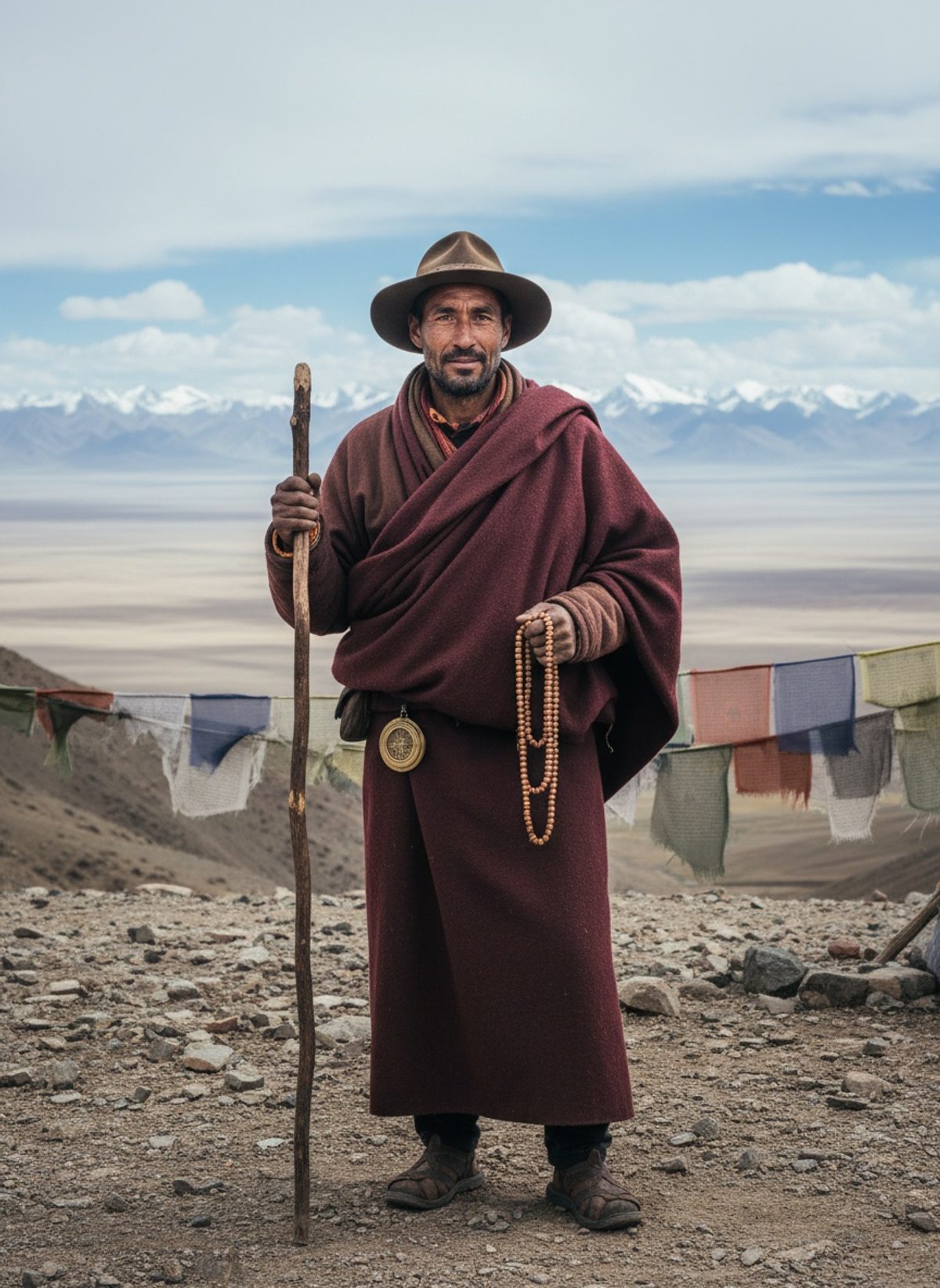
There was no room for error, no margin for comfort, in the sneaking grip of the Himalayas. The monumental task required subterfuge and precision. Disguised as a mendicant pilgrim, Nain Singh carried a singularly peculiar tool for such a high-stakes assignment: a rosary of exactly 100 beads. Each bead, woven with intention, served a dual purpose. While the rosary appeared to the untrained eye as a simple article of faith, in the hands of Nain Singh, it was his compass, his navigator, counting each step he took with steadfast determination.
Nain Singh possessed a mind sharpened in the rudimentary but effective schools of the Himalayan foothills, but it was his training under the British Great Trigonometrical Survey that honed his skills into a knife edge. Trained to walk in paces measured meticulously — sixty-three and a half inches to an educated stride — his feet became the measure by which entire landscapes were known. In an era when a map was as good as currency, Singh provided the currency of knowledge, a treasure beyond gold.
Read next: When Hodson's Horse Charged at Delhi, 1857
The world between India and Tibet was as dangerous as it was beautiful. The landscapes stretched wide and wild, the towering peaks of the Himalayas whispered the secrets of the ages, cloaked in the crystalline crispness of high altitude air. Each step Singh took advanced a survey that would unravel intricate details of a world that few had grasped. Yet, the rigors of terrain weren’t his only resistance. Tibet was a forbidden land, inviolate and unyielded to the foreign presence, carefully shutting its gates to any incursive intentions from beyond its rugged frontiers. Cloaked in the guise of a native, with every beat of his heart he risked betrayal, for exposure surely meant death or at best, eternal imprisonment.
His journey was a tale told in silence, a catalog of memorization and mental maps drawn in the quiet recesses of his mind. There were no sketchbooks pulled brazenly beneath the gaze of Tibetan watchmen. Instead, the etchings of geographical sketches were carefully tucked away, hidden beneath the folds of memory. At night, under the guise of prayer, Nain Singh would recount, rekindle, and commit his reconnoiter to the paper sparse and secreted within his garb.
In an era when the British railway extended its iron fingers to the corners of the Empire, and innovations in mapping were on the cusp of a monumental shift, his accomplishments went largely uncelebrated in the public sphere. But to those in his field and his sponsors in British intelligence, Nain Singh was a prodigy in disguise. His survey became the most accurate and complete account of the region that the British Empire had ever wielded. The pride of a nation was embodied in his simple success, for the industrious mind of a solitary man had mapped not just geographical terrains but a future path of exploration.
With Nain Singh’s return to India, the knowledge he carried was extraordinary. He brought back more than coordinates; he unfurled ancient trade routes, indicated the peculiarities of Tibetan social norms, and detailed its bridges and rivers as if recalled from a personal retelling. His data were lauded — sufficiently praised to become the cornerstone of further British exploration efforts.
In reflecting upon Nain Singh's achievements, the lessons echo with simple clarity. They remind us that history is often shaped not by those adorned with laurels at their brow but by unheralded pioneers whose feats, shrouded in the complex depths of time, recommit us to the idea that greatness is often tucked away in the most unexpected of places. His story matters today, not just as a footnote in the annals of imperial ambition, but as an illustration of ingenuity and bravery in the unlikeliest of figures. In the tapestry of human endeavor, it is these hidden threads that provide strength and resilience, revealing the possibilities that lie at the intersection of culture, resolve, and exploration.