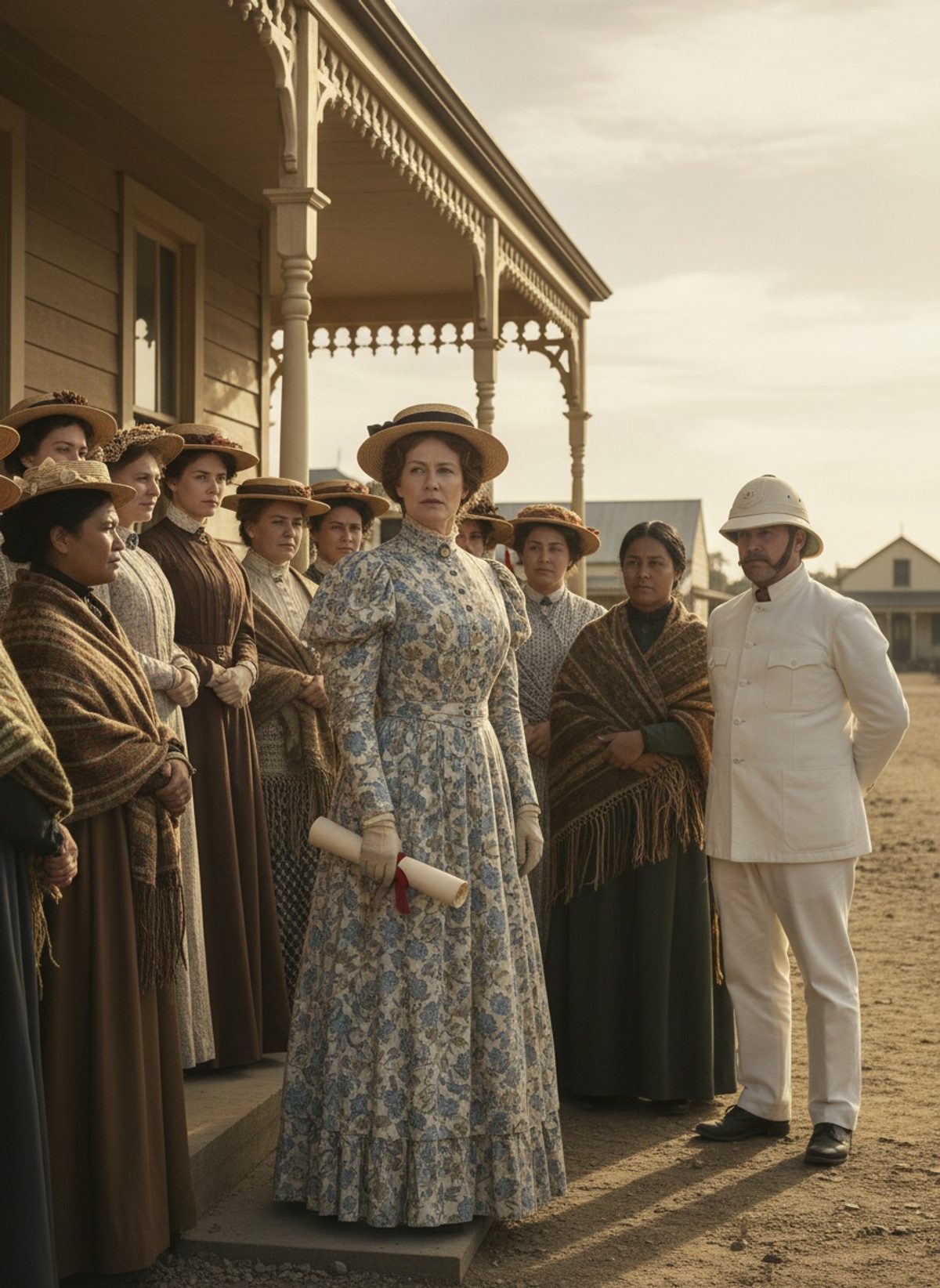
September 19, 1893. The ink had barely dried on the Governor's signature, yet the atmosphere was electric.
The Distant Colony Defies Convention
In the heart of the South Pacific, on a land where the indigenous Māori legends spoke of mighty warriors and gods, another kind of history was being made. New Zealand, a mere dot in the sprawling British Empire, had orchestrated an upheaval more profound than any battle could muster. The signing of the Electoral Act on September 19, 1893, by the Governor of New Zealand, Lord Glasgow, extended the right to vote to women, an unprecedented move for a self-governing nation. News spread like wildfire; a colony had surpassed the mother country in progress, sparking both awe and ire across the globe.
While suffrage movements flared like distant sparks in England and the United States, New Zealand's women had quietly but determinedly built a blaze. They were led by figures whose names may not echo in history's annals but whose actions resound. Campaigns by women such as Kate Sheppard pushed against societal constraints. They fought at kitchen tables, church halls, and street corners, gathering over 30,000 signatures for the cause, manifesting their resolve in ink and paper. These petitions, now legendary, were unfurled across the New Zealand parliament floor, relentless in their clarity and conviction.
The boldness of this act was a surprise to many in the Colonial Office back in London, where expectations leaned towards resistance. After all, the British Empire thrived on tradition, a formidable structure not easily swayed by notions of equality. Yet, the decision in New Zealand challenged the status quo, presenting a quiet yet potent rebuke to the reluctant progress of its colonial counterpart across the seas. Britain might have mustered its military over vast territories, but here was a colony that had mobilized the power of its women, offering a lesson in true democracy.
Read next: When Nana Sahib's Messenger Walked Into Cawnpore, 1857
Votes and Vestiges of Empire
The Colonial Office likely anticipated a deluge of dissent the moment the act was signed. Yet, what unfolded was a quiet revolution, one that quivered ever so slightly at the farthest edge of empire. Women dashed to polling stations for the first time in November 1893. It was an election marked by spontaneity, the thrill of finally being included in a discourse that had long excluded half its populace. The participation of women did not, as some predicted, lead to chaos or societal ruin. Instead, it solidified New Zealand's standing as a beacon of progressive politics, a title it would hold steadfastly along its rolling hills and vast, verdant forests.
Indeed, the first female vote in New Zealand did not ripple outwards immediately; the colony's own achievement was often glimpsed as a distant star rather than a heralding comet. New Zealand became a whisper of possibility to suffrage movements worldwide, an embodiment of courage and foresight marred by layers of patriarchy elsewhere. This quietude in the wake of monumental change highlights an unsettling truth: while New Zealand took tangible steps forward, the Empire it belonged to shunned its example, entangled in bureaucratic red tape and hesitations.
Even within New Zealand, the triumph of suffrage was tempered by the prevailing winds of the Victorian era. Women could vote, yes, but they were still expected to fit within the contours of traditional roles—domestic, subservient, silent in the sectors of power wielded by men. The road beyond the vote would be long, jagged, and fraught with battles yet to be fought, but it was a road, nonetheless—a path tread upon by trailblazing women who dared envisage more.
Lessons from the Far Edge
Was New Zealand’s enfranchisement of women a bold proclamation of newfound values, or a quirk of colonial independence testing the tides of change? In a broader sense, it stood as a radical experiment that set the stage for future reforms. Politicians in the British metropole watched with skeptical eyes, perhaps nervous about how this colonial shift might inspire the suffrage movements gaining momentum back home. It did not go unnoticed that such a formidable step occurred not in the realm of Europe's grand courts and clamorous capitals, but in an outpost inscribed on maps often as an afterthought.
The passage of the 1893 Electoral Act was more than just an isolated legislative change; it invited the world to re-evaluate what democracy could mean if shorn of its rigid patriarchal spine. It kindled a flame that would illuminate the path not only for the Empire but for countries beyond its dominion. That New Zealand—a land known more for its sheep than its politics in the 19th century—achieved this stands testament to the transformation led by determined and visionary leaders who believed in the unyielding justice of equality.
As the pages of history turn, the actions on that September day in 1893 serve not merely as a historical oddity, but as a clarion call advocating for the continual reexamination of societal norms. New Zealand’s defiance of conventional wait-and-follow tactics—choosing instead to lead—highlights the profound impact smaller voices can have in reshaping the larger narrative of progress. These are not just stories of ballots cast in wooden boxes within a remote island nation, but rather echoes of a sentiment that dares to challenge the empire and the world: that all voices deserve to be heard, regardless of the bounds history might once have imposed.