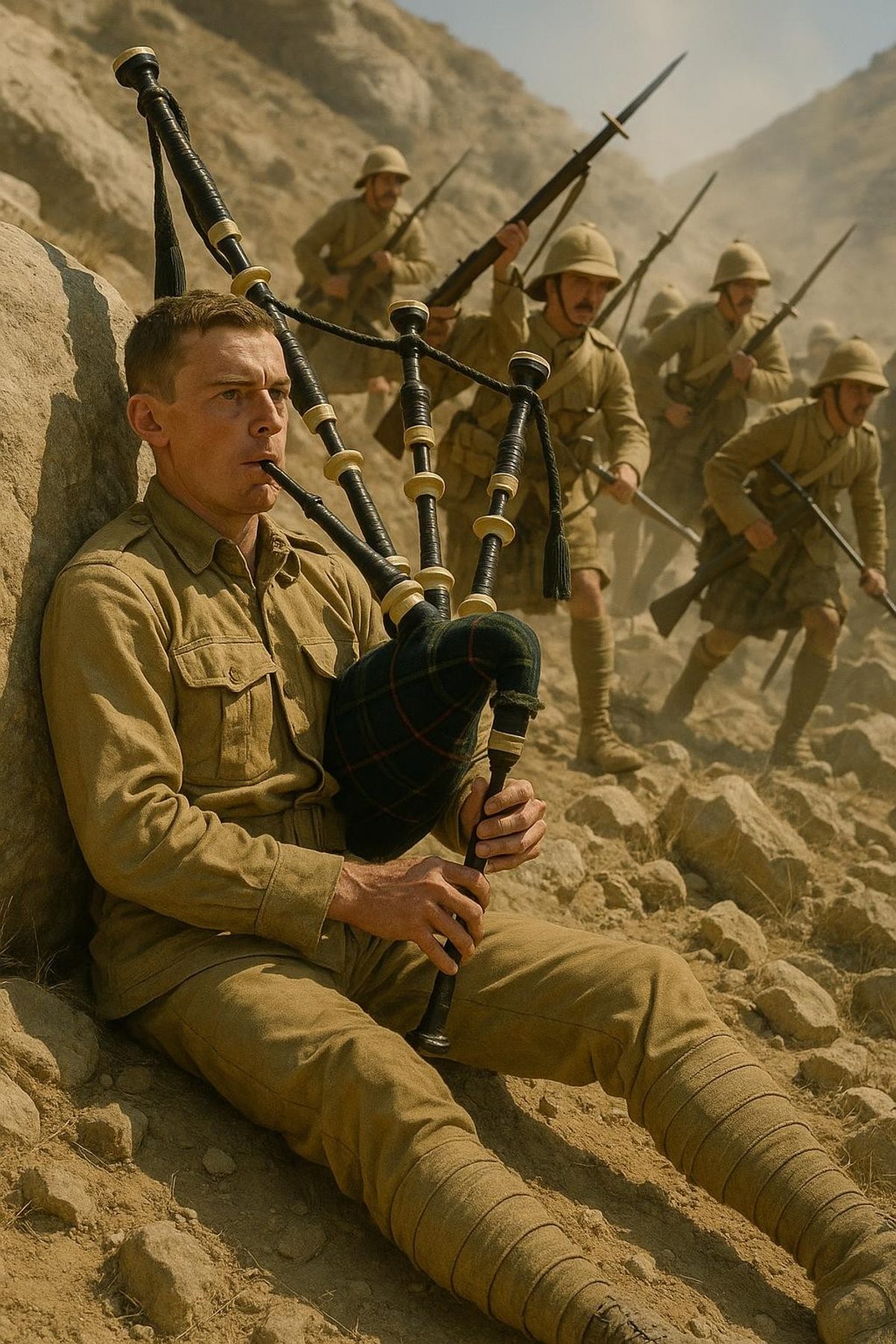
The sharp report of rifle fire echoed across the rocky slopes as Piper George Findlater grimaced against the searing pain in his ankles. The battle for Dargai Heights was at its bloody zenith, and around him, the ground was a chaos of spent cartridges and cries of the wounded. Above, the ridge held by Afghan tribesmen loomed indomitable, raining lead down the incline. The Gordon Highlanders were caught like a stag in hounds' jaws, pinned to the unforgiving earth. Yet, amidst the pandemonium, Findlater dragged himself upright against a boulder, cradling his pipes like a soldier does his rifle.
Findlater's fingers danced over the chanter, summoning the solemn, resolute notes of "The Cock o' the North." The familiar melody, the regimental march of the Highlanders, sliced through the chaos with surprising clarity. The effect was electric. For a moment, the world contracted to just the sound of the pipes and the fierce determination in Findlater's eyes, eyes that defied the impossibility of his situation. Two bullets through both ankles had failed to silence him. The notes were a rallying cry, stirring something primal within the hearts of his comrades.
In the inexplicable spell of that martial music, the Highlanders stirred from their cover. The piper played on, unrelenting, as if each note was a call to arms, a resolute stand against the chaos that threatened to unmake them. Slowly at first, then with gathering momentum, his fellow soldiers rose to their feet, a wave of tartan and steel surging up the treacherous slope. Re-energized by the music, the men found the courage to make a third and decisive push.
The assault on Dargai was not the first time the British Army had tangled with the fiercely independent Afghan tribesmen. The strategic importance of the heights was undeniable. It was a key position in the North-West Frontier, a tumultuous region caught in the relentless gaze of Victoria's Empire—a place where borders were drawn in blood and dust. The campaign here was an extension of the Great Game, that shadowy struggle for dominance in Central Asia that captivated strategists and statesmen alike. But amid the grand narratives and geopolitical chess games, it was the grit and valor of individuals like Findlater that forged the legends of the frontier.
Read next: When the Admiralty Scrapped Its Own Fleet and Called It Progress
The Afghan defenders, nimble as mountain goats, had the advantage of height and concealment. Their fight was fueled by the age-old connection to their land, a precious and finite commodity fiercely defended through generations of conquest and resistance. Facing the relentless British push, they held a determined line, their fire as deadly as it was unyielding. And yet, the sound of the pipes changed the tenor of battle, infusing the Highlanders with a tenacity to match their foes.
With gritty resolve, Findlater's regiment ascended the slope, pushing past the invisible walls of fear and doubt that had confined them. The circumstances of war are often dictated by that unseen calculus of morale and fortune. And here, in this bramble-choked theatre of war, the balance was irrevocably altered by one man's indomitable spirit. Among the dust and smoke, victory was not measured solely by the yards gained, but by the reclaiming of courage when it was most desperately needed.
For the Gordon Highlanders, the conquest of Dargai Heights bore testament to the indelible bond between soldier and soil, duty and honor. The valor displayed that day spread far beyond the echoes of the battlefield. Soon, stories of Findlater's defiance were whispered in barracks and printed in papers, his daring immortalized in ballad and book. It was a microcosm of the Victorian spirit, that mix of duty, audacity, and the relentless forward march of imperial ambition.
After the battle ended and the echoes of victory subsided, Piper Findlater found himself adored by a grateful nation. His injuries did not end his connection to the military; they transformed it. The Victoria Cross, the highest military decoration awarded for valour "in the face of the enemy," was bestowed upon him, ensuring his place among the immortal tales of heroism. Yet, even as he took his place in history, his thoughts may well have lingered on those slopes, on the brothers never to return, whose sacrifice gave the Empire one of its legendary victories.
Today, in a world where the Empire has receded into history, the actions of Findlater and those like him offer a poignant reflection on courage and resolve in the face of overwhelming odds. They are tales that compel us to examine the nuances of heroism, not merely as glorious deeds but as acts of profound humanity amidst the horrors of war. The legend of Piper George Findlater, gunsmoke curling around his resolute body as pipes skirled defiantly against the sky, endures as a tale not just of victory, but of the unyielding human spirit in its most exceptional form.