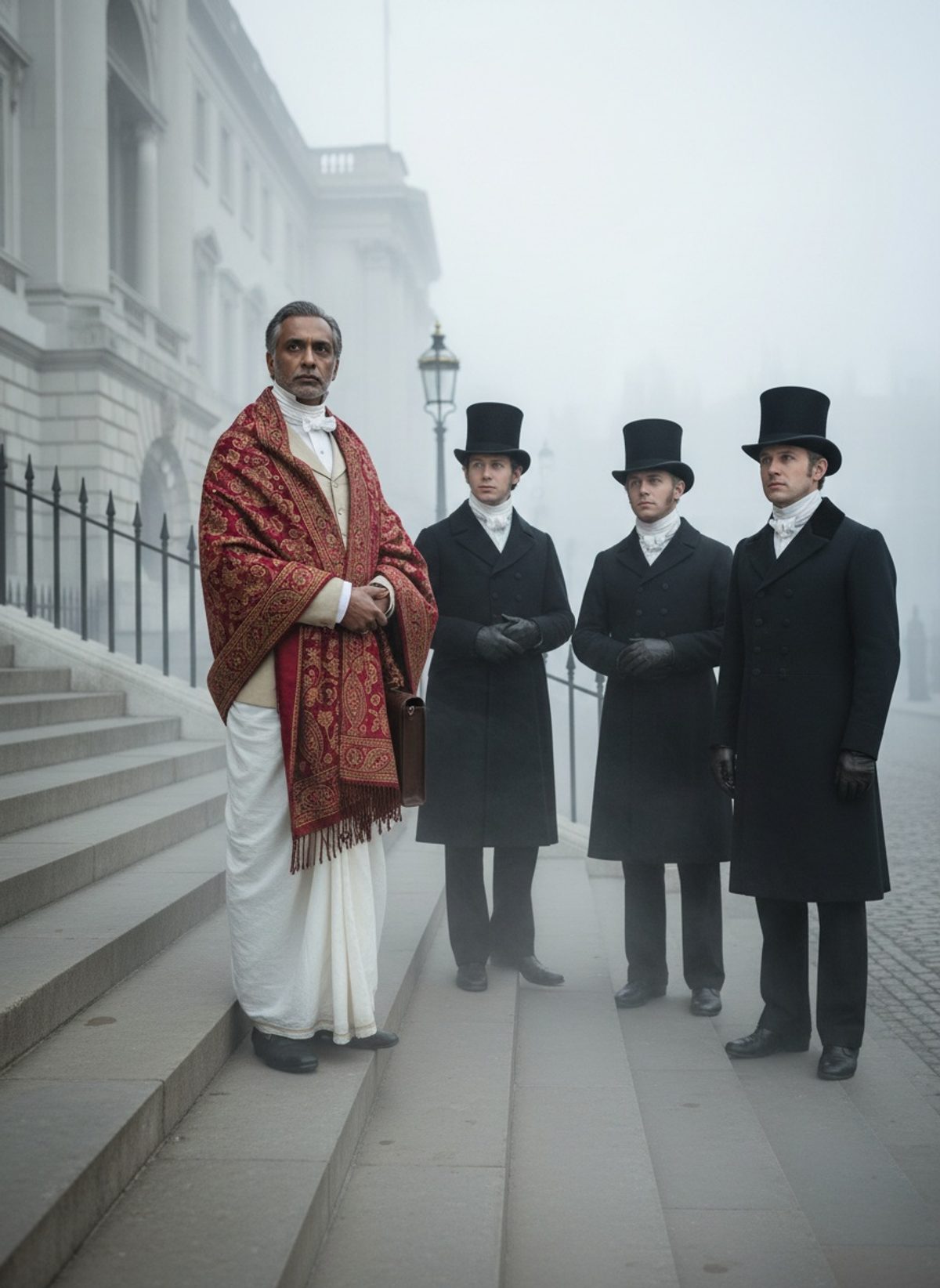
A cacophony of whispers filled the ornate chamber as the curious figure in a flowing robe glided past, his confident steps echoing on the polished stone floor. The eyes of parliamentarians followed him, the collective gaze heavy with a mix of intrigue and skepticism. Rammohun Roy, an enigma from the far reaches of the British Empire, was not here to admire the architectural grandeur of the House of Commons; he was here on a mission to reshape the very discourse of empire itself.
A Scholar's Voyage to the Heart of Power
The year 1831 was a period of transition and tension in Britain, as well as in its vast territories. Like a phoenix unfurling its wings across the Western mind, Rammohun Roy arrived in London as the empire's first Indian envoy. Born in the verdant lands of Hooghly, Bengal, in 1772, Roy's upbringing was steeped in the rich traditions of a Hindu Brahmin family. These roots were nurtured by an insatiable curiosity that led him to master six languages: Sanskrit, Persian, Arabic, Hebrew, Greek, Latin, and later, English.
Roy's intellectual prowess was not confined to linguistic pursuits. He was a polymath who devoured knowledge with an astounding appetite, challenging the very foundations of the religious and social mores of his time. His journey from Bengal to Britain was not just physical but metaphorical — a crossing from colonized subject to diplomatic pioneer. As an ambassador, he bore not only a petition querying the empire's policies but also a profound hope for reform.
Upon his arrival, London society found itself captivated by his distinguished presence. His persona defied categorization: a learned philosopher and a man of action, he moved with an air of authority among the architects of the British power structure. His aim was clear: to present his petition directly to Parliament and challenge the systemic inequalities that formed the bedrock of British dominance in India. His presence was more than symbolic; it was defiant, a subtle reminder that the voices and aspirations from the colonies could not be ignored forever.
Read next: When English Common Law Became Australia's Constitution, 1901
The Petition that Echoed in Silence
Amid the hallowed halls of Parliament, Roy stood as a beacon of change, a thunderclap in a serene sky. But what exactly drove this educated man of the East to confront British legislators? He was fueled by a mission to address grave injustices faced by Indians under colonial rule. The issues ranged from the crippling economic policies imposed by the East India Company to the entrenched racial hierarchies that dehumanized Indian lives.
Roy's presence challenged the British perception of India as merely a land of backward customs. He embodied progressive ideals and, with his intellect, demonstrated the potential for enlightenment within the colonies — a truth that Britain had long sought to ignore. His advocacy for social and religious reform, alongside his campaign against the age-old practice of Sati, where widows were compelled to self-immolate on their husband's funeral pyres, highlighted the diverse causes he championed throughout his life.
The silent corridors of power, home to countless legislative decisions, now bore witness to an unprecedented challenge to empire. Yet, even as Roy animatedly laid out his case, there was resistance within these walls. Many British politicians remained unyielding, comfortably ensconced in their assumptions about their colonial subjects. Nonetheless, Roy's advocacy reverberated beyond discussions in Parliament, provoking public discourse and encouraging social reformers throughout Britain and India alike.
A Legacy Writ Large
Rammohun Roy's impact was not confined to the corridors of Westminster; it extended far and wide, etching his mark on global consciousness. During his stay in London, Roy engaged with influential figures across British society. As a guest in drawing rooms and lecture halls, he articulated his profound ideas about the modernization of Indian society, intertwining the aspirations of India with the intellectual vigor of Europe. Roy envisioned a future where colonial relationship evolved from a dynamic of subjugation to one of mutual respect and understanding.
Rammohun Roy's legacy, however, extends beyond his immediate objectives. He planted the seeds for a dialogue that questioned the morality of the empire itself, a discourse that would only become more pronounced in the years to follow. While some might argue that his presence did not immediately dismantle the oppressive structures of colonial rule, it certainly laid the groundwork for future generations of reformers who would continue to push for equality and justice.
The tale of Rammohun Roy is not just a story of standing up against oppression; it is a narrative of bridging cultures and fostering mutual respect between disparate worlds. As the echoes of his footsteps faded from the halls of Parliament, he left behind an indelible message — one about the power of eloquence and intellect in the fight for justice. In many ways, Rammohun Roy walked into the British Parliament as a lone figure, but he emerged as a beacon of change, reminding us of the simple yet profound truth: all voices, no matter how distant, have the power to affect the heart of an empire.