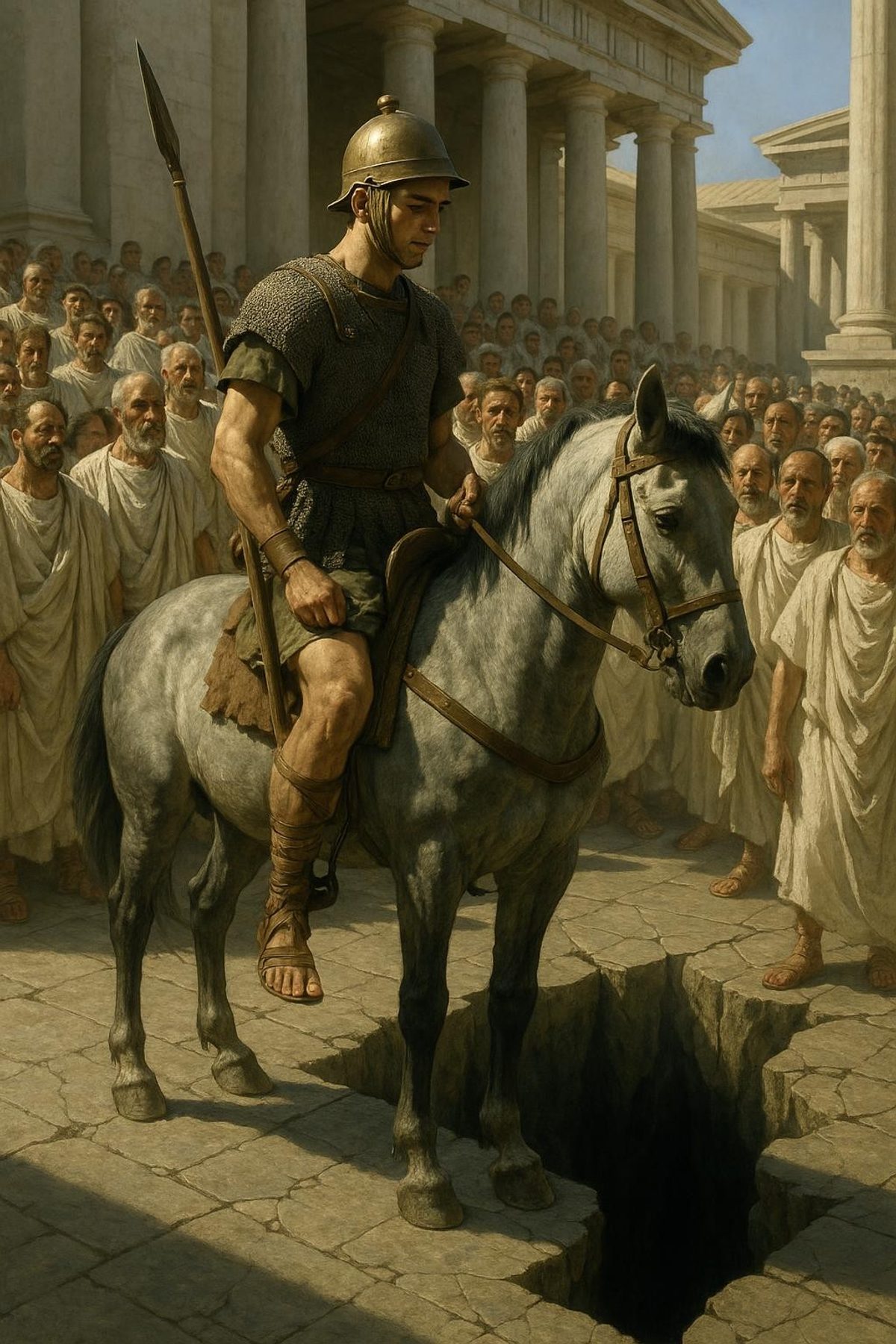
The horse snorted, its hooves thundering against the hardened ground, and Marcus Curtius, armor glinting under the Roman sun, urged his steed forward. The young soldier was resolute, his gaze fixed on the gaping maw of the earth that loomed ahead—an abyss that seemed to pulse with an ominous vitality in the heart of the Roman Forum. Around him, the citizens of Rome stood silent, their breaths held in collective suspense. The ancient city, steeped in myth and history, had never borne witness to such a scene.
The Awakening of the Earth
The year was 362 BC, and Rome was an emerging power in the ancient world. The Roman Forum, the bustling epicenter of public life and commerce, found itself at the mercy of the earth's unpredictable tectonic forces. One day, without warning, the ground cracked violently open, leaving a cavernous chasm where vibrant debates and lively transactions had once taken place. Panic and confusion swept through the city, as Romans, conditioned to attribute natural phenomena to the will of the gods, sought answers from the only source they trusted— the oracles.
The oracles delivered their verdict with solemnity: the chasm would not close until Rome committed its greatest treasure to the depths below. The ambiguity of the oracle's pronouncement sparked fervent debate. Was Rome's greatest treasure its wealth and gold? Some argued it was the valor of its soldiers, while others insisted it lay in its collective piety and traditions. In the swirling chaos of speculation and dread, a young Roman noble named Marcus Curtius emerged with a clarity that cut through the uncertainty like a knife.
Born into the Curtia gens, a family of some renown, Marcus was no stranger to the expectations placed upon him. The Curtii were known for their martial prowess, and Marcus, a soldier himself, had been raised with the virtues of duty and sacrifice instilled deep in his heart. As the city he loved teetered on the precipice of fear and uncertainty, Marcus became convinced that Rome's greatest treasure was its youth and bravery—the qualities that defined its very future. It was this future that he volunteered to lay upon the altar of the unknown.
Read next: Musonius Rufus Stood Before Nero. He Did Not Stop.
It is said that Marcus Curtius appeared in full battle regalia, his armor shimmering defiantly in the sunlight. Mounted upon his stalwart steed, he led the animal briskly to the edge of the chasm. The citizens watched with mounting awe and terror as Marcus raised a hand in a silent farewell, pledging himself to the gods and the city of Rome. Then, without a trace of hesitation, he urged his horse forward, and together they plunged into the abyss. The moment was at once a testament to human courage and a manifestation of divine mystery.
Into the Abyss
The tale of Marcus Curtius is enshrined in Roman lore, yet as much as it speaks to heroism, it also shields itself in layers of allegory and interpretation. As his steed descended into the dark, there was, according to legend, a miraculous occurrence. The open maw of the earth shuddered, closed with a finality that left the place whole. This spot, hallowed by his sacrifice, henceforth bore his name—Lacus Curtius—a reminder of both the event and of the man's transcendental decision.
In the years that followed, the narrative surrounding Marcus Curtius evolved, serving different purposes for different segments of Roman society. For some, Curtius became a symbol of religious faith, an exemplar of the belief that the gods favored Rome, demanding not merely offerings of coin or cattle, but the nobler sacrifice of valor. To others, his act represented the virtues that sustained the Republic—the courage to face the chasms, literal and metaphorical, that threatened its stability.
Archaeological excavations have attempted to confront the legend with a scientific lens, uncovering layers of soil and history beneath the Forum. Yet, like many ancient tales, the historicity of Marcus Curtius's leap remains a subject of debate. Was the sacrifice a literal truth or an eloquent myth, woven to impart a moral lesson about the civic virtues the Romans held dear? The whispers of history offer no concrete evidence, leaving only the collective narrative that underscored a society’s ideals.
The Lacus Curtius continued to be a site of intrigue throughout Rome's storied past. It was at times a place of sacrifice and at others a stage for debate, but it was always a symbol of the intrinsic connection between the divine and the mortal realms. The presence of a temple nearby dedicated to the deities ensured the community’s constant interaction with the sacredness of their land, with Marcus Curtius's story acting as an ever-present reminder of duty—a narrative thread woven into the Republic's cultural and moral tapestry.
The Legacy of Courage and Commitment
In the greater arc of history, Marcus Curtius's tale endures as a powerful narrative—whether fact or fable—capturing the Roman ethos that celebrated the individual's sacrifice for the greater good. His leap is more than an isolated act of bravery; it is emblematic of the constant balance between the earthbound concerns of a civilization and its aspirations to placate and honor the divine forces believed to shape its destiny.
Rome itself was built on the shoulders of such legends, tales that carved deep etches into the societal psyche. Marcus Curtius stands as a figure of continuity, an echo of Rome's undying spirit that resonates through stories of founders and conquerors alike—a lineage of heroes ready to do whatever the Republic requires. As each generation faces its own metaphorical chasms, the legend serves as a reminder that courage and sacrifice are the bedrock upon which great societies are built.
While modern visitors to the Forum may find only stone markers and historical extrapolations where the Lacus Curtius once stood, the enduring message of its story remains unyielding. At its core, the plight and choice of Marcus Curtius challenge us today to ask ourselves: in moments of crisis, what do we consider our greatest treasures—and what are we willing to sacrifice to safeguard them? In an age where historical memory competes with the relentless march of progress, stories like that of Marcus Curtius evoke the timeless question of what it means to be truly human.