
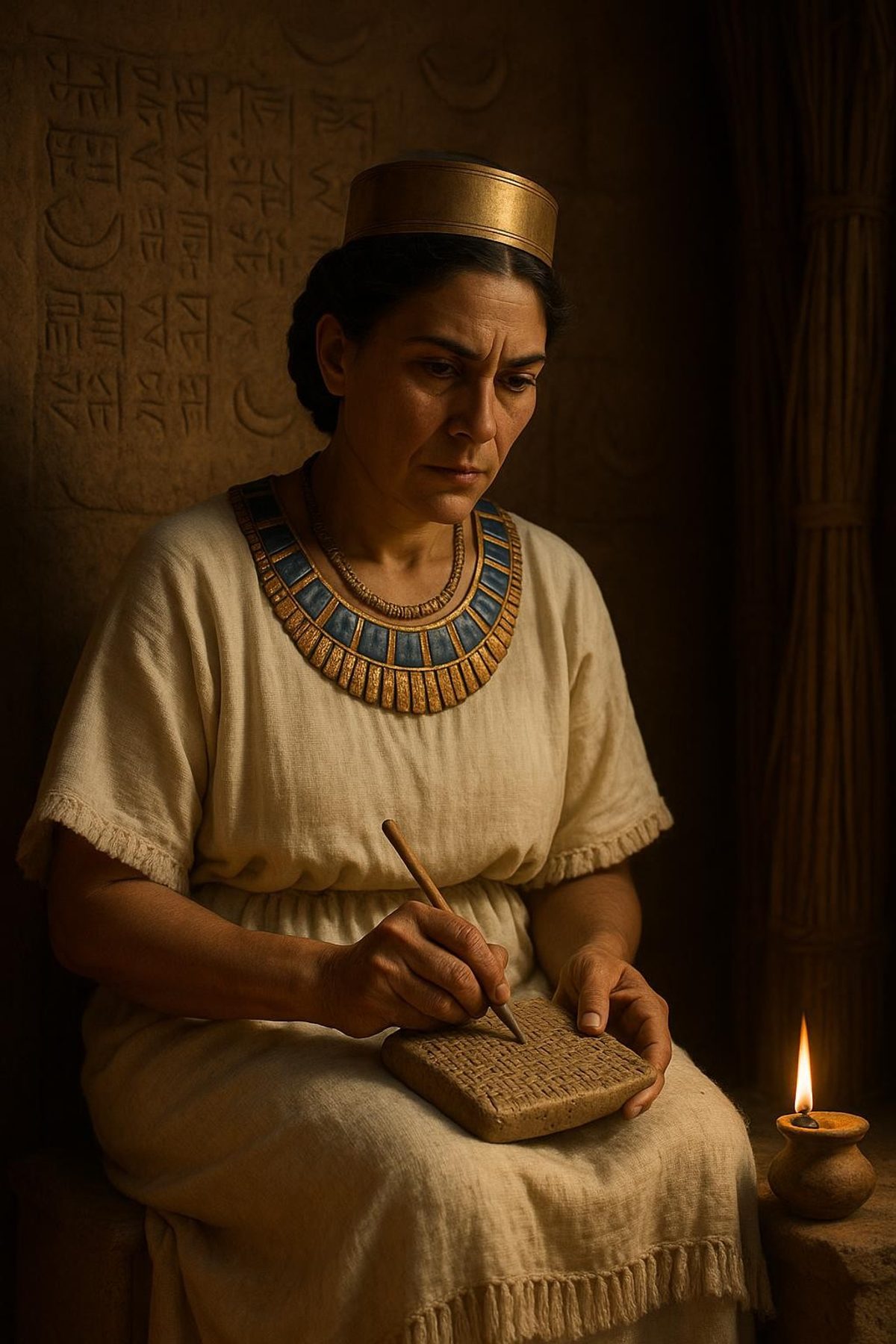
Enheduanna is not a name echoed through the streets of modern-day Uruk. Yet, it should be, for her legacy is both living and omnipresent. In a world four millennia removed, where cities rose and fell under the harsh desert sun, Enheduanna's words carry forward—etched in clay, whispered through time. Her story unfolds not with battles of might, but with the relentless power of the pen, a legacy of endurance that wasn't as easily erased as the imposing empires of her era.
Around 2285 BCE, a tremor shook the sacred heart of one of the world's earliest civilizations—Sumer. In the thriving city of Ur, where ziggurats reached toward the vast heavens, a rebellion was brewing. Ur had been captured by Sargon of Akkad, who had by force knitted together a tapestry of disparate city-states into what became known as the Akkadian Empire. To solidify his newfound power, he appointed his daughter, Enheduanna, as the high priestess—or entu—of Nanna, the moon god venerated by the Sumerians. This role wasn't merely ecclesiastical; it was a deeply entrenched political position entwined with the unity of two peoples—Akkadians and Sumerians. Enheduanna's name, whispered with reverence, became a cornerstone of her father's sprawling empire.
But as her father’s glittering conquests expanded, a storm of dissent brewed beneath the surface. It wasn't long before the delicate balance between divine right and militaristic might faltered. A usurper seized power in Ur, dragging the gifted Enheduanna from her temple, her sacred vestments torn asunder in his lust for control. Exiled, removed from the beating heart of the city, she appeared silenced. Here, the story might have ended—the voice of a high priestess drowned in the cacophony of history. But Enheduanna was far from defeated.
Even in exile, the indomitable Enheduanna wielded a weapon more potent than any spear or sword—her words. She poured her soul into her hymns, compositions so profound and articulate that they weaved their way into the literary canon of Sumerian society. In a language carved into clay, her words stood indestructible against the sands of time. One of her most striking works, the Exaltation of Inanna, is an impassioned plea to Inanna, the goddess of love and war. More than mere supplication, it’s a testament to Enheduanna's anguish and a fierce assertion of her authority and connection to divinity.
Read next: Wyoming Refused to Join America Without Its Women
These hymns weren't mere religious texts but potent tools of influence and reconciliation. Through them, Enheduanna fortified her identity as a figure bridging cultural divides. By invoking both Nanna and Inanna, she elegantly synthesized Akkadian and Sumerian elements, embodying a critical part of her father's efforts to cement a unified faith and culture across his empire. Her hymns, suffused with personal emotion and unwavering conviction, became anthems for political stability and spiritual unity, a tapestry woven to withstand the temporal tumult.
Her legacy lay dormant, locked beneath the soil for millennia until it was dusted off by Sir Leonard Woolley in the late 1920s. Discovering an alabaster disc at the Giparu in Ur was like finding a key to an ancient riddle—one that spoke of a woman, a priestess, and a poet whose works had left indelible impressions on religious and cultural ideology. Inscribed with her titles and affiliations with the moon god and her imperial lineage, the discovery began unfolding the mysterious enigma of Enheduanna's stolen identity and her undeniable authorship left behind in clay tablets.
Debate arose among Assyriologists as to whether these works truly emanated from Enheduanna’s hand. Scribed centuries later during the First Babylonian Empire, in a dialect that evolved over time, the vocality and style remained peculiarly hers though. While some argue that these could be masterful attributions and mythical embellishments, placed upon her by later scribes conjuring her role within Sargon’s dynasty, the spirit of her words retains a potent authenticity that leads many to uphold her as the world's first named author. In a society where anonymity prevailed in scribal tradition, her name echoes resiliently, richly imprinted on history's narrative.
Today, Enheduanna stands as an icon of literary genius, her works imbued with rhetorical force and poetic depth. The simplicity with which she navigated divine myth and personal lament reveals the philosophical underpinnings of ancient thought—where humanity dared to converse with deities through raw emotion as much as ritualistic reverie. Evoking both the intimacy and grandeur of worship, she reshaped how prose could move beyond its physical bounds to embrace emotion and intellect.
In today's world, perhaps what is most compelling about Enheduanna is her fortitude and foresight—her story serves as evidence that history is not exclusively written in the blood of conquerors or the ruins of great cities; it is also etched in the song of those who dared to pen their pain into power. She represents a defiance that is neither passive nor aggressive but one which rebuilds through acknowledgment and empathy, even when cast into silence.
Enheduanna’s narrative is more than a footnote in the annals of time. It is a call to remember and celebrate the voices that shaped our past, so often delivering the stories that books forgot to teach. To know Enheduanna is to understand the significance of voice—how it persists, transforms, and survives even when the world seeks its quiet undoing. Her story is a testament to the enduring power of words to transcend conquest, sit above conflict, and stand the test of time on the scrolls of humanity’s evolving consciousness.