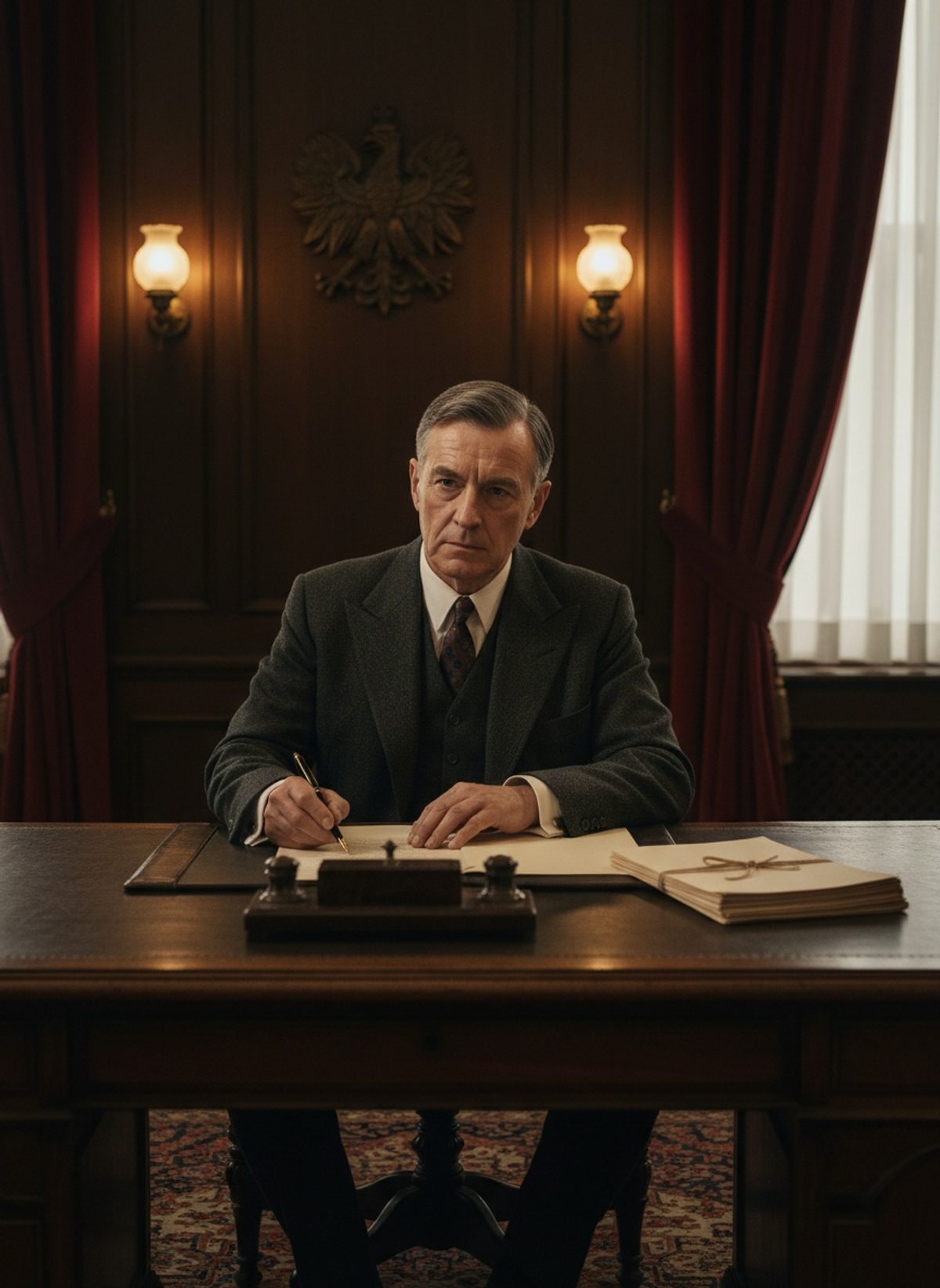
The telegram machine clattered to life in the dimly lit office of the Polish government-in-exile, its metallic clinks echoing like distant artillery fire. As an attendant hastily transcribed the thick ribbon of tape, the room fell silent, waiting for the latest maneuver in a world embroiled in unprecedented conflict. The year was 1941, and the map of Europe was being rewritten with blood and strife. Yet within these walls in London, a most peculiar decision was about to unfold—a declaration of war against Japan, a nation half a world away. Few present would have imagined that this message, sent across countless miles of ocean, would be received in Japan with little more than bureaucratic indifference, destined to linger in a twilight zone of diplomacy for over sixteen years.
In the aftermath of Germany’s invasion of Poland in September 1939, the Polish government had fled, first to France and then to the United Kingdom, as their homeland lay divided between German and Soviet forces. From their exile, the Polish government, under the presidency of Władysław Raczkiewicz and Prime Minister General Władysław Sikorski, fought tirelessly to maintain their nation’s sovereignty in the eyes of the world. Amidst this turbulent backdrop, on December 11, 1941, an extraordinary decision was made. Following the Japanese attack on Pearl Harbor and the subsequent declarations of war by the Axis Powers against the Allies, the Polish government-in-exile declared war on Japan. It was a symbolic gesture of solidarity with their British and American allies, yet it was also a proclamation destined for a curiously muted response.
The declaration arrived in Tokyo through the peripheries of diplomatic channels, reviewed perhaps with a mixture of formal interest and quiet amusement. Japan, deeply entrenched in its own expansive campaign across the Asia-Pacific, chose not to reciprocate with any military action or official acknowledgment. It was a nonchalant sidestepping of typical wartime protocols, almost as if the message had been shelved with a gentle nod to avoid any further complicating entanglements. In reality, Japan’s position was practical; Poland, under occupation, posed no tangible threat to Imperial Japan at the time. This unrequited declaration thus relegated both nations into a peculiar limbo—a state of war recognized legally but not physically, a paper conflict without battlefields or barracks.
The decision by the Polish government, while seemingly ceremonial, played a subtle but significant role in the tangled web of World War II diplomacy. It underscored the Polish resolve to remain an actively contributing member of the Allied forces, even amidst the horrors of their own occupied lands. But despite the symbolic nature, the declaration of war stuck like an unnoticed burr until it was finally snipped away in the post-war era. A conflict that officially began on a cold day in December 1941 would not be formally concluded until early 1957, when a peace treaty was quietly signed, ending a war that never truly began on battlegrounds the world could see.
The reasons for this lengthy state of ‘war’ without engagements were multifaceted, tied strongly to the geopolitical currents that swirled through post-war Europe and Asia. After the devastating toll of World War II, Poland emerged as a reconstituted version of itself—a Soviet satellite within the ideological confines of the Eastern Bloc. The newfound reality for Poland meant re-evaluated international relations, especially as the globe polarized into the arenas of the Cold War. PoliSh relations with Japan languished in this stasis, unaddressed partly because of the sharp political pivot in Eastern Europe, and partly because Japan had moved on toward its post-war reconstruction under American oversight.
The geopolitical landscape of the 1950s was markedly different from that of the war years. By the time both nations circled back to their forgotten quarrel in 1957, the question was tasked not with repairing any damages but rather with wrapping up an administrative loose end. As diplomats inked their signatures onto the peace treaty, Poland and Japan closed a surreal chapter of their shared history, a reminder that war does not always manifest in physical confrontation but can exist in the murkier waters of statecraft and symbolic gestures.
This unusual episode in history serves as more than just a diplomatic footnote. It highlights a period of intense global upheaval where nations like Poland fought valiantly to maintain their presence on the world stage, using all the political tools at their disposal. It prompts us to consider the power of diplomacy and international relations, perceptions, and reactions in shaping not just the outcomes of wars but also the worldviews that define post-conflict realities. As our global society navigates its own complex interconnections, the Polish-Japanese ‘war that wasn’t’ reminds us that the consequences of decisions made in the shadows of greater conflicts can extend beyond weapons and battlefields, shaping history in ways both strange and profound.