Picture this: you're lying in a military hospital bed, your hand mangled by shrapnel, fingers hanging by threads of sinew and skin. The doctors examine the damage and shake their heads—they can save the fingers, they insist, though they'll never work properly again. Most men would accept this verdict. But Sir Adrian Carton de Wiart was not most men. Without a word, he reached across with his good hand and tore off his own mangled fingers, one by one.
Then he asked when he could return to the front lines.
This wasn't bravado or madness—this was simply Tuesday for perhaps the most indestructible soldier in British military history. A man who would be wounded eight times, survive two plane crashes, tunnel out of a prisoner-of-war camp, and at the end of it all, declare that he had "thoroughly enjoyed the war."
The Making of an Unstoppable Warrior
Adrian Carton de Wiart entered the world in 1880, the son of a Belgian lawyer and an Irish mother, but Britain would claim him as her own. Educated at Balliol College, Oxford, he seemed destined for a comfortable life among the intellectual elite. Instead, when the Boer War erupted in 1899, nineteen-year-old Carton de Wiart did something that would define his entire existence: he lied about his age, assumed a false name, and enlisted as a trooper in the Middlesex Imperial Yeomanry.
Read next: The Day a British Stretcher-Bearer Refused an Order to Save Lives
This was his first taste of combat, and like a man discovering his favorite wine, he found it intoxicating. Shot in the stomach and groin during his very first engagement, most would have considered this a sign to pursue a different career. Carton de Wiart saw it as an initiation.
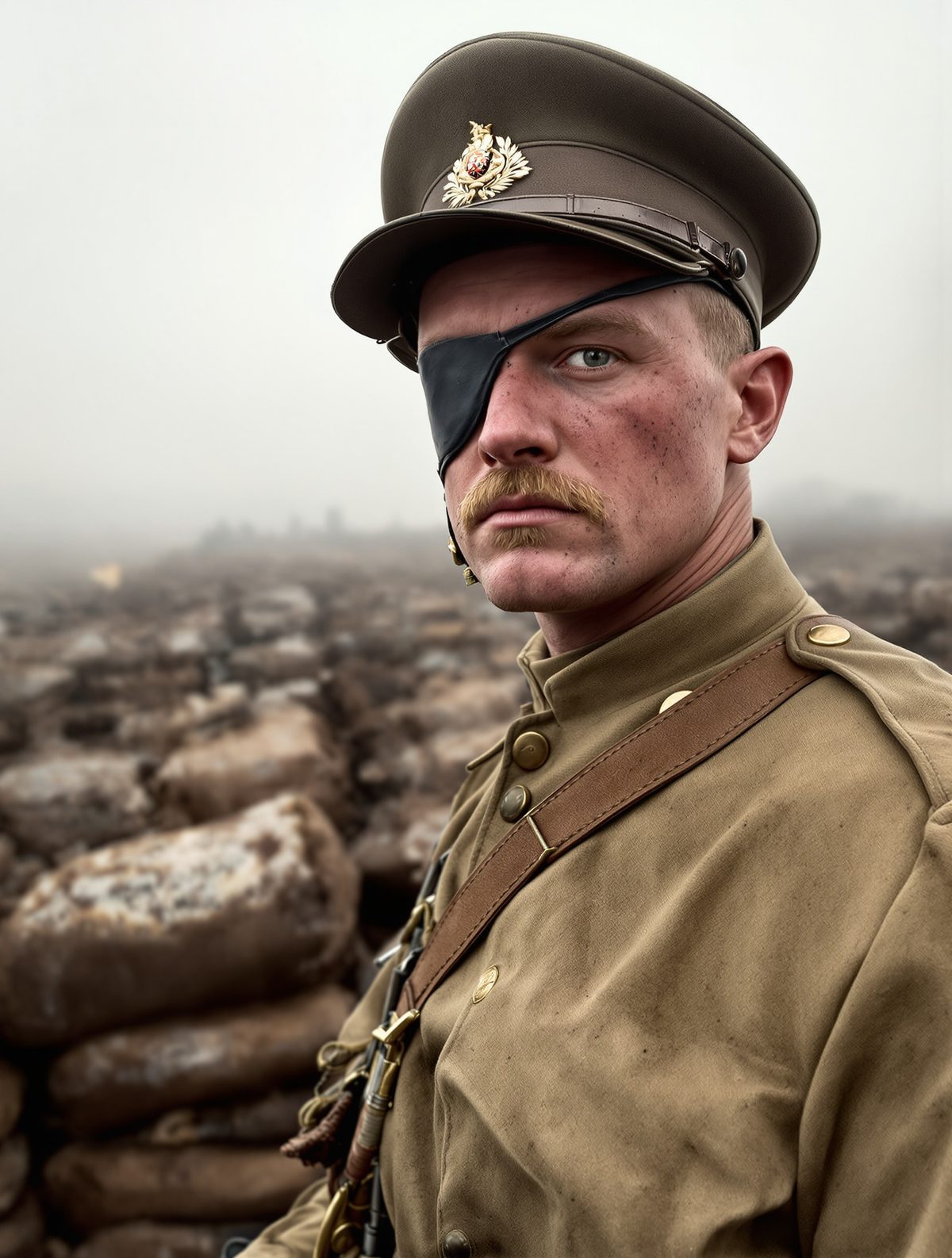
After recovering, he received a commission in the 4th Dragoon Guards. But peacetime soldiering bored him—he craved the chaos and uncertainty of battle. When troubles flared in Somaliland in 1914, he volunteered immediately. It was here, in the scorching heat of the Horn of Africa, that he would lose his left eye to a Dervish bullet during the action at Shimber Berris.
The remarkable part wasn't losing the eye—it was his reaction. While being evacuated, he insisted on writing his own casualty report, calmly noting his injury as if describing the weather. The bullet had entered near his left eye and exited behind his left ear. Lesser men might have been grateful for a ticket home. Carton de Wiart was already planning his return to active duty.
The Western Front: Where Heroes Go to Die
By 1915, the Great War had settled into its grim rhythm of mud, blood, and futility along the Western Front. For most, it was hell on earth. For Carton de Wiart, now a Lieutenant Colonel commanding the 4th Battalion, Gloucestershire Regiment, it was exactly where he wanted to be.
The Somme offensive of July 1916 was a meat grinder that consumed entire generations of British youth. On the first day alone, 60,000 British casualties fell in a single morning. Carton de Wiart was there, leading from the front as always, when German artillery found its mark. Shrapnel tore through his left hand, mangling his fingers into a twisted ruin of bone and flesh.
Evacuated to a casualty clearing station, he found himself arguing with army surgeons who insisted they could save his damaged digits. The doctors meant well, but Carton de Wiart understood something they didn't: half-functional fingers would be worse than no fingers at all in combat. When medical reasoning failed to persuade them, he took matters into his own hands—literally.
The image is almost too extraordinary to believe: this one-eyed colonel, without anesthetic or ceremony, gripping each mangled finger and yanking it free from his hand. The medical staff watched in stunned silence as he methodically removed what remained of his fingers, as calmly as a man removing splinters.
His only comment afterward was to ask how soon he could return to his battalion.
The Collector of Wounds
Most soldiers pray to avoid injury. Carton de Wiart seemed to collect wounds like medals. By war's end, his body was a roadmap of violence: shot in the face, head, stomach, ankle, hip, leg, and ear. He'd been blown up by shells, caught in gas attacks, and buried alive by explosions—yet he kept returning to the fight.
At the Battle of Passchendaele in 1917, that apocalyptic struggle in the Belgian mud, he was shot through the head. The bullet entered his skull and should have killed him instantly. Instead, he regained consciousness, shook off the blood, and continued leading his men forward. When concerned soldiers suggested he seek medical attention, he reportedly replied, "Nothing wrong with me. Carry on."
His men began to believe he was immortal—and frankly, the evidence supported their theory. During one attack, an explosion buried him completely under debris. His soldiers dug frantically, certain they were recovering a corpse. Instead, they found Carton de Wiart spitting out dirt and asking for a situation report.
But perhaps the most telling incident occurred when a young private, new to the battalion, expressed amazement at his colonel's numerous wounds. Carton de Wiart's response revealed everything about his character: "My boy, I've been extraordinarily lucky. I've had the most tremendous fun."
When the Shooting Stopped (Briefly)
The Armistice of November 11, 1918, brought peace to Europe but not rest to Carton de Wiart. While other officers were demobilizing and returning to civilian life, he volunteered for the Allied intervention in Poland, helping the fledgling nation fight off Soviet invasion in 1919.
During this campaign, he added two more wounds to his collection—shot in the ankle and hip during separate engagements. Each time, he refused evacuation until the immediate tactical situation was resolved. His Polish allies began calling him "the man who cannot die."
For his service in Poland, he received not only British decorations but Polish honors as well. The Poles understood what they had witnessed: a warrior from another age, someone who fought not for glory or politics but for the pure, inexplicable joy of combat itself.
Between the wars, he settled into what passed for a normal life—serving as British liaison to Poland and enjoying country pursuits. But when Hitler's armies smashed across the Polish frontier in September 1939, Carton de Wiart was ready for one more dance.
Read next: The Day a Army Chaplain Gave His Coat to a Dying Stranger
The Final Campaign: Sixty and Still Fighting
Most men would consider age sixty an appropriate time for retirement, perhaps some gardening and gentle walks. Carton de Wiart saw it as an opportunity for one last adventure. In 1940, he commanded the Central Norway expedition, a desperate attempt to halt German advances in Scandinavia.
The campaign was a disaster—but not through any fault of his leadership. Outgunned and outnumbered, his forces were evacuated after barely two weeks. But Carton de Wiart had tasted combat again, and at sixty, he moved with the same fearless energy that had characterized his youth.
His final military adventure came in 1941 when his aircraft crashed into the Mediterranean while en route to Yugoslavia. Captured by Italian forces, the sixty-one-year-old general was imprisoned in a supposedly escape-proof camp. Within months, he was tunneling his way out with the enthusiasm of a schoolboy playing hooky.
Though recaptured after eight days of freedom, he'd made his point: age hadn't dimmed his appetite for action. He spent the remainder of the war in captivity, released only when Italy surrendered in 1943.
The Warrior's Paradox
After the war, journalists inevitably asked Carton de Wiart about his extraordinary career. His autobiography, published in 1950, contained perhaps the most honest assessment ever written by a professional soldier: "Frankly, I had thoroughly enjoyed the war."
This statement scandalizes modern sensibilities. How could anyone enjoy something as horrible as war? But Carton de Wiart's honesty illuminates a uncomfortable truth about human nature: some people are simply built for conflict. They find in war's chaos a clarity and purpose impossible to achieve in peacetime.
His story challenges our comfortable assumptions about heroism and normalcy. We want our heroes to be reluctant warriors, citizen-soldiers who fight only when duty demands. Carton de Wiart was something more unsettling: a man who found his truest self in humanity's darkest moments.
Perhaps that's why his story resonates today. In an era of drone warfare and cyber attacks, when combat has become increasingly distant and technological, Carton de Wiart represents something we've lost: the warrior as an almost mythological figure, someone who faced death with a smile and walked away from explosions that should have killed him.
He died peacefully in 1963, aged eighty-three—proving that sometimes, the only thing that can kill a truly unstoppable man is time itself.