
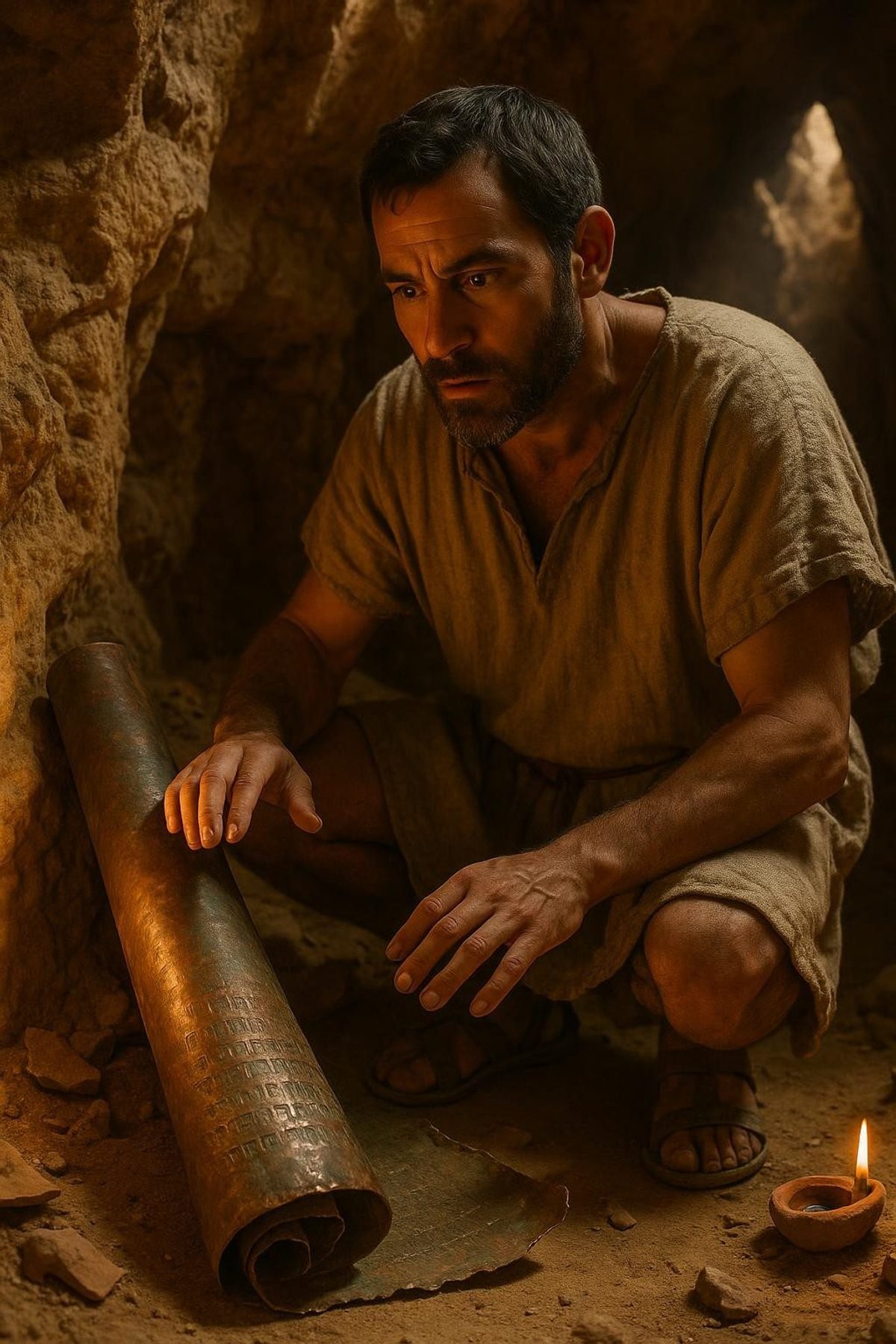
The Copper Scroll stands as one of the most tantalizing mysteries of the ancient world. Yet, despite its clear directions, its treasure remains undiscovered, perhaps forever.
A Discovery in Metal
In 1952, an unusual find emerged from Cave 3 in the arid wilderness of the Dead Sea region, an area steeped in the echoes of distant antiquity. Archaeologists, accustomed to retrieving brittle parchment and papyrus from the ancient Judean desert, found themselves grappling with a most unexpected artifact: a scroll made not of paper but of copper. This unique document, akin more to a shopping list of the ancients than to sacred scripture, exhibited a stunningly practical purpose. Engraved upon its oxidised surface was an inventory of treasure—64 detailed entries noting hidden caches of gold, silver, and other valuable items, spread across Judea. This was unprecedented, both in its medium and in its potential implications.
The Copper Scroll's metallic substance safeguarded its record from the ravages of time far more effectively than its parchment counterparts, yet it also added to the enigma. The scroll was found in two separate pieces, brittle with age but intensely vibrant in promise. Translating its contents was less about literary prowess and more about geographical riddle-solving, a task that remains a daunting prospect even today.
The Treasure Map That Eludes
The Copper Scroll doesn't hide its intent. It straightforwardly lists locations where treasures lay hidden, in the manner of a treasure map. Each entry, succinct and deliberately direct, might refer to landmarks and measurements, giving the impression that recovery was expected and imminent. The treasures are said to include vast amounts of gold and silver bullion, along with sacred vessels meant for rituals, hinting at connections to the Second Temple period or possibly the Jewish Revolt against Rome.
Read next: The Jar Was Sealed. The Message Was 2,000 Years Old.
Yet, there’s an uncomfortable silence where discovery should have followed. Over seven decades have passed since the Copper Scroll was unearthed, but the bountiful caches it describes have eluded every adventurer, every scholar, and every archaeologist determined enough to search. The reasons are plentiful—a lack of detailed modern geographical markers, the possible erosion of ancient landmarks, and even the potential for the treasure to have been moved long before the scroll was buried. This enigma remains one of archaeology's great unsolved mysteries.
Theories and Speculations
The Copper Scroll has spawned a plethora of theories, each as captivating as the last. Could these listed treasures have been offerings from the Temple, hurriedly hidden during a time of crisis? Or perhaps they were part of the wealth of the Essenes, the mysterious sect often linked with the Dead Sea Scrolls? Some scholars even wonder whether the scroll represents a legend doggedly inscribed into metal, a dream of a bounty rather than a list of reality.
The narrative also tantalizes with the possibility that the documented treasures were already uncovered by ancient peoples—Romans, locals aware of the caches, or even rebel forces. This consideration raises the stakes, adding an element of urgency to those historical moments, and dramatizing the desperation and hope of communities on the brink of annihilation. While the Copper Scroll’s treasure might lie untouched, some believe eventual discovery could revolutionize our understanding of Jewish society during a time when it stood at the crossroads of monumental change.
The Haunting Legacy of the Scroll
The Copper Scroll's allure doesn't merely stem from its undivulged riches but from the profound questions it raises about history and our comprehension thereof. Carved into its metallic surface lies a hint of an existence lived, of a society layered with complexities yet straightforward in their presumption of a future—one where their treasures could someday be claimed. The scroll is more than a list; it is a voice from antiquity, whispering tales of faith, conflict, and hope into an age far removed from its realities.
This mystery beckons like a siren from across time, not just as a promise of wealth but as a challenge to the modern worldview: how much do we truly grasp of our heritage? Why does a simple copper engraving from an ancient land captivate us with such enduring intensity? Perhaps it is because it speaks to our endless quest for discovery, for resolving the unknown, for bridging the past to the present. Whether the Copper Scroll's treasures are ever located or remain hidden from the grasp of time, their haunting presence excites scholar and dreamer alike, reminding us that history's secrets are both the treasure and the hunt itself.