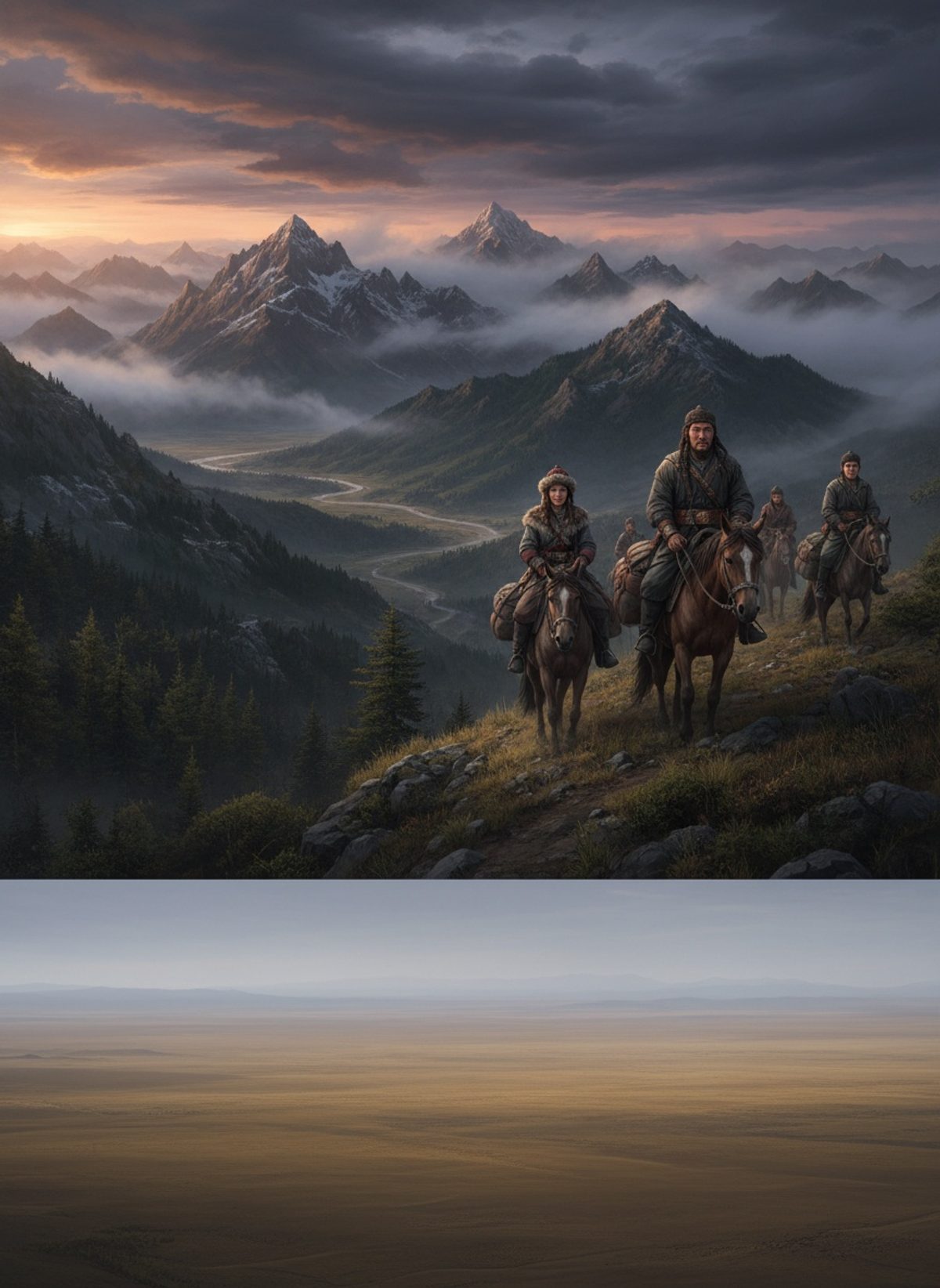
In the unforgiving wilderness of Mongolia, the wind sweeps across an endless plain, shaping the land into soft, undulating waves. As the first light of dawn breaks over the horizon, shadows stretch across the ground where history and legend entwine beneath the amber sky. This remote and hauntingly beautiful landscape once bore witness to an event shrouded in mystery that has captivated historians for centuries—the secret burial of Genghis Khan.
Cradle of an Empire
Long before his death in 1227, Genghis Khan emerged as a formidable force, a leader capable of uniting disparate Mongol tribes under a single banner and forging an empire that spanned continents. Accompanied by a retinue of just 100,000 warriors, he harnessed the blistering fury of the steppe and unleashed it upon the world, creating an empire that was twice the size of Rome. Genghis Khan's name invoked both fear and admiration, his strategies and innovations leaving a deep and indelible mark on history.
The legacy of Genghis Khan is a tale woven with conquest and cultural transformation, yet the final resting place of this legendary figure remains elusive—an enigma that defies time and human curiosity. Such is the intrigue that surrounded his death; legend speaks of a funeral procession unlike any other. A thousand soldiers, fiercely loyal even beyond their leader's death, allegedly embarked on a fateful 40-day journey to conceal the burial site. These grim and determined escorts slaughtered every living soul and beast they encountered, a chilling tale meant to safeguard the location and preserve Genghis Khan’s sanctity in death.
Amid the howling winds of the steppe, these soldiers vanished into obscurity, themselves slaughtered to ensure the ultimate secrecy of their mission. Thus, the final chapter in the life of the great Khan was penned in blood and darkness, leaving behind a puzzle that has beguiled archaeologists, adventurers, and scholars through the ages. Could such a massive operation leave no trace? Could a tomb so significant endure as a mere myth of the Mongolian plains?
Read next: The Map Was Buried for 1,500 Years. It Changed Everything.
The Secret Kept: A Journey Through Centuries
For nearly 800 years, the tomb of Genghis Khan has remained hidden, a mystery shrouded in the very elements that the mighty ruler once commanded. Early accounts from travelers and historians offer little to unlock this puzzle, their writings often echoing local folklore with conflicting accounts of the burial site. Some claim the Khan was interred in Burkhan Khaldun, a sacred mountain steeped in spirituality, while others suggest a more obscure resting place yet to be discovered.
Despite the absence of concrete evidence, the quest for Genghis Khan's tomb has spawned countless expeditions, each driven by the allure of discovering a piece of history untouched by time. The land, however, remains obstinate; it reveals its secrets sparingly, if at all. The Mongolian government, respectful of its historical heritage, has been reluctant to pursue widespread excavation, preserving the sanctity of the possible sites.
Modern technology has only intensified the search. Satellite imagery, once the stuff of science fiction, has provided new tools in this age-old mystery. In an ambitious effort, 10,000 volunteers meticulously analyzed thousands of images, scouring the Mongolian landscape for anomalies—a labored search that, to date, has revealed nothing conclusive. Indeed, the absence of evidence is a testament to the success of the Khan's followers, who might have been the most effective guardians a legend could ask for.
A Mystery That Endures
Even as the pages of history turn with the passing centuries, the question of Genghis Khan's burial site persists, captivating those drawn to the echo of his era. It's not merely the allure of treasure that drives this quest, but a deeper, more profound connection to a time and a person who reshaped the world with indomitable will and imagination.
Genghis Khan's empire may have crumbled into the sands of time, but his enigma looms larger than ever. Each generation ensnared by this mystery adds its own layer of interpretation. It's the story of man against the wild, the primal urge to seek what lies beneath the surface. To uncover Genghis Khan's tomb is to peel back the layers of legend to glimpse the essence of a world long past—a chance to connect with the indomitable spirit of one of history's most enigmatic figures.
Yet perhaps the secrecy of Genghis Khan's burial site serves as its own profound message. In a world where empires rise and fall, where monuments crumble to dust, the true power lies not in the concrete and stone but in the stories whispered among the windswept grasses of the steppe. The enduring mystery of his tomb invites us to ponder the nature of legacy and memory, suggesting that perhaps some secrets are best left to the ages, honoring not just the man but the spirit of a history forever on the cusp of legend.