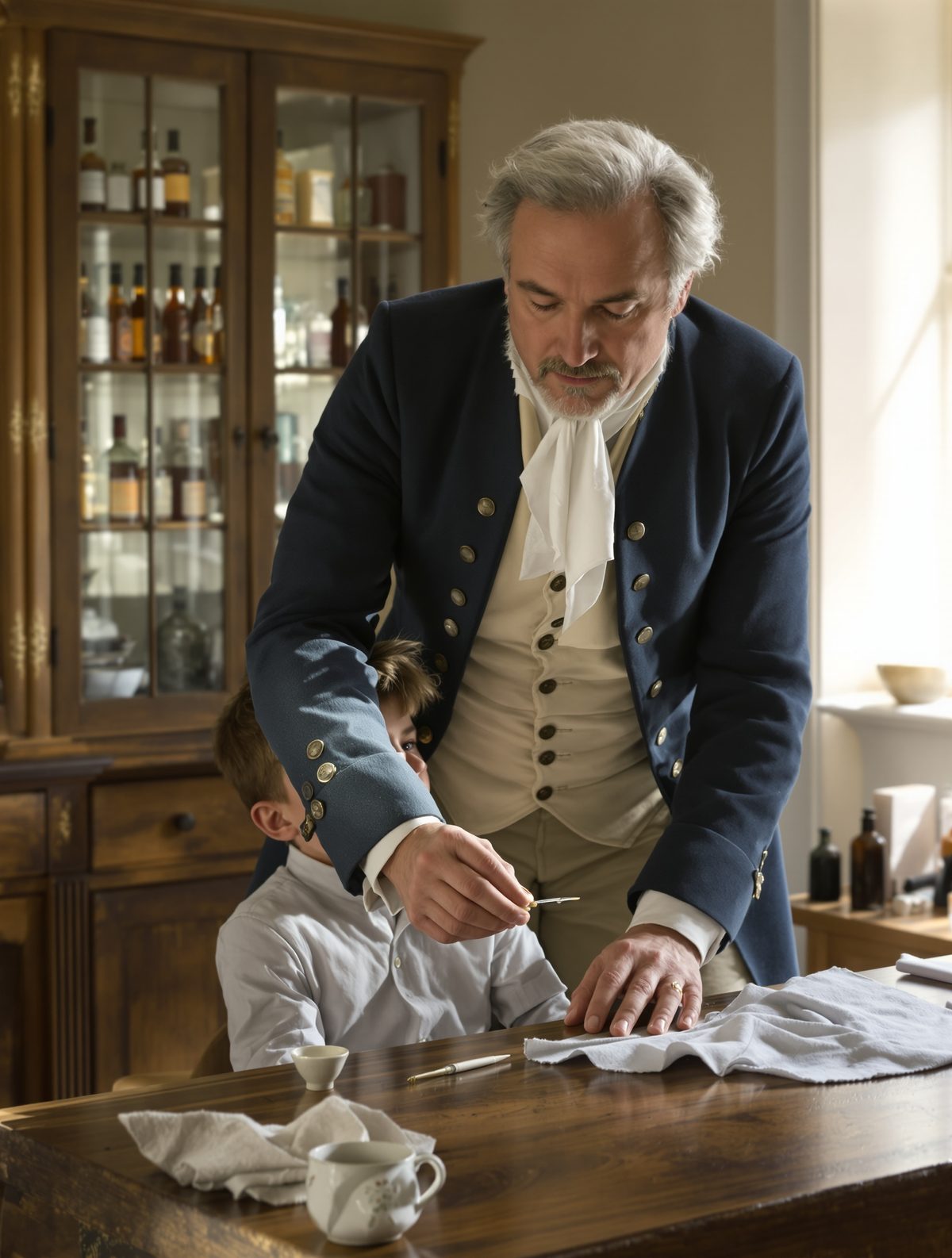
On a balmy day in May 1796, amidst the undulating green hills of Gloucestershire, a daring act took place—an act that would shift the course of medical history forever. It was a gamble that could have sealed the fate of a young boy, but instead, it became the cornerstone of modern immunology. This is the riveting story of how a country surgeon named Edward Jenner changed the world with a single, bold experiment.
The Unseen Killer: A Nation Gripped by Fear
In the Georgian Era, smallpox was the undisputed tyrant of contagious diseases, a virulent phantom that carried off nearly one in every three of its victims. Earning its dread name through blistering rashes and disfiguring scars, smallpox claimed millions of lives, devastating families and entire communities. Its grip on Britain was absolute, sparking waves of fear and hopelessness.
Against this backdrop of despair, a curious epidemiological curiosity began to capture the attention of Edward Jenner, a down-to-earth surgeon practicing in the serene countryside of Gloucestershire. For over two decades, Jenner noticed a puzzling peculiarity among the rural dairymaids who doted the landscape; these women, with cheeks rosy from labor and sun, seemed to walk untouched through the shadows of smallpox outbreaks. Some whispered that the milkmaids could even boast of their beauty unmarred by scars, thanks to their mysterious invulnerability.
A Country Surgeon’s Gamble: The Cowpox Connection
Jenner's fascination with this immunity prompted closer scrutiny. Could there be a connection between the milkmaids' work and their resistance to smallpox? His answer appeared in the form of cowpox—a much milder disease, often contracted by those tending to bovine herds. Jenner hypothesized that an infection with cowpox could protect against smallpox, a theory that initially earned him no small amount of skepticism from his peers.
Read next: The Day a Baronet Stood Up in Court and Freed His Slaves
Determined to test his bold theory, Jenner prepared for an experiment that would either carry him into medical history or plunge him into infamy. The year was 1796, and in the village of Berkeley, an eight-year-old boy named James Phipps presented the perfect test subject. With solemn resolve, Jenner set the stage for an unprecedented medical intervention.
The Fateful Day: A Leap into the Unknown
The day was May 14th, 1796, when Jenner took the plunge into controversial waters. He initiated the experiment in his modestly equipped, rural clinic. Using a sterile lance, he extracted fluid from a cowpox sore on the hand of Sarah Nelmes, a local milkmaid. The fluid was then introduced into several superficial scratches made on young James Phipps's arm.
What transpired next was a meticulous act of brave patience. Young James developed a mild fever—a typical response to cowpox—but, as predicted, these symptoms subsided within a few days. Jenner then awaited the critical test: exposure to smallpox itself.
The Trial of Endurance: A New Medical Dawn
In July 1796, James Phipps stood once more in Jenner's office, this time facing an inoculation with smallpox matter itself. The outcome was extraordinary—not a single blister appeared, no sign of illness. James was immune. Jenner’s hypothesis held true, a resolution that was both exhilarating and transformative.
Jenner's finding quickly disseminated beyond the borders of Gloucestershire. It challenged prevailing medical views and stirred both awe and skepticism among the medical community. Within a decade, Jenner's method—a process he would coin as vaccination, after the Latin vacca for cow—spurred the development of smallpox vaccines and inspired future pioneers in the field of immunology.
From Local Lores to Global Lifelines
Jenner's discovery was akin to a rippling stone cast into the still pond of 18th-century medicine. It soon captured the attention of the international community, with vaccination campaigns burgeoning across the continents. By the dawn of the 20th century, vaccination had taken root as a primary defense against infectious diseases, saving untold millions from the clutches of smallpox—a disease ultimately declared eradicated by the World Health Organization in 1980.
The legacy of Jenner’s work extends beyond smallpox; it laid the groundwork for modern vaccines against a multitude of diseases: polio, measles, influenza, and more. It created a paradigm shift, transforming death sentences into preventable inconveniences, endowing humanity with hope and resilience.
The Human Element: Lessons and Reflections
Edward Jenner’s experiment in May 1796 with young James Phipps represents one of history's most pivotal moments, driven by observation, curiosity, and courage. It is a testament to what can occur when one questions the known in pursuit of unknown truths. Today, as vaccine development becomes ever more sophisticated, Jenner's legacy compels us to recognize a world interwoven with medical advances that protect the fabric of our communities.
This enduring revolution from a rural cottage clinic to a worldwide movement elucidates a singular message: scientific exploration, driven by empathy and ingenuity, remains humanity's most powerful ally. Jenner’s gamble was not merely a triumph of science; it was a profound victory of hope and perseverance against the shadows of despair—echoing through the annals of history and into the modern age.